


More than 80% of home-buyers and tenants rely on real estate applications for searching, evaluating, and finalizing their renting and purchasing decisions. For real estate agents, that means your properties must be listed on the applications that your audience is relying on to buy and rent those properties.
This is especially critical for solo agents building their client base and small teams managing multiple leads and listings simultaneously. The right set of applications can directly impact how consistently you generate leads, manage client relationships, and close deals.
Being on platforms that are growing rapidly ensures you have a consistent lead flow. But that’s only one aspect to consider when evaluating apps for real estate agents. More aspects that make an app worth using include ratings, functionality, performance, and the region the app is for. The next section mentions each in detail.
An Overview of the Real Estate Apps for Agents
| Platform | Category | Best For (Business Size) | Audience & Scale | Primary Value for Agents | Limitations |
| Zillow | Marketplace | Solo Agents | 228M active users; 65% of US app traffic. | Lead Volume: High-traffic portal for building a client base from scratch. | Extreme lead competition; requires instant follow-up. |
| Redfin | Marketplace | Solo Agents & Small Teams | 49.5M monthly users; highly accurate MLS data. | Market Research: Reliable “Agent Notes” and sold data for CMAs. | A competing brokerage; no ad placement for outside agents. |
| Trulia | Marketplace | Solo Agents | 9.8M monthly visitors; heavy neighborhood focus. | Client Education: Helping buyers visualize local lifestyle and safety. | Smaller audience; listings are mostly redundant with Zillow. |
| Accumin | Data Intel | Full-Scale Development Agencies | European institutional clients (Vodafone, Allianz). | Portfolio Strategy: AI-driven predictive modeling for large-scale assets. | Enterprise focus; not designed for residential sales agents. |
| Rocket Mortgage | Financing | Small Teams | Largest US lender; 22-day average closing. | Deal Velocity: Digital pre-approvals that help teams move faster. | High origination fees; requires data before showing rates. |
| Bricks / Morta | Dev. ERP | Full-Scale Development Agencies | Built for property developers & construction firms. | Project ERP: Full-scale resource planning and development accounting. | High technical complexity; overkill for standard realtors. |
How to Find the Best App for Real Estate Agents?
Not every application listed is worth trying. To know which ones are, you must know how to separate the best from the rest.
Check the ratings and reviews
Visit app marketplaces like google playstore and appstore and see the app’s rating and reviews. Generally a rating between 4 and 5 is ideal. Ratings alone can be misleading. So make sure to check actual detailed reviews. If there’s a negative aspect highlighted by multiple users, then the app is likely to be a trouble to handle.
When checking the ratings, also check the number of reviews. A perfect 5-star rating with under 10 reviews is more likely to mean ‘the reviews are fabricated’ than ‘the app is exceptional’.
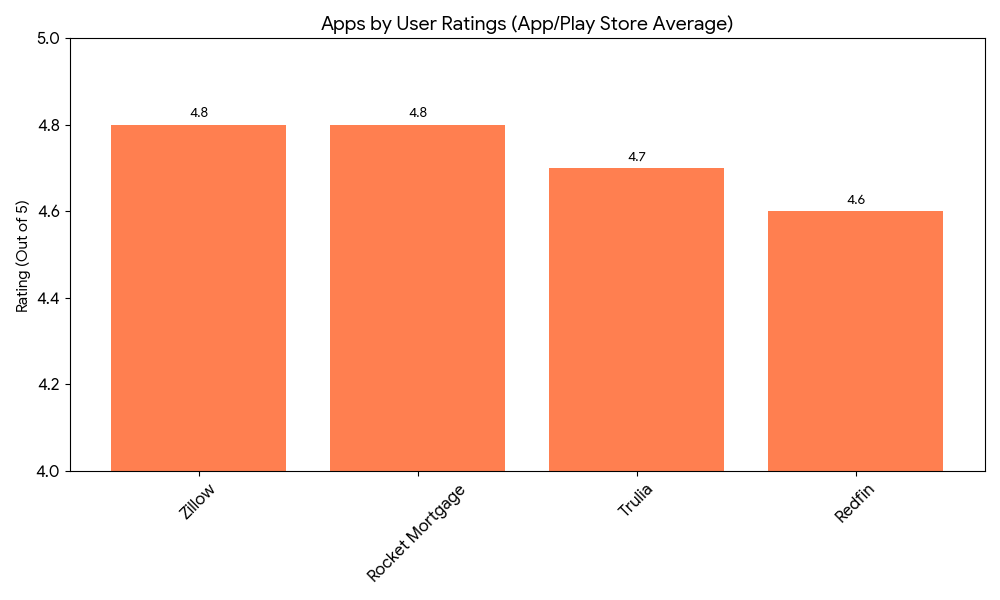
Real estate applications with the highest ratings on google play and apple store
Check app tour videos
to have a detailed idea of what features the app includes and what the use flow is like. If you have to return to the video multiple times to understand the user flow, the app is likely too complex and not worth using.
Pick the right app for your region
The right app for real estate agents, depends on the region you are looking to grow your real estate business in. For example, Bayut.com operates in the GCC region. It has separate applications for KSA and UAE. So using it only makes sense if your properties are listed in the same region.
Vet for reliability and performance
Apps that crash, freeze, or show outdated data are a professional liability. If a listing appears available when it’s already under contract, or your automated follow-up quietly fails, the damage isn’t just internal; it’s visible to clients. Before committing to any platform, look at what actual users say in App Store and Google Play reviews. If reviews aren’t available, then use the ‘free-trial’ version before committing on any payment.
Pick the platforms with the most number of users
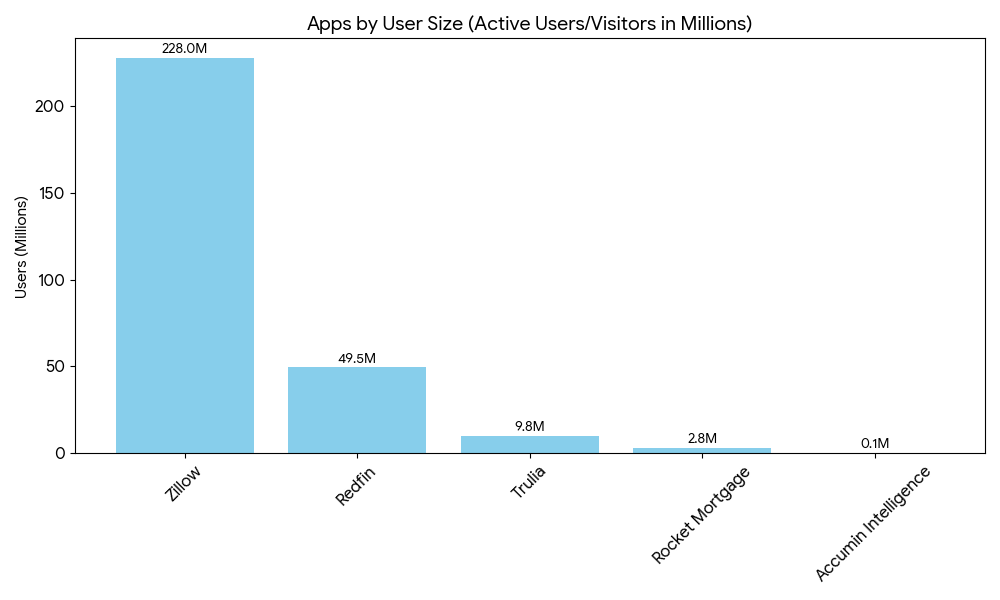
Real estate applications with most users in the US
Finally, pay attention to what functionalities are available in the app you are considering onboard. A top-tier app for real estate agents must have these features:
- Listing management
How easy is it to add, edit, and update listings? Can you upload high-resolution photos, video walkthroughs, and virtual tours without friction? Does the platform syndicate to other listing portals automatically, or do you have to publish to each one separately?
- Lead capture and follow-up
Where do leads come in, how are they tracked, and how easy is it to set up automated follow-up sequences? The difference between a lead that converts and one that goes cold is often just timing and consistency. A platform that automates reminders and follow-up messages turns one of the most discipline-heavy tasks in the business into a system.
- Communication tracking
Every conversation with a prospect or client is context you’ll need later. When your tools log emails, calls, and messages against the right contact or deal record, you stop relying on memory and start working from an accurate picture of where each relationship stands.
- Readable analytics
Not every agent needs forecasting tools. But knowing which lead sources are converting, which listings are getting traction, and where your pipeline is thin versus healthy is information worth having. The question is whether your platform surfaces it clearly or buries it in charts that require their own learning curve to interpret.
- Integration with tools you already use
Calendar syncing, email integration, and compatibility with your brokerage’s systems are practical requirements. A CRM that doesn’t connect to your email creates double entry. Double entry creates errors. Errors eventually cause you to stop using the tool entirely.
The Major Property Marketplace Platforms
The first category of apps for real estate agents that every agent must know about is the marketplace platforms. These are the consumer-facing platforms where buyers and renters search for homes. For agents, they serve two purposes: lead generation and listing visibility. Understanding each platform’s audience and business model helps you decide where to spend your advertising budget and how to set realistic expectations for the leads that come in.
Zillow
Zillow is the most used real estate platform in the United States. It averaged 228 million active users across its app and website in 2024, generating 9.3 billion visits over the course of the year. The Zillow app has been downloaded over 50 million times on Google Play and holds a 4.7-star rating from 1.22 million reviews. On the Apple App Store, 7.1 million users give it 4.8 stars.
Coverage is primarily in the US, with a growing presence in Canada. 65% of all real estate mobile app traffic in the US runs through Zillow, which tells you clearly where buyers are spending their time.
For agents, Zillow’s value is reach. The platform has two agent programs. Premier Agent is a paid advertising arrangement where agents pay to have their profile appear on relevant listings. Zillow Flex routes pre-screened leads directly to participating agents. Zillow generated 16.9 million leads for agent advertisers in a single year, which reflects the scale of traffic the platform commands.
The downside
That same massive audience creates heavy competition. When a buyer inquires on a listing, multiple Premier Agent advertisers in that area may receive the same lead simultaneously. Lead quality varies, and speed of response is one of the biggest factors in whether a Zillow lead converts. Agents who invest in Zillow advertising need a fast, consistent follow-up process in place, or the spend won’t perform.
Redfin
Redfin is structured differently from Zillow. It operates as a full-service real estate brokerage, reaching approximately 49.5 million monthly average users across its apps and websites, primarily in the US and Canada. That distinction matters: Redfin is not just a listing portal; it is a competing brokerage that connects buyers with its own salaried agents.
Redfin serves more than 100 markets across the US and Canada and helped customers buy or sell more than 61,000 homes in 2023. In early 2025, Redfin was acquired by Rocket Companies, deepening its connection with Rocket Mortgage.
The app is well-regarded for data accuracy. MLS listings refresh frequently, and the platform includes sold-home pricing data, agent tour notes, and detailed neighborhood information on schools, commute times, and walkability. The Apple App Store rating sits at 4.8 stars.
Where Redfin is genuinely useful for all agents is as a market research tool. Its sold-price data, days-on-market tracking, and price reduction alerts are reliable and easy to access. For building CMAs and staying current on local conditions, it is one of the better free resources available.
The drawback
For independent agents, the key thing to understand is that Redfin is designed to route buyers to its own agents, not to outside practitioners. Unlike Zillow’s Premier Agent program, there is no advertising arrangement for independent agents to purchase placement. Your listings may appear on Redfin through MLS syndication, but lead flow from those listings goes to Redfin agents by default.
Trulia
Trulia was acquired by Zillow Group in 2015 and now operates within that ecosystem. It is the third most visited online real estate brand in the US, attracting approximately 9.8 million average monthly visitors. On Android, Trulia’s apps have accumulated an estimated 30 million installs.
Where Trulia differs from Zillow is in its focus on neighborhood context. The app includes more than 30 map overlays covering schools, commute times, nearby amenities, crime data, and natural disaster risk. It also features local resident reviews, which give buyers a ground-level perspective that listing data alone can’t provide.
Trulia launched in 2005 and built its reputation by going beyond standard listing aggregation, layering in geospatial data including crime statistics, school ratings, local businesses, commute maps, and neighborhood characteristics.
The limitation
For agents, Trulia works as a complementary visibility channel. Because it sits within the Zillow Group, listings published to Zillow typically syndicate to Trulia automatically. Agents already on Zillow get Trulia exposure at no additional effort. Its neighborhood data is also a useful resource to point buyer clients toward when they’re comparing areas and want context beyond price and square footage.
Other Marketplace Platforms
In addition to the four mentioned above, there are several other marketplace platforms that should be on the radar of realtors looking to grow in the North American market. These include:
- Realtor.com
- Homes.com
- Xome Real Estate
- Compass Real Estate and Homes
These can be used for market intelligence purposes to figure out property prices, listings, and reviews.
Best Real Estate Apps for Data Intelligence
Marketplace applications, although the most essential, aren’t the only type of real estate apps for agents. As an agent eying growth, applications that help you gather market knowledge are equally necessary. The tools mentioned below help you accomplish exactly that.
Accumin Intelligence
Accumin Intelligence is a European real estate data and analytics platform formed through the merger of several Spanish companies: Tinsa Digital, Deyde, DataCentric, and urbanData Analytics. The platform consolidates data quality, geolocation, geomarketing, and AI-driven real estate analytics into two core products. AccuMate handles real estate portfolio management with integrated market analytics. Accumin Data House provides access to the company’s full data library and AI valuation models in real time.
Accumin’s focus is on reducing market opacity by applying AI capabilities including natural-language search, predictive price modeling, and automated property image analysis to turn complex data into usable insights.
To be clear about who this platform is built for: Accumin’s client base is primarily institutional. Its current users include major corporations such as Vodafone, IKEA, Allianz, and Santander. It is not a practical tool for an independent US-based agent. It is included here because it represents the leading edge of what AI-driven property analytics looks like, and that context is useful.
For agents who want market intelligence tools built for individual practitioners, the more practical US-based options include HouseCanary (automated valuation data and market forecasting), PropStream (which aggregates MLS records and public property data for sales and investment analysis), and Altos Research (which tracks active listing trends, price reductions, and supply conditions in real time). These platforms serve the same purpose as Accumin, turning market data into a competitive advantage, but at a scale and price point designed for working agents.
Mortgage and Financing tools Keeping Deals on Track
An agent who understands financing options is more useful to clients at every stage of a transaction. When a deal slows down because a buyer doesn’t understand their loan options or hits an unexpected approval delay, the agent who can clearly explain what’s happening and point them toward the right resource keeps the deal alive.
Rocket Mortgage
Rocket Mortgage is the largest mortgage lender in the United States by origination volume and has set the standard for digital mortgage applications. It operates in all 50 US states and has an average closing time of 22 days, against an industry average of 42 days. It ranked first in J.D. Power’s 2025 US Mortgage Origination Satisfaction Survey and holds an A+ rating from the Better Business Bureau.
For borrowers with standard W-2 employment, the entire application process can be completed online. The mobile app lets users get preapproved, upload documents, and sign digitally from their phone. The Overnight Underwrite program can produce a fully verified approval in as little as two hours for qualifying borrowers.
For agents, the practical value is clear: clients with a Rocket Mortgage preapproval letter move faster and make stronger offers. Clients who buy through a Redfin or Compass-affiliated agent and finance with Rocket Mortgage can receive either a 1% interest rate reduction for the first year of their loan or a lender credit of 0.75% of the loan amount, up to $6,000. That is a meaningful incentive for eligible buyers and worth raising in the right conversations.
The honest limitation: some borrowers report that Rocket Mortgage’s origination fees run above the industry average, and the platform requires you to submit contact details before showing a personalized rate. Encourage clients to get loan estimates from at least two or three lenders before deciding. Rocket Mortgage is a strong recommendation for speed and user experience, but it is not always the lowest-cost option.
What if the applications on the list don’t satisfy your needs?
If there’s no single app that has all the functionalities you require, it’s best to use multiple as a stack, where each tool has a specific role, and those roles don’t overlap.
Option 1 – Use multiple applications that work together
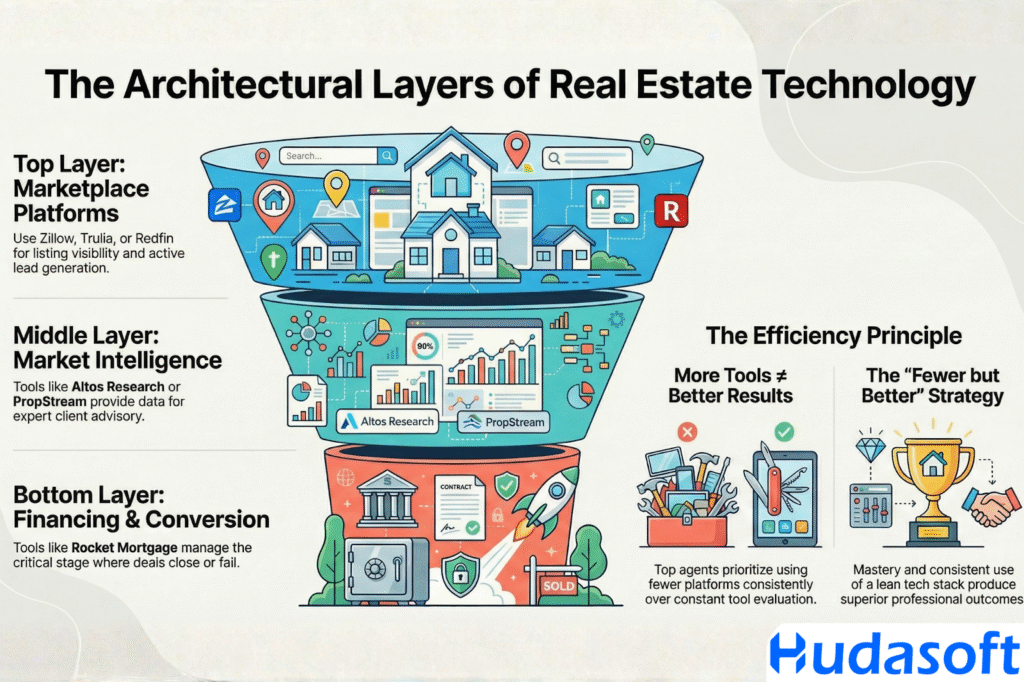
Think of it in layers. The marketplace platforms, Zillow, Trulia, and Redfin, sit at the top of the funnel. They are where buyers search, and where your listings need to be visible. For active lead generation, Zillow’s Premier Agent program is the most direct route for most agents, though it requires both a realistic budget and a responsive follow-up system.
Market intelligence tools sit beneath that. Whether you use an enterprise-grade platform like Accumin or a practitioner-focused tool like Altos Research or PropStream, having reliable data on price trends, inventory levels, and days-on-market conditions is what enables you to advise clients rather than just relay information back to them.
Financing tools like Rocket Mortgage sit at the conversion layer: the point where a deal closes or falls apart. Knowing what’s available and being able to guide a client quickly makes a material difference at that stage.
One principle worth stating plainly: more tools do not produce better results. The agents who use technology most effectively tend to use fewer platforms, not more. They know what each tool does, they use it consistently, and they are not in a constant cycle of evaluating something new.
If, like most real estate agents, you are also managing property development gigs, then it is worth knowing the top accounting software for property developers. The top apps include: Bricks ERP, Morta and Accumatica. These are full-scale ERPs for managing development projects.
Option 2 – Build a custom real estate application
The other alternative to using multiple applications is to opt for custom real estate application development. This allows you to combine all your desired functionalities into one single, easy to use application.
Generally, custom apps are a lot costlier compared to SaaS-based applications discussed above. However, the advantages of going custom are undeniable.
The application you develop is your asset and you do not have to pay for a subscription. Additionally, you own the data entirely with no risk of compromised privacy. On top of that, you can also opt to monetize your real estate application. This involves allowing other businesses in your space to use the platform against a fee, rather than using it just for your business.
The Best App for Real Estate Agents Based on Business Size
Solo agents building their practice should focus on two things: visibility on a platform where real buyers are actively searching, and a reliable follow-up system for the leads that come in. Zillow is the defensible choice for reach. The most common mistake solo agents make is investing in visibility without having any follow-up process in place. Traffic without follow-up produces nothing.
Agents building a small team need to shift focus toward systems. You need tools that can track multiple client pipelines, assign leads to specific people, and give you a clear view of activity across the team. This is when a dedicated real estate CRM, such as Follow Up Boss, LionDesk, or Wise Agent, becomes worth its monthly cost. Connectivity between tools also becomes more critical at this stage: calendar syncing, shared communication records, and consistent email integration prevent leads from slipping through the gaps.
Agents working with investor-focused buyers need stronger analytics than standard residential search provides. Understanding cap rates, rental yields, off-market inventory, and emerging market trends requires different tools than a basic listing portal offers. PropStream and BiggerPockets’s data tools are practical starting points for this type of work.
Common Mistakes When Choosing Real Estate Software
Choosing based on features instead of usability
A platform with dozens of features you’ll never touch is less valuable than one with ten you’ll use every single day. Before committing, run any new tool inside your actual workflow for at least two weeks. The question isn’t whether it has the capability; it’s whether it fits how you work.
Underestimating onboarding complexity
Some platforms are genuinely difficult to set up, and that friction has a real cost: not just in time, but in the motivation to follow through. A tool that requires a full day of configuration before it does anything useful has a high abandonment rate, and for good reason.
Skipping integration checks
Before adopting any new tool, confirm that it connects to what you already use. A CRM that doesn’t sync with your calendar, or a lead platform that doesn’t connect to your email, creates manual data entry. Manual data entry creates gaps. Gaps cause deals to fall through.
Ignoring future scale
A tool that fits your current situation may become a problem as your business grows. Understand a platform’s pricing at higher user counts and its limitations for team use before you build your workflow around it. Switching CRMs after two years of data entry is an expensive disruption.
Using tools that don’t talk to each other
A lead comes in through Zillow, gets logged manually in a spreadsheet, gets an email from your personal inbox, and then gets forgotten when you get busy. That’s not a technology problem; it’s a system problem that technology can either solve or make worse. Integration between your tools is what turns individual apps into an actual workflow.
Conclusion
The real estate industry in 2026 has more software options than ever, and that abundance makes clarity more important.
If you are just looking to grow your business, then start with a basic marketplace app like Zillow. As your business grows and you need more advanced tools you can move to other applications and integrate them together, or you can choose to build a custom real estate app. In case you opt for the latter, then partner with the right technology company that has experience in developing apps for real estate agents. Hudasoft has a portfolio of high-performing applications developed specifically for the real estate sector. This means the backend architecture is likely figured out, and you will get an application delivered within a significantly less amount of time than choosing a partner that builds the app from scratch.
