


Generative AI has moved beyond basic content creation. Businesses now use it to support product design, software development, data analysis, customer service, research, reporting, and everyday knowledge work.
McKinsey estimates that generative AI could add $2.6 trillion to $4.4 trillion in economic value annually across 63 analyzed business use cases. About 75% of the potential value falls across customer operations, marketing and sales, software engineering, and R&D.
The most practical benefits of generative AI come from helping people complete information-heavy and repetitive tasks faster while improving access to knowledge and supporting better decisions. AI delivers stronger results when businesses integrate it into existing processes with clear workflows, reliable data, and defined human oversight.
These generative AI benefits can apply across departments. Their value depends on the use case, the quality of available data, integration with existing systems, and the level of human oversight involved.
Quick Takeaways
This article covers 10 key business benefits of generative AI, including productivity, product development, software development, customer experience, and decision support.
- Generative AI can reduce time spent on repetitive writing, research, summarization, and administrative tasks.
- Product teams can explore more design concepts and evaluate alternatives before committing to expensive development cycles.
- Developers can use generative AI across coding, testing, documentation, debugging, and application modernization.
- Sales and customer-service teams can use generative AI to personalize interactions and analyze customer feedback at scale.
- Real business value depends on selecting AI use cases that address clearly defined workflow needs and measurable business outcomes.
- Generative AI creates more sustainable value when businesses combine automation with reliable data, governance, and human review.
What Are the Benefits of Generative AI?
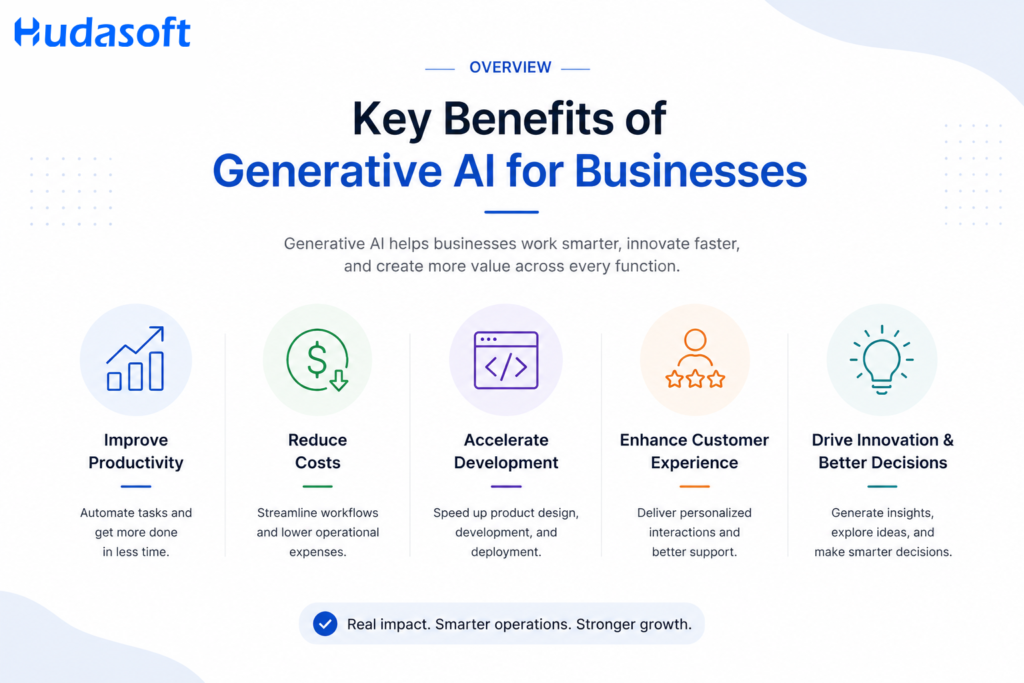
Generative AI can improve productivity, reduce repetitive work, accelerate product and software development, support data analysis, personalize customer interactions, improve knowledge access, and help teams explore ideas faster.
Modern generative AI systems can support a wide range of business activities using documents, customer records, software code, business knowledge, reports, and other information. AWS identifies business-process automation, software development, content creation, customer experiences, and employee productivity among common enterprise use cases.
The practical value becomes clearer when these advantages are examined within specific business processes.
Key Generative AI Benefits Across Business Workflows
Generative AI creates the most value when businesses apply it to a clearly defined problem with measurable outcomes.
Improve Employee Productivity With Generative AI Assistants
Generative AI assistants can improve employee productivity by reducing the time people spend searching for information, summarizing documents, drafting routine material, and completing repetitive knowledge-based tasks.
A study of 5,179 customer-support agents found that access to a generative AI assistant increased productivity, measured by issues resolved per hour, by 14% on average. The improvement reached 34% among novice and low-skilled workers, showing that productivity gains can vary by employee experience and skill level.
An employee might use an assistant to summarize a long meeting, extract action items from several documents, prepare a first draft of a report, compare internal information, or find an answer across an approved knowledge base.
Common productivity applications include:
- Summarizing lengthy documents and reports
- Turning meeting discussions into clear action items
- Preparing first drafts of emails and internal documents
- Searching approved company knowledge using natural language
- Comparing information across multiple sources
- Supporting routine research and information gathering
AI-assisted workflows can give employees control over tasks that require judgment and verification. The system can handle initial processing, while employees review the output, apply business context, verify important information, and make the final decision.
Enterprise AI assistants increasingly support this type of work. AWS describes Amazon Q Business as a generative AI assistant that can help employees search enterprise information, generate content, and complete routine tasks using approved business data.
Reduce Operational Costs Through Smarter Automation
Generative AI can reduce operational costs when businesses use it to remove unnecessary manual steps within an existing process.
Consider tasks such as preparing repetitive summaries, categorizing incoming information, drafting standard responses, producing first versions of documents, or processing large amounts of text.
Generative AI can help streamline activities such as:
- Routine report preparation
- Document summarization
- Information classification
- Standard customer communication
- Large-scale text processing
- First-draft document creation
When these activities consume significant employee time, partial automation can shorten turnaround times and increase the amount of work a team can handle.
Cost reduction should still be evaluated at the process level. Businesses need to account for model usage, software licenses, integration, security, employee training, monitoring, and human review.
Businesses should prioritize workflows where the value of time saved or additional capacity exceeds the cost of operating the AI system.
Accelerate Product Design and Reduce Iteration Costs
Yes, generative AI can help reduce costs in product design by allowing teams to explore, compare, and refine more concepts before committing resources to physical prototypes or later-stage production.
Design teams traditionally evaluate a limited number of concepts because every additional iteration requires time. AI-assisted workflows can expand that exploration process by producing alternatives based on defined objectives, constraints, materials, performance requirements, or other inputs.
In practical product-design workflows, generative AI can help teams:
- Generate multiple design concepts
- Explore alternative configurations
- Work within defined design constraints
- Compare potential materials or approaches
- Support virtual prototyping
- Evaluate more variations before production
In product-design environments, generative AI may also work alongside specialized generative-design and CAD software. Autodesk describes generative-design systems as tools that can create and evaluate multiple design alternatives according to defined goals and constraints such as materials, manufacturing methods, cost, and performance.
Specialized software can therefore improve the product design process by helping designers explore more possibilities, identify viable alternatives earlier, and make better-informed decisions before expensive production stages.
Designers and engineers remain responsible for confirming that generated concepts are technically appropriate, safe, manufacturable, and aligned with product requirements.
Businesses assessing similar applications can use AI development services to connect generative AI capabilities with existing product, engineering, data, and approval workflows.
Speed Up Software Development and Testing
Generative AI can support developers across the software development lifecycle, including coding, testing, documentation, debugging, requirements analysis, and application modernization.
In a controlled experiment, developers using GitHub Copilot completed an assigned JavaScript coding task 55.8% faster than the control group. The result applies to the study task and should not be treated as a universal productivity benchmark.
Developers can use AI across several practical tasks:
- Generate boilerplate code
- Explain unfamiliar code
- Prepare technical documentation
- Create test cases
- Suggest possible fixes
- Support debugging
- Summarize requirements
- Assist with legacy application modernization
IBM identifies generative AI applications across requirements analysis, planning, development, testing, deployment, maintenance, and documentation.
This can allow developers to spend less time on predictable tasks and more time on architecture, complex problem-solving, security, user experience, and business logic.
AI-generated code should pass the same review standards as human-written code. Developers need to validate functionality, dependencies, security implications, test coverage, and alignment with the underlying requirement.
Businesses considering custom implementation can work with a GenAI development company to integrate coding, testing, documentation, and modernization capabilities into defined development workflows.
Improve Data Analysis and Reporting
Generative AI can improve data analysis and reporting by making complex information easier to query, summarize, interpret, and communicate.
A manager reviewing several reports, for example, could ask an AI system to summarize major changes, compare periods, organize findings, or create a first draft of an executive summary.
Useful applications include:
- Summarizing lengthy business reports
- Comparing results across periods
- Identifying recurring patterns
- Explaining findings in natural language
- Creating executive summaries
- Turning questions into analytical queries
- Preparing first drafts of reports
IBM notes that generative AI can analyze large datasets, identify patterns, extract insights, and generate hypotheses or recommendations that support decision-making.
Generative AI can help teams interpret and communicate data. Critical figures should still be validated against authoritative source systems before teams use AI-generated explanations in business decisions.
Critical figures should remain grounded in verified source systems. Financial results, operational metrics, customer records, and other important data need validation before an AI-generated explanation is used in a business decision.
Increase the Value of Existing CRM Systems
Integrating generative AI into an existing CRM can make customer information easier to understand and act on while keeping the CRM as the customer system of record.
For example, AI can support sales and customer-service teams by:
- Summarizing account histories
- Preparing context before sales calls
- Drafting personalized follow-up emails
- Organizing service-case information
- Suggesting relevant next actions
- Preparing account notes
- Drafting contextual support responses
Customer-service applications can also use customer history and engagement information to produce more contextual responses. Salesforce describes generative AI applications that summarize complex cases, draft personalized replies, and use past customer conversations and data to support more tailored interactions.
AI can prepare relevant account and interaction context for employee review, reducing the time required to examine multiple records.
The CRM should remain the authoritative customer-data system. Access controls, permissions, customer privacy requirements, data retention rules, and human approval should govern how information is used.
Automate Customer Feedback Analysis
Generative AI can automate customer feedback analysis by processing large volumes of reviews, surveys, support tickets, chats, and open-text responses to identify recurring themes and summarize what customers are saying.
An AI-assisted feedback workflow can process information from:
- Customer reviews
- Surveys
- Support tickets
- Chat conversations
- Email feedback
- Open-ended feedback forms
It can then help teams identify:
- Repeated customer complaints
- Common feature requests
- Emerging service issues
- Frequently mentioned product problems
- Recurring positive feedback
- Broader customer themes
A product team may have thousands of comments but limited time to review them individually. AI can group similar complaints, highlight repeated requests, and produce an overview for product and customer-experience teams.
This makes qualitative feedback easier to include in decision-making alongside quantitative metrics.
Salesforce, for example, supports AI-generated summaries of survey responses, while IBM describes product teams using generative AI to consolidate customer feedback during product development.
Human review remains particularly important when feedback is ambiguous, sarcastic, culturally specific, highly emotional, or being used to justify an important product or policy change.
Create More Personalized Customer Experiences
Generative AI can improve customer personalization by using relevant context to create responses, recommendations, explanations, and support interactions that better reflect an individual customer’s situation.
Potential applications include:
- Contextual customer-service responses
- Personalized recommendations
- Account-specific explanations
- Customized follow-up communication
- Conversational assistance
- Multilingual support where appropriate
An AI-assisted system can use approved account context, previous interactions, products used, and the current support issue to create more relevant responses.
Salesforce describes AI-assisted customer service as using engagement data and company knowledge to provide tailored recommendations and responses.
Strong personalization implementations limit AI access to the information required for the task and apply appropriate permissions, privacy controls, and business rules.
This approach can support service representatives as well as customer-facing AI agents.
Support Faster Ideation and Creative Experimentation
Generative AI gives creative and marketing teams a faster way to explore possibilities before deciding what deserves further development.
Teams can use it to explore:
- Alternative headlines
- Campaign concepts
- Content structures
- Messaging variations
- Rough visual directions
- Product ideas
- Creative testing concepts
Teams can use AI-generated outputs as starting points for evaluating a wider range of creative directions.
The main creative advantage is faster experimentation. Human input remains necessary for brand positioning, originality, cultural context, accuracy, audience understanding, and final selection.
Human input remains necessary for brand positioning, originality, cultural context, accuracy, audience understanding, and deciding which ideas are actually worth pursuing.
Teams building AI into a larger digital strategy should connect creative experimentation with defined workflows, review standards, and measurable business objectives.
Improve Knowledge Sharing and Remote Collaboration
Generative AI can improve remote collaboration by helping teams summarize discussions, find information across shared workspaces, document decisions, and reduce the effort required to catch up on distributed work.
Remote and distributed teams can use AI to:
- Summarize meetings
- Extract decisions and action items
- Search internal knowledge
- Summarize lengthy message threads
- Prepare handover notes
- Maintain shared documentation
- Reduce repeated internal questions
A remote employee returning after several days away may need to review meetings, messages, project documents, and task updates. AI can condense that information into a manageable summary and highlight decisions or actions that require attention.
The same approach can help teams maintain internal documentation, search knowledge bases, prepare handover notes, and reduce information silos.
Current collaboration platforms increasingly embed these capabilities directly into existing work environments. Microsoft says Copilot in Teams can work across meetings, calls, chats, and channels, while Slack provides AI features for summarizing conversations, searching information, taking notes, and supporting workflows.
Accelerate Research and Decision Support
Generative AI can speed up research by helping users organize information, compare material, summarize lengthy sources, identify relationships, and generate questions for further investigation.
It can support research workflows by:
- Summarizing lengthy research material
- Comparing documents or viewpoints
- Organizing findings into themes
- Identifying relationships between information
- Preparing initial research summaries
- Generating follow-up questions
- Exploring possible scenarios
This is particularly useful when employees spend substantial time reading documentation, market information, technical material, customer research, or internal reports.
Generative AI can also help teams explore scenarios or structure an initial analysis. IBM identifies data analysis, pattern recognition, hypothesis generation, and recommendation support among the ways generative AI can assist decision-making.
People remain responsible for high-impact financial, legal, safety, hiring, healthcare, security, and policy decisions. Generative AI can support research and analysis when teams verify important information and apply appropriate domain expertise.
AI can shorten the path between information and understanding while keeping decision accountability with the responsible people.
What Industries Benefit Most From Generative AI?
Industries with large volumes of information, repetitive digital workflows, complex knowledge work, software processes, customer interactions, or design activity often have the clearest opportunities to gain value from generative AI.
There is no single industry that automatically receives the greatest benefit. Results depend more on the suitability of the underlying use case than on the industry label itself.
| Industry | Common Generative AI Opportunities |
| Automotive | Dealership knowledge assistants, customer support, sales follow-ups, service information, feedback analysis, software development |
| Software and Technology | Coding, testing, documentation, research, knowledge support |
| Financial Services | Document analysis, reporting, internal knowledge and customer assistance |
| Healthcare and Life Sciences | Research support, documentation and information summarization |
| Manufacturing | Product design, engineering knowledge, documentation and process support |
| Retail and E-commerce | Personalization, customer support and feedback analysis |
| Marketing and Media | Content ideation, variations, research and creative experimentation |
| Professional Services | Research, document review, summarization and knowledge management |
| Public Sector | Document processing, internal knowledge support and citizen-service assistance |
| Real Estate | Property content, document summarization, customer communication, market research and internal knowledge support |
AWS highlights use cases across industries including financial services, healthcare, manufacturing, and other enterprise environments, while IBM documents applications spanning software, manufacturing, product development, and business analysis.
McKinsey estimates that generative AI could contribute roughly $310 billion in additional value for retail, including auto dealerships, with marketing and customer interactions among the functions that could benefit.
The better question for a business is therefore not simply, “Does our industry benefit from generative AI?” It is, “Which of our processes contain enough repetitive or information-intensive work for AI assistance to create measurable value?”
How Transparency and Human Oversight Improve Generative AI Outcomes
Generative AI delivers more sustainable business value when users understand what the system is doing, what information it can access, where its limitations exist, and who remains accountable for the final output.
Transparency and human oversight directly influence whether employees, customers, and other stakeholders can use generative AI with appropriate confidence.
Why Transparent Generative AI Matters in Public Services
Transparent generative AI can benefit public services by making it easier for citizens, employees, auditors, and decision-makers to understand where AI is being used, what role it plays, and who remains accountable for its outcomes.
Transparency may include:
- Clearly disclosing where AI is being used
- Documenting its intended purpose
- Identifying known limitations
- Defining human responsibilities
- Maintaining appropriate records
- Establishing review and escalation processes
This is particularly important in public services because decisions can affect citizens at scale.
NIST’s AI Risk Management Framework and Generative AI Profile provide guidance for managing trustworthiness and generative AI risks across the AI lifecycle.
Effective transparency provides enough appropriate information for meaningful accountability while protecting sensitive data, system information, privacy, and security requirements.
Why Human Review Still Matters
Generative AI systems can produce convincing output even when underlying information is incomplete, misunderstood, outdated, or incorrect.
Human review becomes particularly important for:
- Customer-facing decisions
- Financial information
- Production software
- Security-related outputs
- Regulated activities
- Legal or policy documents
- Healthcare or other high-impact use cases
Teams should define which outputs can move automatically through a workflow, which require approval, and who holds responsibility for each decision.
NIST’s AI risk-management resources specifically address governance, transparency, human roles, known limitations, and oversight as part of responsible AI deployment.
The level of human control should match the potential impact of an error.
How to Determine Whether Generative AI Is Right for a Business Process
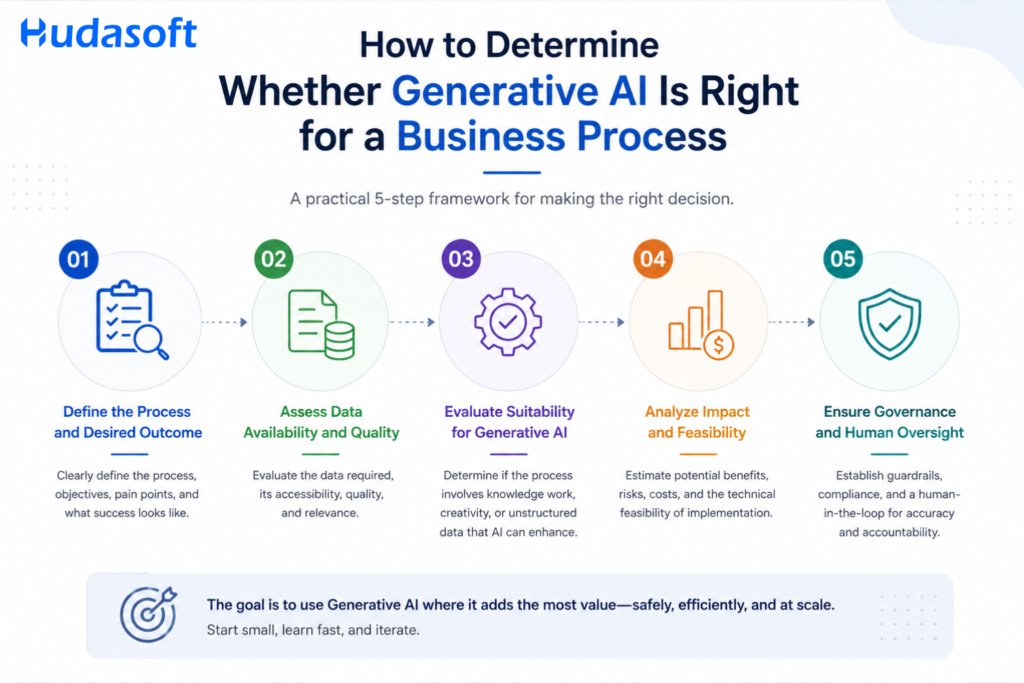
A practical AI initiative should start with a workflow problem, not with a model.
Businesses can assess an opportunity using five questions: Task, Data, Integration, Review, and Outcome.
1. Task: Is the Work Suitable for AI Assistance?
Look for processes involving repetitive writing, summarization, research, categorization, information retrieval, code generation, customer communication, or other knowledge-heavy activities.
A task that already follows a recognizable pattern is generally easier to evaluate than a process that depends almost entirely on subjective judgment.
2. Data: Does the System Have Reliable Information to Work With?
An AI assistant can only provide useful context if the information available to it is relevant and sufficiently reliable.
Businesses should identify where the source data lives, who can access it, how current it is, and whether sensitive information requires additional restrictions.
3. Integration: Can AI Fit Into the Existing Workflow?
A technically capable model can still fail to create business value if employees must leave their normal workflow, copy information between multiple systems, or complete more steps than before.
A structured artificial intelligence implementation approach can help connect AI with CRM systems, productivity suites, knowledge bases, development environments, customer-service systems, and internal applications while defining data access, review, and governance requirements.
4. Review: Can the Output Be Checked?
The business should know how an employee or automated control will determine whether the result is acceptable.
Low-impact content suggestions may require light review. Financial calculations, production code, customer decisions, legal documents, or sensitive recommendations may require much stronger validation.
5. Outcome: Can the Business Measure Improvement?
A use case needs a measurable objective.
Depending on the workflow, useful measures may include:
- Time required per task
- Cost per completed process
- Employee throughput
- Customer response time
- Development cycle time
- Rework or error rate
- Resolution time
- Conversion rate
- Customer satisfaction
- Volume of work completed
Measure the process before implementation and compare the same metrics after deployment to determine whether the AI use case improved business performance.
Frequently Asked Questions
Which generative AI platforms can improve remote team collaboration?
Platforms such as Microsoft 365 Copilot, Google Workspace with Gemini, Slack’s AI capabilities, and Notion AI can support remote collaboration, but the most suitable choice depends on where a team already works and stores its knowledge.
Microsoft 365 Copilot can support Teams meetings, chats, calls, and channels, including capturing key points and action items. Google Workspace with Gemini provides AI features across Workspace tools for activities such as drafting and document work. Slack supports conversation summaries, search, meeting notes, translation, and workflow-related assistance, while Notion combines shared workspace collaboration with AI search, agents, and automation capabilities.
A business should evaluate integration, permissions, security requirements, existing software, knowledge sources, and employee workflow when selecting a collaboration platform.
Can businesses use generative AI without replacing their existing software?
Yes. In many cases, businesses can add generative AI capabilities to existing business systems through APIs, built-in copilots, custom assistants, connectors, or embedded AI features.
Organizations can integrate AI through APIs, built-in copilots, custom assistants, connectors, or AI features already available within CRM, productivity, development, and collaboration platforms.
For example, an existing CRM might remain the customer system of record while an AI assistant summarizes account information or drafts responses. A development environment can remain unchanged while an AI coding assistant supports testing or documentation.
The best integration keeps established systems responsible for authoritative business data while using AI as an additional layer for generation, summarization, search, analysis, or workflow assistance.
How can businesses measure the ROI of generative AI?
Businesses should measure generative AI ROI by comparing the cost of implementation with measurable improvements in the process where the AI is used.
For a customer-service application, this could include response time, resolution time, number of cases handled, rework, or customer satisfaction. A development team might evaluate feature cycle time, throughput, production issues, or time spent on repetitive development tasks.
The calculation should also include:
- Software or API fees
- Implementation costs
- Infrastructure
- Integration
- Employee training
- Monitoring
- Governance
- Human review
Measuring activity such as prompts submitted or AI features enabled does not demonstrate ROI. The metric should show whether the underlying business process improved.
Does generative AI always reduce business costs?
No. Generative AI can lower the cost of some processes, but it also introduces implementation and operating costs.
A company may save employee time by automating report preparation, document review, support summaries, or repetitive development work. However, those savings need to be compared with model usage, software subscriptions, infrastructure, implementation, security, monitoring, training, and human review.
An AI use case can also be valuable without directly reducing headcount or operating expenses. It may increase capacity, shorten product cycles, improve response times, or allow employees to complete work that was previously impractical at scale.
Businesses should evaluate total process value, including cost, capacity, cycle time, response time, quality, and other measurable outcomes.
Which business processes are best suited for generative AI?
The strongest starting points are usually repetitive, information-heavy, language-heavy, scalable, measurable, and reviewable processes.
Examples include:
- Document summarization
- Customer-service assistance
- Internal knowledge search
- Reporting
- Customer feedback analysis
- Software documentation
- Code assistance
- Research
- Content preparation
- Repetitive customer communication
The process should also have a clear source of information and an acceptable method for verifying the output. Workflows involving highly sensitive decisions or outcomes that cannot be reliably checked require a much more cautious implementation.
A useful starting rule is simple: choose a process where employees spend significant time transforming existing information into another usable form and where the quality of that transformation can be evaluated.
Conclusion
Generative AI creates the most value when businesses apply it to a clearly defined problem with measurable outcomes.
The strongest benefits of generative AI often come from combining automation with human expertise. AI can handle repetitive processing, information retrieval, first drafts, analysis, and exploration, while people provide judgment, context, validation, and accountability.
Start with a measurable workflow, identify the information the system needs, determine how it will integrate with existing software, and define how outputs will be reviewed. Then compare the result against the original process. Teams that need implementation support can work with Hudasoft to connect AI capabilities with existing business workflows.
This approach makes generative AI a practical business capability that can improve productivity, development, customer experience, and decision support.

