


Computer vision in retail is the application of AI-powered cameras and machine learning models to analyze visual data inside physical stores and ecommerce environments. It turns ordinary camera footage into real-time operational intelligence that drives decisions automatically, without a human watching the screen.
Retailers are adopting this technology at a fast pace because the business case is no longer theoretical. Stores using computer vision are cutting shrinkage, eliminating manual shelf audits, reducing checkout friction, and building a detailed picture of how customers actually behave in their spaces. The ROI is documented, the vendors are established, and the implementation playbook is well understood.
This guide covers everything an enterprise retail team or technology decision-maker needs to evaluate, plan, and deploy retail computer vision successfully. You will find a breakdown of the top use cases, the technology stack from cameras to cloud, a structured implementation roadmap, real-world examples, common challenges, and a look at where the technology is heading next.
The global computer vision in retail market is on track to reach $12.6 billion by 2033, growing at 23.6% annually. The retailers who are building expertise now are the ones who will set the competitive standard in the next three to five years.
What Is Computer Vision in Retail?
Computer vision in retail is an AI discipline that enables systems to interpret and act on visual information from cameras installed in stores, warehouses, and ecommerce platforms. Unlike a standard security camera that records footage for later review, a retail computer vision system processes video in real time and produces structured data: shelf gaps, customer movements, suspicious behaviors, product recognition, and more.
The shift AI brought to traditional retail analytics is significant. Before computer vision, retailers relied on periodic manual audits, point-of-sale transaction data, and occasional mystery shopper reports. These methods are slow, infrequent, and human-dependent. AI in retail changes the model entirely. The system watches continuously, learns from what it sees, and delivers insights that no team of human observers could produce at scale.
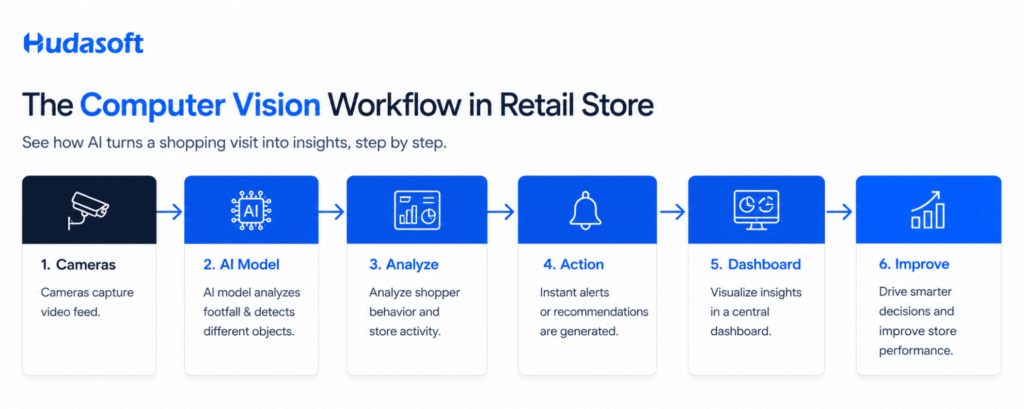
How Computer Vision Works in a Retail Store
The workflow runs through six stages, each feeding into the next:
Computer Vision vs Traditional CCTV
| Traditional CCTV | Retail Computer Vision System |
| Records footage passively | Interprets footage in real time |
| Requires human review | Generates automated alerts and data |
| Reacts after incidents occur | Acts during or before incidents |
| Produces raw video files | Produces structured, actionable data |
| Watches a fixed area | Monitors the entire store simultaneously |
| No integration with business systems | Feeds directly into POS, ERP, and analytics |
What This Means for Your Business?
If your cameras are only recording footage that no one reviews, you are paying for storage instead of intelligence. Every hour your shelves go unmonitored, your staff respond to problems that already cost you sales. Computer vision closes that lag completely.
Why Retailers Are Investing in Computer Vision
Retailers face a specific set of structural problems that traditional technology has failed to solve. Computer vision helps retailers detect and respond to problems in real time, reducing the delay between an issue occurring and someone taking action.
Shrinkage Is Getting Worse
Retail shrinkage costs the global industry over $112 billion per year. Shoplifting drives the majority of losses, but internal theft at self-checkout terminals and point-of-sale systems contributes significantly. Manual monitoring is too slow and too expensive to scale. Computer vision retail automation provides continuous behavioral surveillance without adding headcount.
Labor Shortages Are Forcing Automation
Retail has one of the highest staff turnover rates of any industry. Manual shelf audits, planogram checks, and inventory counts depend on consistent human labor that many retailers cannot reliably maintain. Computer vision solutions for retail automate these repetitive tasks, freeing staff for customer-facing roles where they add more value.
Stockouts Are Costing More Than Retailers Realize
When a product is out of stock, two out of three customers will not select a substitute. They will leave and buy from a competitor. Out-of-stock products cost retailers roughly 4% of annual revenue. Real-time shelf monitoring through AI in retail catches gaps within seconds, not hours.
Customer Expectations Have Changed
Customers expect frictionless experiences: fast checkout, accurate product availability, and personalized engagement. Omnichannel retail has raised the bar further. A customer who checks product availability online before visiting a store expects the shelf to match what the website showed. Computer vision retail systems provide the real-time data layer that makes this level of accuracy possible.
Competitive Pressure from Pure-Play Tech Retailers
Amazon built its entire retail model around computer vision, sensor fusion, and real-time AI. Traditional retailers now face a competitor whose stores operate with near-zero shrinkage, frictionless checkout, and granular behavioral data. Retail innovation through computer vision is no longer optional for retailers who want to stay relevant against technology-native competitors.
Business Perspective
If shrinkage, stockouts, or labor inefficiencies are already affecting store performance, delaying automation usually increases those costs over time. Even a focused pilot project can help retailers identify where AI delivers the fastest return.
Top Computer Vision Use Cases in Retail
The following ten use cases represent the most deployed and highest-ROI applications of retail computer vision today. Each one targets a specific business problem with a documented solution path.
1. Inventory Management
Business problem: Manual inventory counts are inaccurate, infrequent, and expensive. By the time staff identify a gap, customers have already encountered empty shelves.
How computer vision solves it: AI cameras mounted above shelving units scan the shelf continuously. Computer vision inventory management systems identify each product by its visual profile, detect empty slots, flag misplaced items, and send an automated restocking alert to the nearest staff member within seconds of a gap appearing.
AI technologies used: Object detection, image classification, edge AI processing, real-time inference.
Business impact: A large European grocery retailer using Scandit ShelfView achieved over 95% on-shelf availability and increased store sales by more than 2%. Staff time on manual counting dropped significantly.
Practical example: Morrisons (UK) deployed Focal Systems AI cameras across its store network. The system monitors shelves in real time, sends alerts when products run low, and verifies planogram compliance automatically, all without staff walking the floor with clipboards.
2. Shelf Monitoring and Out-of-Stock Detection
Business problem: Shelf gaps go undetected for hours. By the time a staff member notices and the restocking process completes, a measurable portion of sales have already been lost.
How computer vision solves it: Retail shelf analytics systems process camera feeds frame by frame, identify the planogram-specified product at every position, and detect when any slot falls below a minimum threshold. The system distinguishes between a genuine gap and a product that is simply facing the wrong way.
AI technologies used: Image segmentation, optical character recognition (OCR) for price tags, convolutional neural networks (CNNs), edge inference.
Business impact: Faster restocking cycles, fewer lost sales, and a reliable data layer that feeds into demand forecasting models to reduce the root cause of stockouts over time.
Practical example: Auchan (France) uses ceiling-mounted cameras with its ReShelf system to generate real-time out-of-stock alerts. In-store staff are notified immediately when a product runs low, and the system provides supply chain reports that help buyers adjust reorder quantities.
3. Planogram Compliance
Business problem: Non-compliance with planograms costs manufacturers and retailers 3 to 5 percent of category sales. Quarterly manual audits miss problems that occur daily.
How computer vision solves it: AI cameras compare what is actually on the shelf against the planogram specification. The system flags products in the wrong position, incorrect facings, missing price tags, and unauthorized substitutions, then generates a compliance report that updates in real time.
AI technologies used: Object detection, multi-label image classification, template matching against planogram database.
Business impact: Planogram compliance rates rise from typical industry averages of 50 to 60 percent to above 90 percent in well-implemented deployments. Supplier negotiations improve because retailers have objective compliance data.
Practical example: Simbe Robotics deploys autonomous shelf-scanning robots that navigate store aisles, photograph every shelf section, and produce planogram compliance reports automatically. Focal Systems takes the fixed-camera approach, turning each overhead camera into a continuous compliance verification tool.
4. Cashierless and Automated Checkout
Business problem: Long checkout lines cost retailers $19 billion in abandoned purchases annually (Source: DHL). Self-checkout machines reduced queues but introduced new fraud vectors and customer frustration.
How computer vision solves it: Cashierless checkout systems track every item a customer picks up from the moment they enter the store. AI cameras watch product interactions across the entire shopping journey, maintain a virtual cart, and charge the customer automatically when they exit. No scanning, no queuing, no friction.
AI technologies used: Multi-camera object tracking, person re-identification, shelf-weight sensor fusion, deep learning on action sequences.
Business impact: Amazon Just Walk Out technology operates in over 375 stores across five countries, with 99.9% system uptime and shopper theft rates below 1% (Source: Just Walk Out, 2025). Checkout throughput increases dramatically and customer satisfaction scores rise.
Practical example: Aldi launched its Shop&Go checkout-free format in selected UK and European stores. Amazon sells its Just Walk Out technology to third-party retailers including sports stadiums, university campuses, and airport operators where speed is the primary customer requirement.
5. Loss Prevention and Theft Detection
Business problem: Retail shrinkage exceeds $112 billion globally. Manual observation is not scalable, and traditional alarm systems only detect theft after it has already occurred.
How computer vision solves it: Behavioral AI models watch for the specific movement patterns that indicate theft: unusual dwell time near high-value items, concealment gestures, repeated self-checkout visits without completed transactions, and sweep-and-go behavior at gondola ends. Alerts go to store staff in real time, before the customer leaves.
AI technologies used: Action recognition, behavior sequence modeling, anomaly detection, real-time edge inference. These systems work on movement patterns, not facial recognition, keeping them compliant with GDPR, CCPA, and BIPA.
Business impact: Documented shrinkage rates below 1% in cashierless environments. Tesco and Lidl have both deployed behavioral theft detection AI across their store networks with measurable reductions in incidents.
Practical example: Veesion provides purpose-built behavioral theft detection AI deployed in European supermarkets. VF Corporation saved 60% of associate scanning time at self-checkout using Scandit computer vision, which also eliminates the most common internal theft vector at POS terminals (Source: Scandit, 2025).
6. Customer Behavior Analytics
Business problem: Store layouts are designed by intuition and updated infrequently. Retailers lack objective data on where customers go, what they engage with, and where they disengage and leave.
How computer vision solves it: Customer analytics systems track anonymized movement paths across the entire store floor. The output includes heat maps showing dwell concentrations, engagement rates per display, popular routes and dead zones, conversion rates from entry to purchase, and time-of-day behavioral patterns.
AI technologies used: Person tracking with re-identification across multiple camera views, trajectory analysis, zone-based dwell time calculation, heat map generation.
Business impact: Layout changes based on customer behavior data consistently outperform intuition-based decisions. Phillips 66 deployed an AWS-based computer vision system called Connected Store across its convenience store network, using behavioral data to identify the highest-performing promotional positions and optimize staff deployment by traffic patterns.
Practical example: Carrefour uses customer behavior analytics across multiple markets to optimize store flow, promotional display effectiveness, and product placement decisions. The data feeds into category management reviews with suppliers, giving buyers objective evidence for negotiating shelf position.
7. Queue Monitoring and Checkout Optimization
Business problem: Queue length is one of the strongest predictors of basket abandonment in grocery and convenience retail. Most retailers cannot predict or respond to queue build-up fast enough to prevent walkouts.
How computer vision solves it: Queue monitoring systems count the number of people waiting at each checkout lane in real time, calculate estimated wait times, and trigger automatic alerts when wait times exceed a configurable threshold. Store managers can open additional lanes before the queue reaches the abandonment threshold, not after.
Business impact: Reduced basket abandonment, higher average transaction value, and improved staff deployment efficiency. Several major grocery chains report measurable reductions in peak-hour walkout rates after deploying queue monitoring AI.
8. Visual Product Search
Business problem: Customers often see a product they want but cannot describe it with enough precision to find it through text search. This gap between discovery and purchase is a direct source of lost ecommerce revenue.
How computer vision solves it: Visual product search allows a customer to upload any photo to a retailer’s website or app. The AI analyzes the image for shape, color, texture, material, and style attributes, then returns the closest matching products from the catalog, regardless of whether the customer can name what they are looking for.
AI technologies used: Vision-Language Models (VLMs), image embedding and similarity search, multimodal AI that combines visual and textual understanding.
Business impact: Amazon, Target, and IKEA all operate live visual search functionality. IKEA’s implementation allows customers to photograph any piece of furniture and instantly find matching or similar items in the catalog. Retailers consistently report higher conversion rates from visual search sessions compared to text search.
9. Dynamic Pricing and Smart Store Management
Business problem: Static pricing on physical shelves creates a disconnect between actual demand signals and the prices customers see. High-demand periods, expiry risk, and competitor pricing shifts all deserve a faster pricing response than weekly manual updates allow.
How computer vision solves it: Electronic shelf labels (ESLs) connected to AI inventory and demand systems allow prices to update automatically based on stock levels, time-to-expiry, queue length, and competitive data. Computer vision confirms that the displayed price matches the system price, eliminating pricing discrepancies that create customer complaints and compliance issues.
Business impact: Retailers using dynamic pricing report meaningful improvements in margin on perishable goods, reduced waste from unsold expiring products, and faster clearance of slow-moving inventory.
10. Store Operations Optimization
Business problem: Store operations span dozens of overlapping tasks: cleaning schedules, temperature compliance in refrigeration units, promotional signage accuracy, occupancy monitoring, and staff positioning. Managing all of these with manual processes leaves gaps that affect customer experience and compliance.
How computer vision solves it: AI cameras monitor store conditions continuously. They flag refrigeration units that are running warm, detect promotional signage that does not match the current sales period, track occupancy levels for capacity compliance, and optimize staff positioning based on real-time traffic patterns across different store zones.
Business impact: Walmart has deployed store operations AI that monitors shelf conditions, tracks product availability, and flags maintenance issues autonomously. Zara uses AI-driven store intelligence to align product placement with its rapid inventory turnover model, ensuring that what is trending online is prominently displayed in physical stores.
Key Takeaway
You do not need to deploy all ten use cases to see a return. One well-chosen pilot on a shared camera infrastructure can pay for the entire system and create the internal evidence you need to justify the next three. Start with the use case that maps to your most expensive operational problem today.
How Computer Vision Technology Works in Retail
Understanding the technology stack helps enterprise teams make better vendor selection, build-versus-buy, and infrastructure investment decisions. Retail computer vision technology runs through four interconnected layers.
Layer 1: Data Collection (Cameras and Edge AI)
The hardware layer is where raw visual data enters the system. Most retail deployments use a combination of existing CCTV infrastructure, purpose-built AI cameras, shelf-level units for close product inspection, and handheld smart devices for mobile workers. In larger deployments, autonomous robots from companies like Simbe Robotics carry their own camera arrays down every store aisle on a scheduled route.
The component most retailers underestimate is the edge AI processor. Devices like NVIDIA Jetson and Intel NUC units sit between the cameras and any central server. They process video locally, at the camera, before sending anything to the cloud. This matters for three reasons: it drops latency from seconds to milliseconds, it cuts bandwidth costs significantly, and it ensures that raw customer footage never leaves the store, which is the foundation of a privacy-compliant architecture.
Layer 2: AI Models and Deep Learning
The AI layer is where raw images become usable information. Several distinct model types are used, often in combination:
- Object Detection (YOLO, Faster R-CNN): Identifies and locates specific products, people, and objects within a camera frame. YOLO (You Only Look Once) is widely used in retail because of its real-time speed on edge hardware.
- Image Classification (CNNs): Categorizes what the model sees: this is a product gap, this is a person concealing an item, this is a planogram violation.
- OCR (Optical Character Recognition): Reads price tags, product labels, expiry dates, and shelf edge labels to verify accuracy against the system of record.
- Vision Transformers (ViT): A newer architecture that understands the full context of an image rather than scanning it in patches. ViT models outperform CNNs on complex scenes where multiple objects interact, such as crowded checkout areas or busy promotional displays.
- Segment Anything Model (SAM): Meta’s foundational segmentation model, now used in retail to precisely isolate individual products on cluttered shelves, even under occlusion or poor lighting conditions.
- Vision-Language Models (VLMs): Multimodal AI models that combine image understanding with natural language. In retail, VLMs power visual product search (understanding a customer’s photo against a text-described catalog), generate shelf audit reports in plain language, and enable AI agents to reason about store conditions autonomously.
- AI Agents: Autonomous AI systems that combine computer vision with decision-making logic. A retail AI agent can watch inventory levels, compare them against sales velocity data, and trigger a reorder automatically, all without human intervention at any step.
Layer 3: Integration (POS, ERP, Cloud Analytics)
Computer vision retail systems generate value when they connect to the systems retailers already use. POS integration allows the CV system to cross-check what a customer scans against what the camera sees, catching mis-scans in real time. ERP integration connects visual inventory data to procurement systems, so reorder triggers flow directly to suppliers. For retailers modernizing enterprise operations, understanding how AI works alongside ERP platforms can help maximize the value of computer vision deployments.
Cloud analytics platforms aggregate data from all store locations into unified dashboards that give operations leadership a single view across the entire estate.
The integration challenge is that most retailers run on legacy POS systems not designed for real-time AI data inputs. The standard solution is an enterprise service bus (ESB) that acts as middleware, translating between the CV system’s output format and the protocols your existing systems understand. Cloud CV services from AWS Rekognition and Microsoft Azure Vision offer managed APIs that simplify integration for retailers without dedicated ML infrastructure teams.
However, retailers with unique workflows or specialized operational requirements often require custom computer vision development services to build models, integrations, and analytics that match their business processes.
Layer 4: Continuous Learning and Model Maintenance
A computer vision model deployed in January will begin to degrade by April if the store environment changes. New product packaging, seasonal displays, store resets, and lighting changes all affect model accuracy. Enterprise deployments require a continuous learning pipeline: a process that captures new data from the deployed cameras, uses it to retrain and fine-tune the models, and pushes updated models back to edge devices without disrupting store operations.
This is the layer that most vendors underemphasize during sales cycles and that most retailers underestimate in their cost models. Budget for ongoing model maintenance as a recurring operational cost, not a one-time deployment expense.
Architecture Insight
The success of a computer vision project depends on more than the AI model. Camera placement, edge processing, system integration, and ongoing model maintenance all influence accuracy, performance, and long-term operating costs. When evaluating vendors, ask how they address each of these areas, not just the AI itself.
Benefits of Computer Vision in Retail
The following table maps each primary benefit to its specific business impact, drawn from documented real-world deployments.
| Benefit | Business Impact | Evidence |
| Inventory Accuracy | Fewer stockouts, higher on-shelf availability | European grocer: 95%+ availability, 2%+ sales increase (Scandit, 2025) |
| Faster Shelf Audits | Reduced manual labor hours per store | From quarterly counts to real-time continuous monitoring |
| Shrinkage Reduction | Lower theft and fraud losses | Cashierless stores: <1% shopper theft rate (Just Walk Out, 2025) |
| Checkout Speed | Eliminated queue wait time, higher throughput | 375+ cashierless stores, 99.9% uptime (Amazon, 2025) |
| Staff Efficiency | Labor reallocated to customer-facing tasks | VF Corp: 60% time saving on scanning tasks (Scandit, 2025) |
| Better Customer Experience | Higher satisfaction, lower basket abandonment | Queue monitoring reduces walkouts at peak hours |
| Revenue Protection | Eliminated undercharging and overcharging | One retailer: $1.3M annual revenue protected (Scandit, 2025) |
| Data-Driven Decisions | Behavioral insights replace gut instinct | Heat maps and foot traffic analytics improve layout ROI |
| Planogram Compliance | Higher category revenue, stronger supplier terms | Compliance rates from 50-60% to above 90% with CV monitoring |
| Loss Prevention | Reduced shrinkage without adding security headcount | Tesco and Lidl: behavioral AI deployed across store networks |
Business Impact
Every number in the table above comes from a named retailer running a live deployment, not a vendor projection. That is exactly what your finance team needs to approve a pilot budget. Use these figures to anchor your internal business case, then add your own shrinkage rate and out-of-stock cost to calculate what the same outcomes are worth in your specific operation.
How to Implement Computer Vision in Retail
Successful retail AI implementation follows a structured, phased process. The Hudasoft Computer Vision Implementation Framework covers eight stages, each with a defined deliverable before the next stage begins.
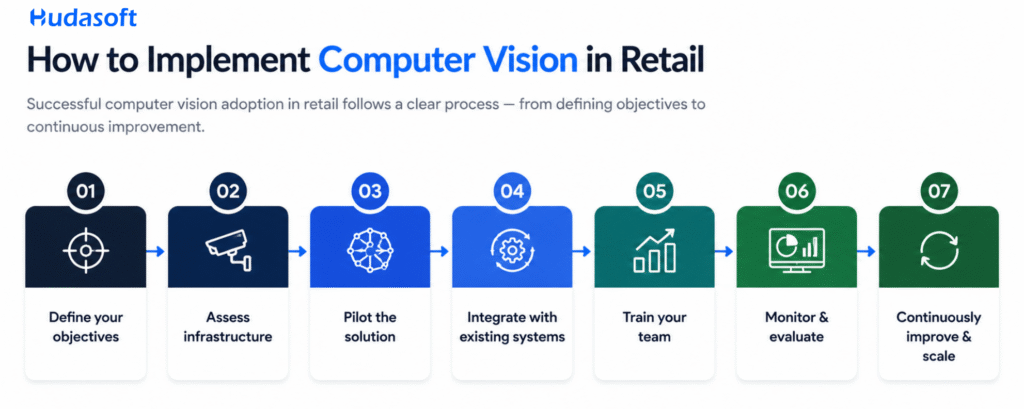
1. Discovery and Readiness Assessment
Audit existing camera infrastructure, network bandwidth, POS and ERP data formats, and quantify your biggest operational pain points in dollar terms. Determine whether edge processing or cloud-managed CV better fits your infrastructure and privacy requirements. The output is a prioritized use case list with estimated ROI per use case. At this stage, many enterprise retailers also seek AI consulting services to validate technical feasibility, prioritize use cases, and build a realistic implementation roadmap. This helps reduce project risk before committing to a larger investment.
2. Data Collection
Capture video samples from your actual store environment under realistic conditions: different lighting, store layouts, product assortments, and customer traffic levels. The quality of training data determines the ceiling of model accuracy. Synthetic data generation can supplement real data for edge cases like unusual theft behaviors or rare product configurations.
3. Pilot Deployment
Deploy your highest-ROI use case in two or three stores for 90 days. Keep the scope narrow and the measurement criteria clear: on-shelf availability rate, shrinkage percentage, checkout throughput, or staff hours on manual tasks. A focused pilot builds the internal business case with real numbers, which is far more persuasive to finance teams than vendor projections.
4. Data Annotation
Label the data captured during the pilot: shelf gaps, product identifications, behavioral events, planogram compliance status. Annotation quality directly determines model accuracy. Budget appropriate time and expertise for this stage. Many retailers underestimate annotation cost and discover it during the pilot rather than planning for it in advance.
5. Model Training
Train or fine-tune AI models on your annotated retail data. Use pre-trained foundational models (YOLO, ViT, SAM) as starting points rather than training from scratch. Fine-tuning on your specific product catalog, store layout, and operational conditions significantly improves accuracy while reducing training time and compute cost. Many organizations partner with an experienced AI development agency to fine-tune foundation models, optimize performance, and integrate them with existing enterprise systems.
6. Production Deployment
Roll out to additional stores with a defined change management process. Brief store managers on what the system does, what alerts look like, and how staff should respond. Plan the anonymization architecture before deployment: process and anonymize at the edge, delete raw footage immediately after inference, and document data flows for GDPR, CCPA, and BIPA compliance.
7. Monitoring and Performance Review
Track model accuracy, alert precision, and false positive rate across all deployed stores. False positives (theft alerts that turn out to be nothing, or shelf gap alerts for products that are actually present but obscured) erode staff trust in the system. Monitor and retrain promptly when accuracy drops below agreed thresholds.
8. Continuous Learning
Build a pipeline that captures new operational data from deployed cameras, uses it to retrain models, and pushes updates back to edge devices without operational disruption. Product packaging changes, store resets, seasonal assortment changes, and new product introductions all require model updates. Treat model maintenance as a recurring operational line item, not a one-time project cost.
Implementation Insight
Successful deployments rarely skip the pilot, data annotation, or continuous learning stages. These steps reduce risk, improve model accuracy, and create the internal evidence needed to scale with confidence.
Real-World Computer Vision Examples in Retail
The following implementations represent some of the most well-documented and outcome-focused retail computer vision deployments globally. Each one is included because it has verifiable business outcomes, not just announced intentions.
Amazon Just Walk Out
Amazon’s cashierless checkout system combines overhead cameras, shelf weight sensors, deep learning action recognition, and computer vision to track every item a customer takes and charge them automatically on exit. The system now operates in over 375 stores across five countries, including third-party venues such as NFL stadiums, universities, and airports. Key outcomes: shopper theft below 1%, 99.9% system uptime over 12 months, and checkout throughput that outperforms every traditional format at comparable store sizes (Source: Just Walk Out, 2025).
Walmart
Walmart has deployed computer vision across multiple operational domains: autonomous shelf-scanning robots that produce inventory reports, AI cameras at checkout to reduce scan fraud, and store operations AI that monitors refrigeration unit temperatures, tracks planogram compliance, and flags maintenance issues. Walmart’s scale makes it one of the most comprehensive retail AI deployments in existence, and the company has shared data showing meaningful reductions in out-of-stock incidents and shrinkage rates at AI-equipped stores.
Tesco
Tesco deployed behavioral theft detection AI across its UK store network, often referred to as “supermarket VAR” (a reference to the video assistant referee technology used in professional football). The system identifies suspicious behaviors at self-checkout terminals in real time. Tesco has also piloted shelf-monitoring cameras at selected stores, producing automated restocking alerts that reduce the time between a shelf gap appearing and a staff response.
Zara (Inditex)
Zara uses AI-driven inventory intelligence, including computer vision, to manage its rapid product turnover model. The system tracks product movement through stores, identifies which items are selling fastest, and aligns physical in-store product placement with what is trending online. This integration between retail computer vision data and ecommerce demand signals is one of the most sophisticated examples of omnichannel retail intelligence in the industry.
Carrefour
Carrefour has deployed customer behavior analytics across multiple market formats, using anonymized foot traffic tracking to optimize product placement, evaluate promotional display effectiveness, and improve store flow design. The data from these deployments feeds into category management negotiations with suppliers, giving Carrefour objective behavioral evidence to support shelf positioning decisions.
What Industry Leaders Teach Us
Amazon, Walmart, Tesco, Zara, and Carrefour are not running pilot programs. They are operating these systems at full commercial scale today. The question for your business is not whether the technology works. That is settled. The question is which deployment model fits your store format, your existing infrastructure, and your most urgent operational problem.
Challenges and Best Practices in Retail Computer Vision
The retail computer vision industry is mature enough that most implementation challenges are predictable. None of them are project-killers when addressed proactively. All of them create expensive failures when ignored.
| Challenge | Practical Mitigation |
| Poor lighting and occlusion in store aisles | Deploy sensor fusion: combine cameras with weight sensors and RFID. Train models on synthetic low-light data. Use edge AI hardware that processes degraded images accurately. |
| Legacy POS and ERP systems without real-time APIs | Implement an enterprise service bus (ESB) as middleware. AWS Rekognition and Azure Vision connect via standard APIs that most modern integration platforms support. |
| Privacy regulations (GDPR, CCPA, BIPA) | Anonymize at the edge. Process footage locally and delete raw video immediately after inference. Avoid biometric data collection where it is not essential. Document all data flows. |
| Model drift as packaging, products, and layouts change | Build continuous retraining pipelines. Budget model maintenance as an ongoing operational cost. Monitor accuracy metrics weekly, not quarterly. |
| Annotation quality and cost | Use pre-trained foundational models (SAM, YOLO) to reduce annotation workload. Prioritize annotation accuracy over volume. Bad labels produce worse models than small datasets. |
| Integration complexity across multiple store systems | Standardize on a single data output format from the CV layer. Use a dedicated middleware layer. Avoid point-to-point integrations that create maintenance debt. |
| Staff adoption and change resistance | Frame CV as task reduction for staff, not workforce reduction. Show staff the direct impact on their own workload. Train on alert systems before go-live. Share results openly. |
| Scalability across hundreds of store locations | Design the architecture for multi-site operation from the beginning. Edge processing at each location reduces central infrastructure load. Cloud-managed edge devices allow remote model updates. |
Best Practices for Enterprise Retail CV Programs
- Start with one use case. Prove ROI in a 90-day pilot before expanding. The pilot data is more persuasive to leadership than any vendor projection.
- Deploy edge AI where latency or privacy matters. Not everything needs to go to the cloud. Edge processing is faster, cheaper per inference, and more privacy-compliant for customer-facing applications.
- Monitor model performance continuously. Set accuracy thresholds and alert when models drop below them. Degradation is silent without monitoring.
- Keep humans in the loop for high-stakes decisions. AI should flag and recommend. Humans should confirm before taking actions with significant consequences, particularly in loss prevention scenarios.
- Measure ROI continuously, not just at deployment. ROI changes as the store environment evolves. Regular measurement also justifies ongoing model maintenance investment to finance teams.
- Build for the use case you have today, but architect for expansion. A shared camera infrastructure that supports multiple AI models simultaneously is far more cost-efficient than deploying separate systems for each use case.
The Future of Computer Vision in Retail
The next wave of retail AI innovation is already moving from research into early commercial deployment. These are the developments that enterprise retail teams should be planning for now.
AI Agents and Autonomous Store Operations
AI agents combine computer vision with autonomous decision-making. A retail AI agent can watch shelf inventory levels, compare them against real-time sales velocity, decide when a reorder threshold has been crossed, and place a supplier order automatically without any human involvement. Early deployments in grocery and convenience formats are demonstrating that agentic AI reduces stockout duration from hours to minutes.
Vision-Language Models in Retail
VLMs like GPT-4V and Google Gemini combine image understanding with natural language reasoning. In retail, this means a system that can answer questions like “which promotional display performed best last Tuesday afternoon?” by processing camera data and generating a plain-language report. VLMs also power the next generation of visual search: a customer can describe what they are looking for conversationally, and the AI can combine that description with image analysis to find the right product even from a low-quality photo.
Autonomous and Predictive Retail
Combining computer vision data with demand forecasting models creates predictive retail capabilities: stores that adjust staffing, pricing, and inventory positions in anticipation of demand shifts rather than in response to them. Autonomous stores take this further, operating with minimal human intervention for routine tasks while deploying staff exclusively for customer service and exception handling.
Digital Twins for Retail Environments
A digital twin is a real-time virtual replica of a physical store, populated with data from computer vision systems, POS transactions, foot traffic sensors, and inventory feeds. Retailers use digital twins to simulate layout changes, test promotional placements, and model the impact of operational decisions before implementing them in the physical store. Major retailers including Walmart are already using digital twin technology for store planning.
Multimodal AI and Robotics
Next-generation retail AI systems will combine vision, language, and action in a single model. Robots guided by multimodal AI will not just scan shelves and report what they see but will understand context, respond to exceptions autonomously, and communicate with staff in natural language. The convergence of computer vision, natural language processing, and robotics is the defining technology shift that will reshape physical retail over the next decade.
Looking Ahead
Retailers investing in edge AI, multimodal AI, and intelligent automation today are building the infrastructure needed for the next generation of retail operations. Starting early gives organizations more time to test, refine, and scale these capabilities before they become mainstream.
Conclusion
Computer vision retail innovation is no longer a competitive differentiator available only to Amazon-scale retailers. The technology is accessible, the implementation paths are documented, and the ROI is proven across every major retail format from convenience stores to hypermarkets to ecommerce platforms.
Retailers who move now are building operational advantages in shrinkage reduction, inventory accuracy, checkout efficiency, and customer experience that will compound over the next three to five years. Those who wait are allowing that gap to widen.
The right starting point is not the most ambitious use case. It is the one that solves your most expensive problem, can be measured clearly in 90 days, and creates the internal proof of concept that justifies a broader program.

