


Generative AI in automotive refers to models that generate design concepts, software code, test data, technical documents, and conversational responses for automotive workflows. Automakers and suppliers apply these systems to design exploration, software development, simulation, manufacturing knowledge, customer support, and in-vehicle assistance. Predictive maintenance, defect detection, optimization, and vehicle control use separate AI capabilities. A generative interface may retrieve, summarize, or explain their results.
Key Takeaways
- Generative AI produces design concepts, code, test data, documents, and conversational responses for automotive workflows.
- Predictive maintenance, visual defect detection, optimization, and vehicle control depend on separate AI capabilities.
- Automotive applications cover vehicle design, software development, simulation, manufacturing knowledge, customer support, in-vehicle assistance, and service operations.
- Each generated output requires validation based on its data source, intended user, system authority, and failure impact.
- Production deployment requires approved data, controlled integrations, user permissions, evaluation criteria, monitoring, and defined review responsibility.
- Automotive market forecasts differ because research firms include different technologies, applications, services, and forecast periods.
How Generative AI in Automotive Compares With Other AI
Generative AI produces new output based on patterns in its training data and the context supplied with a request. That output may contain text, code, an image, a three-dimensional concept, a simulated scenario, or an audio response.
Automotive systems also use predictive models, computer vision, optimization algorithms, and control software. Each category performs a different function. Clear classification matters because the model’s function determines its data, testing method, and acceptable error level.
| Technology | Primary Function | Automotive Example | Typical Output |
| Generative AI | Produces new content or representations | Drafting software tests | Code or text |
| Predictive AI | Estimates a future condition | Estimating component failure | Probability or forecast |
| Computer vision | Detects or classifies visual patterns | Identifying paint defects | Label or location |
| Optimization AI | Selects an option under constraints | Scheduling production capacity | Recommended allocation |
| Vehicle control software | Applies driving or system logic | Managing steering or braking | Control command |
A predictive maintenance model may calculate the probability of equipment failure. A generative assistant can retrieve the supporting sensor history, explain the detected pattern, and draft a maintenance report. The two models contribute separate capabilities to the same workflow.
The same distinction applies to manufacturing quality. Computer vision identifies a defect in an inspection image. A generative model links that result with technical documents and prepares an explanation for the quality engineer.
Where Generative Models Fit
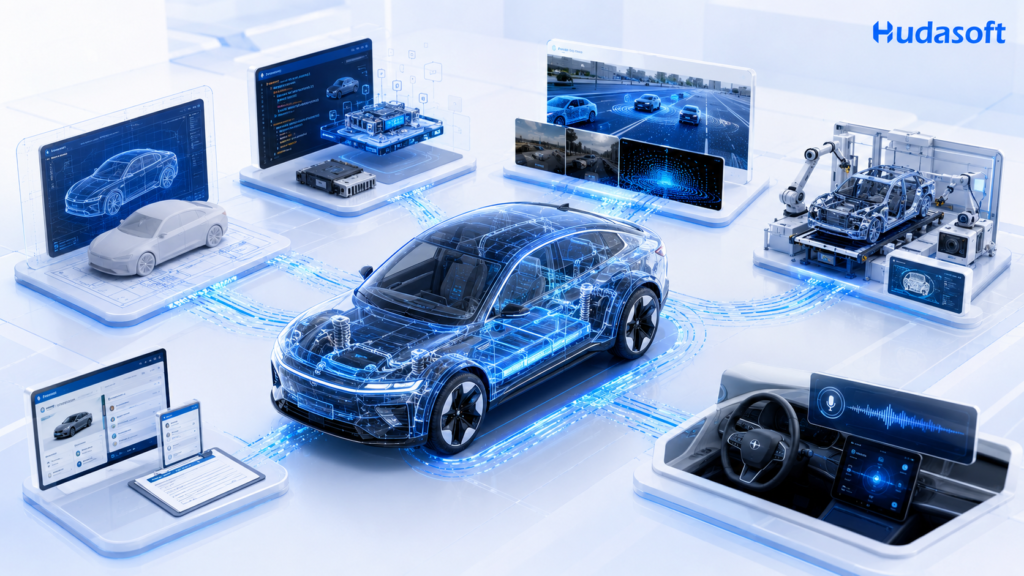
Automotive companies manage several connected lifecycle stages. Research teams define product concepts. Engineers develop vehicle systems. Manufacturing teams assemble and inspect components. Dealerships and service networks support customers throughout vehicle ownership.
Generative models contribute different outputs at each stage:
- Research and planning generates product summaries, requirement drafts, and concept alternatives.
- Vehicle design produces sketches, component concepts, and design variations.
- Software development creates code suggestions, tests, diagrams, and documentation.
- Simulation and validation generates scenarios and synthetic sensor data.
- Manufacturing produces technical instructions, quality reports, and knowledge responses.
- Sales and customer support creates product explanations and conversational answers.
- In-vehicle systems produce contextual responses through voice and visual interfaces.
- Service operations generate diagnostic explanations and repair documentation.
The output changes across these stages, along with its failure impact. A marketing draft requires factual and legal review. Generated embedded code requires engineering review, testing, traceability, and security analysis. An in-vehicle response also needs defined command limits when the assistant interacts with vehicle functions.
Generative AI Use Cases in Automotive Industry Workflows
The following applications reflect functions where a model creates new content, code, data, or explanations. Each use case begins with a defined input and ends with an output that a person or connected system can evaluate.
Vehicle Design and Engineering
Automotive designers explore exterior shapes, interior layouts, materials, surfaces, and interface concepts. Generative tools increase the number of visual alternatives available during early exploration.
The designer can provide an original sketch, vehicle category, brand characteristics, cabin dimensions, and design constraints. The model then produces alternatives that preserve the specified elements. Designers evaluate proportion, identity, usability, and relevance to the vehicle program.
Engineering constraints can also enter the generation process. Toyota Research Institute demonstrated a technique that combines design sketches with engineering conditions such as aerodynamic drag and chassis dimensions. The approach connects visual generation with parameters that affect vehicle feasibility. Toyota Research Institute
The generated concept does not establish engineering compliance. Simulation, material analysis, structural calculation, prototyping, and physical testing determine whether the proposed design meets the program requirements.
Component development follows the same principle. Engineers can define loading conditions, connection points, manufacturing methods, weight targets, and permitted materials. A generative system can propose geometry for review. Computer-aided engineering tools then test stress, durability, thermal behavior, and manufacturability.
The required AI development services depend on the selected capability. A design application may require model adaptation, constraint handling, engineering-software integration, output evaluation, and access controls for proprietary design data.
Software Requirements and Architecture
Software-defined vehicles contain applications for infotainment, battery management, diagnostics, connectivity, body control, and driver assistance. Each system begins with product requirements and technical specifications.
Generative models can compare stakeholder inputs, identify repeated requirements, and draft acceptance criteria. Product managers can also use them to organize expert feedback and prepare user stories.
A model connected to approved engineering documents can trace a requirement to its source. This connection helps reviewers determine whether the generated text reflects the current vehicle program and software version.
Architecture work includes interfaces, data flows, hardware constraints, timing requirements, and dependency analysis. Generative tools can prepare draft diagrams and interface descriptions based on supplied specifications. Software architects remain responsible for system boundaries, real-time behavior, fault handling, and resource allocation.
McKinsey tested ten product-management use cases and reported time savings of up to 39 percent for creating and refining product requirements and user stories. The result came from a defined study rather than a general estimate for every automotive team. McKinsey
Code Development and Testing
Code assistants generate functions, comments, test scripts, and refactoring suggestions. They can also translate older code into another language or explain unfamiliar sections of an existing codebase.
Automotive code introduces hardware and timing requirements that general application software may not contain. An embedded function may operate with limited memory, defined processor capacity, and strict execution deadlines. Generated code requires evaluation against those conditions.
Testing provides another use case. A model can convert software requirements into draft unit tests, integration tests, and acceptance tests. It can identify missing conditions and propose cases for invalid input, timing variation, hardware failure, or network interruption.
Hardware-in-the-loop and software-in-the-loop environments use test scenarios that represent vehicle behavior. Generative tools can prepare scenario definitions and test data. Engineers determine whether each case represents a valid condition and whether the test covers the intended requirement.
Code generation does not change release responsibility. The development team still reviews the code, checks licenses and dependencies, verifies security, tests hardware interaction, and records the approved change. Safety-related software also requires the organization’s established verification process.
Synthetic Data and Simulation
Real road and factory data may contain limited examples of rare events. Autonomous-driving development may need unusual pedestrian behavior, severe weather, construction changes, sensor degradation, or uncommon traffic combinations. Manufacturing models may need examples of defects that appear infrequently.
Generative models create controlled variations of verified examples. Simulation teams can change lighting, weather, object position, road geometry, traffic density, and sensor conditions. These variations expand the scenarios available for development and evaluation.
Synthetic data also supports cases where collection creates cost, safety, privacy, or availability constraints. The dataset still requires a defined relationship with the target environment.
A realistic image does not confirm accurate vehicle physics. Camera, radar, lidar, GPS, steering, and motion data require consistent timing and physical relationships. Simulation engineers measure these properties against real observations.
Real-world evaluation determines whether performance transfers outside the simulation. The validation record needs to show the original data distribution, generated variations, model response, and remaining coverage gaps.
Manufacturing Knowledge
Factory employees use work instructions, maintenance procedures, quality specifications, equipment records, and engineering changes. These sources often exist across several document repositories and operational systems.
A manufacturing knowledge assistant accepts a natural-language question and retrieves the current approved procedure. It can explain the relevant steps, identify required tools, and show the source document for verification.
The assistant can also organize shift notes, inspection records, and incident details into a report. The report remains a generated draft until the responsible employee confirms its accuracy.
Quality workflows may combine several AI capabilities. A vision model identifies an assembly or surface defect. The generative layer retrieves the related specification, explains the finding, and prepares documentation for review.
Maintenance workflows use a similar division. A predictive model detects abnormal equipment behavior. The generative system summarizes the evidence and retrieves the approved inspection sequence. A technician confirms the equipment condition and records the completed work.
Version control affects the reliability of these applications. The retrieval system needs the current document, equipment configuration, plant location, and user permission. An outdated instruction can produce a factually grounded answer that no longer applies to the active process.
Supply Chain and Procurement
Automotive procurement involves supplier specifications, contracts, quality agreements, purchase orders, certificates, and logistics records. Generative models help employees locate and compare this information.
A procurement assistant can compare a supplier submission with defined requirements. It can identify missing documents, summarize contractual conditions, and prepare questions for a supplier review.
Supply-chain forecasting belongs primarily to predictive analytics. Generative models contribute through explanation and document handling. They can summarize the factors behind a delay forecast, prepare an exception report, or translate a planning result into operational language.
These systems may process confidential pricing, product schedules, supplier designs, and legal terms. Identity controls and document-level permissions determine which information the model can retrieve for each user.
Dealership and Customer Support
Automotive websites and dealerships receive questions about vehicle specifications, inventory, financing, warranties, maintenance, and appointment availability. A generative assistant can answer these questions through a connected conversational interface.
The model needs current information from product catalogs, inventory systems, scheduling tools, and approved policy documents. A general model cannot confirm current stock or dealership availability without those connections.
The assistant can compare verified specifications, explain a vehicle feature, collect lead details, and schedule an appointment. It also needs an escalation path for complaints, safety concerns, complex financing questions, and unsupported requests.
Content generation supports dealership and marketplace websites. CarMax used Azure OpenAI Service to create customer-relevant summaries from vehicle reviews. The system converted a large collection of review material into structured research content. Microsoft
Editorial controls still apply to specifications, prices, finance terms, warranty statements, and legal disclosures. The source system determines the facts. The generative model determines how the application presents those facts.
In-Vehicle Assistants
Traditional vehicle voice systems match spoken commands with predefined functions. Generative models add contextual dialogue, follow-up questions, and broader language interpretation.
A driver can ask for information about a vehicle feature, a point of interest, a charging location, or a dashboard indicator. The assistant can retrieve the relevant information and respond in natural language.
Mercedes-Benz and Google Cloud introduced conversational search for the MBUX Virtual Assistant in 2025. The system uses location information from Google Maps Platform and supports multi-turn questions about navigation and points of interest. Mercedes-Benz
An in-vehicle assistant requires defined authority. The application needs a controlled list of vehicle functions, permitted parameters, confirmation rules, and rejection conditions. A language response cannot replace the deterministic controls that govern a safety-related function.
Connectivity also affects system behavior. The vehicle needs a fallback for unavailable cloud services, delayed responses, and incomplete information. Essential vehicle controls remain accessible through conventional interfaces.
Privacy requirements cover voice recordings, conversation history, location, contacts, vehicle state, and user preferences. The product documentation needs to explain what the assistant collects, where it processes the data, and how the user disables related features.
Vehicle Service and Diagnostics
Service technicians work with fault codes, owner reports, repair manuals, technical service bulletins, warranty history, and previous repairs. A generative assistant can connect these sources through one search interface.
The technician can enter a fault code or describe a symptom. The system retrieves relevant procedures and presents the evidence in a structured response. It can also prepare a draft diagnostic report for the service record.
A generated explanation does not confirm the underlying fault. The technician performs the required inspection and records the diagnosis. The system’s role remains evidence retrieval, explanation, and documentation.
Customer-facing diagnostic guidance needs narrower boundaries. The assistant can explain a warning indicator and identify the approved next step. Safety-related conditions require direct escalation to roadside support or a qualified service facility.
What the Business Case Measures
A generative AI project needs a workflow baseline. Model accuracy alone does not show whether the application improves engineering, manufacturing, or customer operations.
Engineering teams can measure requirement preparation time, accepted test coverage, code review findings, documentation time, and rework caused by incorrect output. Design teams can measure the number of concepts that reach engineering review and the time required to prepare each iteration.
Manufacturing teams can measure procedure search time, technician resolution time, report preparation time, escalation frequency, and unsupported answer rate. Customer applications can measure completed tasks, factual accuracy, appointment completion, human transfer, and complaint volume.
| Function | Workflow Measure | Quality Measure |
| Design | Time per reviewed concept | Concepts meeting stated constraints |
| Software | Time per requirement or test set | Approved outputs after review |
| Manufacturing | Procedure retrieval time | Correct source and version rate |
| Service | Diagnostic documentation time | Technician correction rate |
| Customer support | Task completion time | Unsupported or incorrect response rate |
| In-vehicle systems | Command completion time | Rejection and fallback performance |
The baseline needs the same scope as the planned deployment. Vehicle program, plant, dealership group, software repository, and user role can all affect the result.
Generative AI in Automotive Market Development
The market includes foundation models, cloud infrastructure, engineering tools, simulation platforms, in-vehicle applications, dealership systems, and implementation services. Published forecasts vary because research firms do not always include the same categories.
Global Market Insights estimated a market value of USD 662.7 million in 2025 and projected USD 7.6 billion by 2035. Its segmentation includes large language models, generative design, computer vision, synthetic data, digital twins, and AI agents. Global Market Insights
Precedence Research estimated USD 480.22 million in 2024 and projected approximately USD 3.9 billion by 2034. Its application categories include vehicle design, manufacturing optimization, transportation, logistics, autonomous driving, and ADAS. Precedence Research
The difference between these forecasts reflects scope, base year, methodology, and included technology. A market figure needs those details before it can support an investment decision.
Several conditions drive commercial adoption. Automotive companies manage expanding software portfolios, connected-vehicle data, engineering documentation, simulation requirements, and customer interaction channels. Generative systems address specific content and knowledge tasks within those areas.
Market participation also extends beyond automakers. Tier 1 suppliers, engineering software vendors, semiconductor companies, cloud providers, dealerships, fleet platforms, and service networks use different parts of the technology stack.
Production Constraints
A demonstration usually operates with selected data, limited users, and controlled requests. A production application encounters outdated documents, missing records, unusual inputs, access restrictions, system failures, and changing operating conditions.
Output Reliability
Generative models can produce fluent output without sufficient evidence. Retrieval connects the model with approved automotive data, but retrieval alone does not confirm that the model interpreted the source correctly.
A production evaluation checks factual accuracy, citation correctness, format compliance, unsupported claims, and response consistency. High-impact outputs also need expert review or deterministic verification.
Data Control
Automotive information exists across product lifecycle management systems, code repositories, test platforms, ERP software, telematics systems, dealer applications, and document stores.
The data layer needs an authoritative source for each critical field. It also needs document ownership, version status, access level, and retention rules.
Conflicting sources create a specific failure condition. The system needs a defined response when two approved documents provide different instructions or specifications.
Intellectual Property
Vehicle designs, embedded code, supplier specifications, test results, and product plans carry intellectual property restrictions. An unapproved model service can expose that information through provider storage, model training, logs, or third-party integrations.
The deployment design defines permitted data categories, model providers, storage locations, retention settings, and user access. Security teams also need records of prompts, retrieved documents, generated output, and connected actions.
System Integration
A model cannot provide a current inventory answer without inventory data. It cannot retrieve the correct repair procedure without a service-document connection. It cannot summarize a software failure without access to the relevant logs and requirements.
AI integration services connect the model with approved data, user identity, automotive applications, and workflow controls. The integration scope follows the required sources, actions, permissions, and response time.
Cloud and Vehicle Hardware
Cloud deployment provides access to larger models and centralized updates. It introduces network latency, connectivity dependence, data transfer, and provider availability.
Local deployment reduces some connectivity dependence and supports local processing. Vehicle processors impose memory, power, thermal, and model-size limits.
Hybrid architectures divide functions between local and cloud components. The allocation depends on response time, data sensitivity, hardware capacity, connectivity, and update frequency.
Safety, Privacy, and Governance
Automotive GenAI applications involve different levels of operational exposure. An internal document assistant does not affect the vehicle directly. Generated embedded code, diagnostic guidance, and vehicle commands carry higher consequences.
Safety Boundaries
The system architecture defines where generation ends and deterministic logic begins. A language model can interpret a request. A controlled software layer validates the permitted command, current vehicle state, and acceptable parameter range.
Generated code for safety-related systems requires established development and verification controls. These controls include source review, traceability, static analysis, dynamic testing, fault testing, and change approval.
NHTSA continues to study AI techniques, validation approaches, and failure modes in automated-driving and driver-assistance technologies. Its work distinguishes driving automation from lower-risk information applications. NHTSA
Connected-Vehicle Privacy
A connected assistant may process location, voice interactions, contacts, user preferences, vehicle identifiers, and driving behavior. The organization needs a documented purpose for every collected data category.
The Federal Trade Commission took action against General Motors concerning the collection and sale of precise location and driving behavior data. The case shows the regulatory importance of consent, disclosure, use restrictions, and data deletion. Federal Trade Commission
Product settings need to match the privacy notice. Disabling an assistant should produce a defined effect on recording, processing, storage, and third-party sharing.
Cybersecurity and Access
A generative application adds model endpoints, retrieval pipelines, plugins, credentials, and third-party dependencies. Security testing covers prompt injection, unauthorized retrieval, malicious documents, data leakage, and misuse of connected tools.
Role-based access limits the information available to each user. A dealership employee, manufacturing engineer, supplier, and vehicle owner require different data permissions.
Connected actions need separate authorization. Access to an owner’s manual does not grant permission to change a vehicle setting or update a service record.
Governance Ownership
Governance assigns responsibility for data, models, evaluations, incidents, and updates. It also records which team can approve a new model, source repository, tool, or vehicle function.
The control level follows the system’s output and failure impact. Internal drafting, customer communication, engineering software, and vehicle interaction require different approval thresholds.
Selecting an Generative AI Automotive Use Case
Use-case selection begins with the required output. The organization then evaluates data readiness, review effort, system authority, and failure impact.
| Selection Factor | Lower Operational Exposure | Higher Operational Exposure |
| Output | Draft or summary | Vehicle or production command |
| Verification | Expert checks output directly | Correctness requires system testing |
| Data | Current approved repository | Fragmented or conflicting sources |
| Access | Read-only | Write access |
| User group | Limited internal team | Public or vehicle users |
| Failure effect | Additional review time | Safety, privacy, or financial consequence |
Document search, test-log summarization, service manual retrieval, training content, and report preparation have defined human review points. These characteristics limit the system’s authority during evaluation.
Embedded code generation, vehicle diagnostics, ADAS simulation, and in-vehicle commands require additional engineering controls. The output interacts with safety, hardware, vehicle behavior, or customer decisions.
The use case also determines the required model. Some workflows need retrieval and language generation. Others need prediction, optimization, computer vision, or an AI agent that performs actions across systems. Technology selection follows the operating requirement.
Production Architecture
A production automotive application contains several layers:
- User identity establishes permissions.
- Approved data sources supply current evidence.
- Retrieval selects relevant records and document versions.
- The model generates the required output.
- Validation checks format, evidence, and permitted content.
- Connected systems provide data or execute approved actions.
- Human review confirms outputs that require professional judgment.
- Monitoring records performance, failures, and changes.
The model represents one component in this architecture. Data permissions, retrieval quality, integration behavior, and validation logic influence the final result.
Evaluation needs examples from the real workflow. Generic language benchmarks cannot confirm whether a service assistant retrieves the correct procedure or whether a generated test covers a software requirement.
Relevant measures include grounded-answer accuracy, source correctness, unsupported claim rate, tool-selection accuracy, unsafe-command rejection, latency, human correction, and data leakage resistance.
Implementation Sequence
An AI implementation plan defines the baseline, target, data sources, system connections, owners, validation method, and deployment limits.
Define the Output
The first specification identifies the generated artifact or response. It also records the user, supporting evidence, reviewer, and downstream decision.
Audit the Evidence
The data audit identifies authoritative repositories, document versions, ownership, permissions, retention, and known quality gaps.
Configure System Access
The application receives only the sources and tools required for its assigned workflow. Read and write permissions remain separate.
Build the Evaluation Set
The evaluation set includes ordinary requests, edge cases, unsupported questions, conflicting documents, missing data, and malicious inputs.
Establish Release Criteria
Release criteria define minimum accuracy, permitted failure rate, human correction level, latency, security performance, and fallback behavior.
Monitor Production Behavior
Production monitoring records source retrieval, generated responses, connected actions, user corrections, rejected requests, and incidents. Model, prompt, data, or integration changes trigger a new evaluation.
Future Development
Multimodal models will connect text, images, audio, software, sensor records, and engineering documents within the same application. An engineer may use one interface to inspect a test image, retrieve a requirement, and prepare a failure report.
Smaller models will support additional local processing in vehicles and factories. Hardware capacity, energy use, latency, and update methods will determine which functions remain local.
Synthetic environments will generate more complex road and manufacturing scenarios. Real-world validation will continue to measure physical accuracy and transfer performance.
AI agents will also coordinate multi-step workflows across engineering, procurement, service, and customer systems. Their ability to perform actions increases the importance of permission boundaries, approvals, logging, and exception handling.
Conclusion
Generative AI in automotive supports vehicle design, software development, simulation, manufacturing knowledge, dealership operations, in-vehicle interaction, and service documentation. Each application produces a different output and carries a different failure impact.
A defined production scope connects each output with approved data, system permissions, evaluation criteria, and review responsibility. This structure separates content generation from prediction, detection, optimization, and vehicle control.
Hudasoft develops AI applications that connect domain data, models, enterprise systems, evaluation controls, and approval workflows. The required architecture depends on the automotive use case, system authority, and consequences of an incorrect output.
Frequently Asked Questions
Does generative AI control autonomous vehicles?
Generative AI supports autonomous-driving development through synthetic data, simulation, scenario generation, and engineering assistance. Vehicle operation uses a wider system that includes perception, prediction, planning, and control. The exact architecture depends on the vehicle system and automation level.
Can synthetic data replace real driving data?
Synthetic data expands scenario coverage and supplies examples of rare conditions. Real driving data measures whether the model transfers to actual roads, sensors, weather, and driver behavior. Automotive validation uses both datasets for different purposes.
What data does an automotive GenAI application require?
The required data follows the use case. Engineering assistants use specifications, code, requirements, and test records. Service assistants use manuals, bulletins, vehicle history, and fault information. Customer assistants use product data, inventory, scheduling, and approved policy documents.
Which automotive GenAI use cases have lower operational exposure?
Internal document search, test-log summarization, training content, report preparation, and manual retrieval have lower exposure when experts review each result. System authority, data sensitivity, user scope, and failure effect determine the final risk level.
How do automotive companies protect data used by generative models?
Automotive companies use identity controls, document permissions, encryption, retention limits, approved model providers, private processing options, activity logs, and security testing. The controls also cover prompts, retrieved evidence, generated output, and connected actions.

