


The U.S. mobile market is predominantly skewed toward Apple users, but Android still holds a significant share at around 40%. For businesses looking to develop apps, building native Android applications remains crucial, especially if the goal is to expand beyond the U.S., where Android adoption is more widespread across global markets.
So when it comes to developing an Android application, it’s important to partner with the right app development agency to handle your project. That’s where this blog comes in. It lists the top Android app development companies in the U.S.
Key takeaways:
- Each agency has its own set of expertise and operates at a different budget range.
- All of the agencies mentioned in the list have proven expertise in Android app development, verified from third-party sources and their claimed case studies.
- When partnering with an Android app development agency, it’s best to match their expertise, hourly rates, and promised delivery time with your project’s specific requirements.
- For vetting an agency’s expertise, see their portfolio, compliance practices, complexity they are used to handling, their collaboration, and the quality of support they offer.
- Testimonials, third-party reviews, and in-person discussions are the best way to uncover these details about your shortlisted Android app development companies.
An Overview of the Best Android App Development Companies in the US
| Company | Clutch Rating | Pricing (EST.) | Team Size | Delivery Timeline (MVP) |
| 1. Hudasoft | 4.9 / 5 | $40k – $85k | 50 – 249 | 4 – 6 months |
| 2. Appinventiv | 4.7 / 5 | $100k – $200k | 1,000 – 4,999 | 6 – 9 months |
| 3. Fueled | 4.8 / 5 | $150k – $300k | 350+ | 6 – 9 months |
| 4. 10Pearls | 4.9 / 5 | $80k – $180k | 1,500+ | 4 – 8 months |
| 5. Blue Label Labs | 4.8 / 5 | $100k – $250k | 100 – 200 | 4 – 7 months |
| 6. Simpalm | 4.9 / 5 | $25k – $65k | 10 – 50 | 3 – 5 months |
| 7. Tekrevol | 4.8 / 5 | $50k – $120k | 250 – 999 | 4 – 8 months |
| 8. Orangemantra | 4.7 / 5 | $30k – $80k | 250 – 500 | 4 – 6 months |
| 9. Zazz | 5.0 / 5 | $40k – $150k | 50 – 249 | 3 – 6 months |
| 10. Hyperlink InfoSystem | 4.9 / 5 | $20k – $80k | 1,200+ | 3 – 6 months |
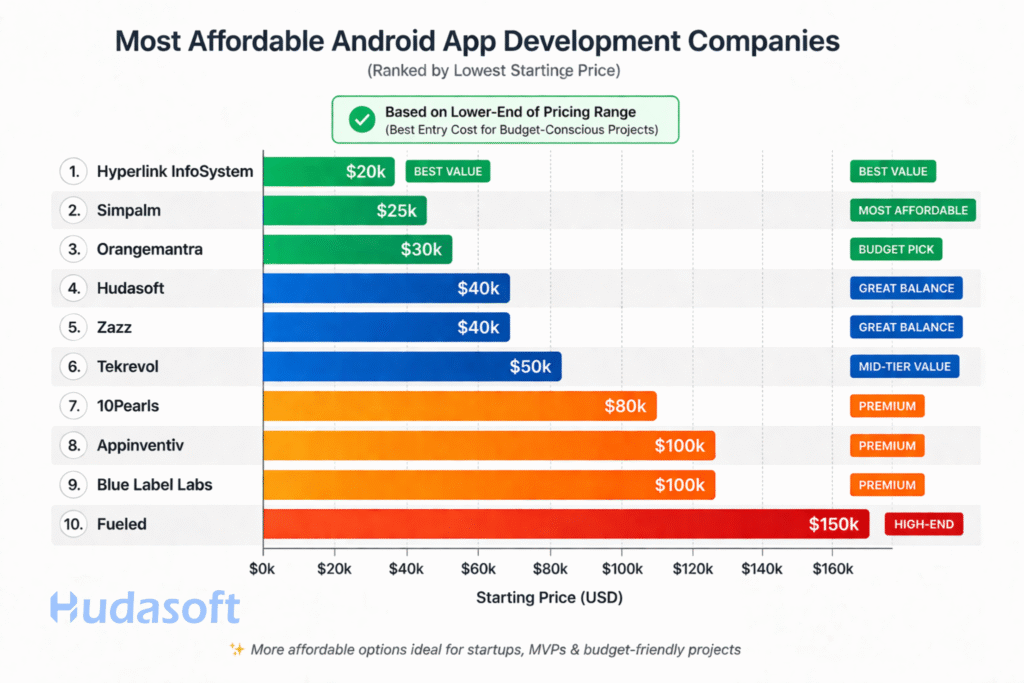
US-based Android App Development Companies with Accessible Pricing
The companies mentioned here are not the most affordable in the US, but the most affordable among the ones included in this list. So here you have the top US companies that handle Android development, ranked by affordability.
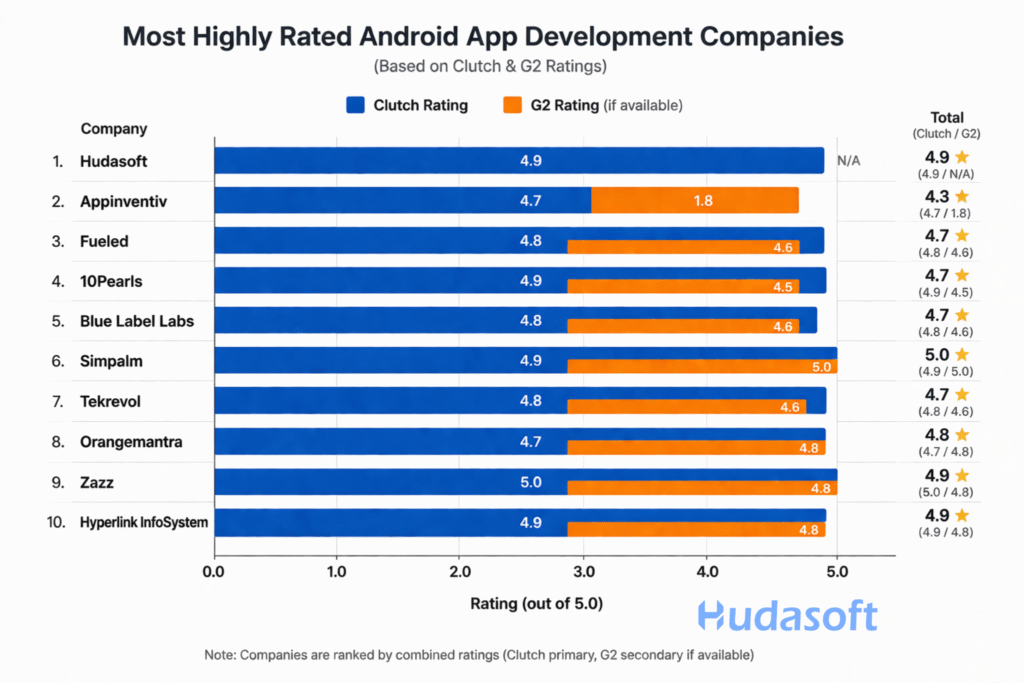
US Android App Development Companies Ranked based on Clutch and G2 Ratings
Here’s the graphical representation of the marketplace ratings (Clutch and G2) of US-based Android app development companies.
Which Company is the Best for Android App Development in the US?
For an agency to be called a top Android app development company, it requires expertise in Android frameworks (Kotlin, Ionic, Java), a clear understanding of user behavior, and proven experience building apps that are stable, scalable, and ready for real market conditions.
Hudasoft stands out across these areas. It combines solid technical execution with practical experience in delivering Android applications that perform reliably and align with business objectives.
In addition, you get competitive pricing and a dedicated engineering team that stays closely involved throughout the development process and continues to provide support after launch.
So if you’re looking for a straightforward answer, this is why Hudasoft ranks as one of the best Android app development companies in the U.S.
The List of Best Android App Development Companies in the US
When you’re searching for a digital agency to partner with, the list below brings together the top Android application development agencies in the U.S., based on multiple independent platforms.
However, not all of them will be the right fit. Each agency has its own area of expertise and a distinct positioning in the market. That’s why it’s important to understand what each one specializes in before deciding which partner aligns with your goals.
1. Hudasoft
- Team Size: 50 – 249 employees
- Located in: Missouri City, TX (Houston area)
- Pricing: $40,000 – $85,000
- Delivery Timeline (for MVP): 4 – 6 months
Hudasoft has 20+ actively deployed Android apps in the US.
They work across industries, with particular depth in building Android solutions that require custom architecture rather than template-based approaches.
Hudasoft‘s primary strength is in building scalable, custom Android solutions for businesses with specific technical or operational requirements.
Their pricing positions them in the mid-market tier, which makes them suitable for companies that need quality engineering without the overhead costs of a large enterprise agency.
Their 4 – 6 month MVP timeline is competitive for the scope of work in their price range.
2. Appinventiv
- Team Size: 1,000 – 4,999 employees
- Located In: New York, NY (Manhattan)
- Pricing: $100,000 – $200,000
- Delivery Timeline (for MVP): 6 – 9 months
Appinventiv is a large-scale digital product agency with offices across the U.S. and international delivery teams.
They serve high-growth startups and enterprise clients, with a portfolio spanning healthcare, fintech, logistics, and e-commerce.
The company has won consecutive Deloitte Tech Fast 50 awards in 2023 and 2024.
When it comes to the value businesses get by partnering with Appinventiv, here are their main strong points:
- The company brings large engineering capacity to complex Android projects.
- Their global delivery model gives organizations access to substantial team bandwidth without building an in-house function.
3. Fueled
- Team Size: 350+ employees
- Located In: New York, NY; Chicago, IL; Los Angeles, CA
- Pricing: $150,000 – $300,000
- Delivery Timeline (for MVP): 6 – 9 months
Fueled is a design-led product agency based in New York, with a client list spanning consumer brands in media, lifestyle, and consumer technology.
They are positioned at the premium end of the market, with project minimums that reflect their focus on high-production-value work.
Their strong points that earn fueled a position in this list is their UX. The quality of user experience that fueled offers is levels above the competition. Their development process is anchored in a structured product design phase, which typically produces more polished end results than an engineering-first agency.
The tradeoff is cost: at $150k–$300k for an MVP, this is among the most expensive options on this list.
Businesses at this budget level should have a clear monetization or enterprise deployment strategy to justify the investment.
4. 10Pearls
- Team Size: 1,500+ employees
- Located In: Vienna, VA (HQ); New York, NY; Chicago, IL
- Pricing: $80,000 – $180,000
- Delivery Timeline (for MVP): 4 – 8 months
10Pearls is a digital transformation company with experience in large enterprises and regulated industries.
They operate U.S.-based project management alongside offshore delivery centers, which keeps costs below pure U.S.-development rates while maintaining oversight close to the client.
Their work covers complex integrations, security-sensitive systems, and compliance-heavy environments.
When it comes to the value businesses get from Android apps developed by 10Pearls, the company is best suited for organizations that need enterprise-grade Android development.
They place strong emphasis on security architecture, regulatory compliance (HIPAA, SOC 2, PCI-DSS), and integration with legacy backend systems.
If your project requires connecting an Android front end to an ERP, EHR, or other regulated data infrastructure, their technical depth in this area helps reduce delivery risk.
5. Blue Label Labs
- Team Size: 100 – 200 employees
- Located In: New York, NY (Manhattan)
- Pricing: $100,000 – $250,000
- Delivery Timeline (for MVP): 4 – 7 months
Blue Label Labs is a full-service product development agency serving startups and mid-sized companies.
Their engagement model covers product strategy, UX/UI design, and engineering within a single team structure. This reduces the handoff problems that arise when strategy, design, and development are split across vendors.
The core value that businesses get with this agency is that their team handles the full product lifecycle from defining scope through post-launch iteration.
For companies without an internal product function, this is a practical advantage. Rather than coordinating between a strategy consultant, a design firm, and a development agency, you work with one team accountable for the complete outcome.
6. Simpalm
- Team Size: 10 – 50 employees
- Located In: North Bethesda, MD; Chicago, IL; New York, NY
- Pricing: $25,000 – $65,000
- Delivery Timeline (for MVP): 3 – 5 months
Simpalm is a mobile and web development agency based in the Washington, DC area. Their client base includes government contractors, nonprofits, and private businesses.
As per the available data, they hold the shortest estimated timeline on this list at 3 – 5 months for an MVP, and their pricing is the most accessible among US-headquartered agencies here.
That’s ideal for businesses with time and budget constraints. Talking of constraints, the businesses positioned best to benefit from partnering with Simpalm are those with clear-cut and narrow requirements.
Think of internal-use tools, proof-of-concept builds, or applications with a focused feature set, designed for particular roles. Simpalm will deliver those without delay, within budget, and without any performance issues.
7. Tekrevol
- Team Size: 250 – 999 employees
- Located In: Houston, TX (HQ); San Francisco, CA; New York, NY
- Pricing: $50,000 – $120,000
- Delivery Timeline (for MVP): 4 – 8 months
Tekrevol is a mobile app development company with U.S. offices and development teams in Pakistan.
They focus on consumer-facing apps and offer mobile development alongside branding and digital marketing services. Their primary client segment is growth-stage startups.
For companies building consumer apps where visual presentation and brand identity need to be consistent across product and marketing channels, Tekrevol’s integrated approach keeps design language coherent from app UI through to campaign assets.
The offshore delivery component keeps its pricing below comparable U.S.-only agencies, though clients should confirm communication protocols and project management structure during the scoping process.
8. Orangemantra
- Team Size: 250 – 500 employees
- Located In: San Jose, CA (U.S. Operations)
- Pricing: $30,000 – $80,000
- Delivery Timeline (for MVP): 4 – 6 months
Orangemantra is a digital transformation company with a services portfolio covering mobility, web, and enterprise software.
Their experience is concentrated in established businesses, modernizing existing systems or extending them to mobile platforms.
Orangemantra’s strength is in integration work. If your Android app needs to connect to legacy ERP systems, existing databases, or complex backend infrastructure, they have relevant experience managing that technical complexity alongside mobile development.
For greenfield consumer apps with no backend integration requirements, other agencies on this list may be a better fit.
9. Zazz
- Team Size: 50 – 249 employees
- Located In: Dallas, TX; Nashville, TN
- Pricing: $40,000 – $150,000
- Delivery Timeline (for MVP): 3 – 6 months
Zazz is a mobile app development agency positioned toward technology-driven startups.
They work across iOS, Android, and cross-platform frameworks and are flexible on the tech stack based on project requirements. Their 5.0/5 Clutch rating is the highest on this list.
Zazz’s pricing range is wider than most agencies here ($40k – $150k), which reflects flexibility in project scope rather than inconsistency in pricing.
They are a practical choice for startups that want a technically current team, comfortable with modern Android development patterns, including Jetpack Compose, Kotlin Coroutines, and modern MVVM architecture.
10. Hyperlink InfoSystem
- Team Size: 1,200+ employees
- Located In: New York, NY; San Jose, CA
- Pricing: $20,000 – $80,000
- Delivery Timeline (for MVP): 3 – 6 months
Hyperlink InfoSystem is one of the larger independent app development companies, with U.S. offices and a substantial development workforce in India.
They handle high volumes of projects across a wide range of categories and platforms.
The agency’s combination of low pricing and large team capacity gives it a structural advantage for organizations that need to develop multiple apps simultaneously or require large development throughput at a managed cost.
The tradeoff is that high-volume agencies typically operate with more standardized processes. If your app has highly specific technical requirements or demands close collaboration on architecture decisions, confirm their project management structure and team assignment practices before signing.
When Is Native Android Development the Right Call?
It’s one thing to know which companies to partner with for building Android applications, and it’s useful. But what’s more important is to know whether Android is the right platform to target. Here are the scenarios where Android app development might be the right choice.
1. Android-First Organizations
If your business issues Android devices to employees (field teams, logistics crews, retail operations, construction workers), native development gives you a real operational advantage. You get tighter device integration, lower hardware costs at scale, and cleaner device management. The investment pays off when the platform is already central to how your team works.
2. Performance-Critical Applications
Apps with real-time processing requirements, heavy animations, or continuous hardware interactions (GPS tracking, sensor data, camera pipelines) benefit significantly from native development. There’s a ceiling to what abstraction layers can deliver, and for performance-sensitive products, native code is simply faster and more reliable.
3. Deep Device Integration
IoT-connected apps, wearables, and embedded Android systems need direct access to native APIs. Cross-platform frameworks have improved considerably, but they still operate within constraints that native development doesn’t face. If your app needs to talk directly to hardware, native is the right foundation.
4. Targeting Emerging Markets
Android commands dominant market share in cost-sensitive regions across South Asia, Southeast Asia, Africa, and Latin America. If your user base lives in these markets, native Android development gives you the broadest device compatibility and the smoothest experience across a wide range of hardware.
5. Long-Term Product Scalability
For complex products that will evolve significantly over time, native apps tend to be more maintainable. You stay aligned with Google’s ecosystem updates, Jetpack library improvements, and Kotlin language advancements without worrying about whether your framework of choice has kept up.
In other scenarios, where you are building for a professional workforce in the US, or a consumer-facing app for the North American market, iOS development might be the right option. In this case, it pays to know the top iOS app development companies in the US.
What Technologies are Android Apps Built On?
Modern native Android development centers on Kotlin as the primary language, with Java still present in legacy systems. Android Jetpack libraries handle UI, navigation, and lifecycle management. Firebase covers authentication, real-time databases, and analytics for most backend needs.
For testing, Android’s built-in emulators handle basic simulation, while Genymotion provides faster, more scalable environments. CI/CD pipelines, typically built on GitHub Actions, Bitrise, or GitLab CI, automate testing and deployment, which matters more than most early-stage teams realize.
Top IDEs agencies use for developing Android applications
Integrated development environments (IDEs) are developer interfaces that they use to code, build features, and eventually create applications. For Android, the top IDEs are:
Android Studio is the standard for pure native development. Built on IntelliJ IDEA, it includes advanced emulators, Jetpack Compose support, and a Gradle-based build system.
IntelliJ IDEA suits Kotlin-heavy projects and teams where backend and Android developers share a codebase.
VS Code is the practical choice for cross-platform frameworks like Flutter and React Native, largely because of its lightweight footprint and extensions ecosystem.
Visual Studio with Xamarin fits C#/.NET teams building across Android, iOS, and Windows from a shared codebase.
How to Vet the Android App Development Companies for Partnership?
A shortlist of agencies is only the starting point. The real work is in the evaluation. Most businesses settle on a partner too quickly, anchoring on Clutch ratings or pricing alone. The five factors below cut through the noise and surface what actually determines whether a partnership succeeds.
1. Evaluate Their Industry-Specific Portfolio
A general portfolio doesn’t tell you much. What matters is whether the agency has built apps in your specific domain. A fintech app demands familiarity with PCI-DSS compliance, secure data flows, and regulatory nuances that a logistics app doesn’t.
Ask the agency to walk you through a case study from a project that mirrors yours in terms of industry, complexity, and user base size. If they can’t produce one, that’s useful information. If they can, pay close attention to how they describe the problems they solved, not just the features they shipped. Execution detail in a case study is a strong proxy for depth of expertise.
2. Assess Technical Compliance and Security Practices
Security and compliance are non-negotiable for certain verticals, and optional for none. For healthcare apps, ask about HIPAA-compliant data handling, encryption at rest and in transit, and audit logging. For financial applications, probe their experience with OAuth 2.0 flows, tokenization, and fraud detection integration.
For any app collecting user data, ask how they handle GDPR or CCPA requirements. A capable agency will answer these questions fluently, without needing to look anything up. Beyond the technical aspects, verify whether the agency conducts code reviews, penetration testing, or third-party security audits as standard practice. Agencies that treat security as an afterthought tend to create problems that are expensive to fix post-launch.
3. Understand Their Team Structure and Communication Model
Who actually works on your project matters as much as who sells it to you. Ask directly: will the team presented in the proposal be the team building the product? Some agencies use senior engineers for the sales process and hand off to junior staff once the contract is signed.
Find out whether your dedicated point of contact is a project manager or a technical lead, since there’s a significant difference in what each can offer. For agencies with offshore delivery models, ask how time zone overlap is managed, what the escalation path looks like when blockers arise, and how sprint reviews are conducted. The quality of communication infrastructure is a reliable signal of project management maturity.
4. Scrutinize Post-Launch Support and Maintenance Terms
The project doesn’t end at launch, and neither should the agency relationship. Android OS updates, Google Play policy changes, and new device form factors (foldables, large-screen tablets) mean your app will need ongoing attention.
Before signing anything, clarify what the post-launch support window looks like: how long does the agency cover bug fixes at no additional cost? What is the SLA for critical issues? Is there a retainer model available for continued development? A reputable agency will have clear, documented answers to these questions. Vague or verbal-only commitments on post-launch support are a red flag worth taking seriously before the contract is finalized.
5. Cross-Verify Ratings Across Multiple Platforms
Single-platform ratings are easy to game. Clutch reviews, for instance, can be solicited at project completion when client satisfaction is highest, which inflates scores relative to overall service quality.
A more reliable picture emerges when you triangulate across platforms: Clutch, G2, GoodFirms, and even LinkedIn recommendations from client-side employees (not just the agency’s account managers). Pay attention to the content of reviews, not just the star count. Negative reviews that describe communication breakdowns or scope creep are patterns worth investigating further. You can also ask the agency directly for two or three client references you can contact by phone.
Any agency confident in its work will accommodate that request without hesitation.
Which Agency Fits Your Budget, Timeline, and Project Type?
The agencies in this list span a wide range of budgets, team sizes, and specializations. Rather than treating them as interchangeable options, use the three filters below to narrow the field based on your actual situation.
Filter by Budget Range
If your budget sits below $65,000, Simpalm and Hyperlink InfoSystem are the practical options. Both deliver functional Android products at accessible price points without sacrificing professional project management.
Between $65,000 and $120,000, Hudasoft, Tekrevol, and Orangemantra offer a strong middle tier with good depth in custom and integration-heavy work. For projects budgeted above $120,000, Fueled, Blue Label Labs, Appinventiv, and 10Pearls are better equipped to handle the complexity, scale, and design expectations that come with larger investments. Zazz spans a wide range and can flex upward or downward depending on the scope.
Filter by Project Type
For consumer apps where the user experience is the product, Fueled and Blue Label Labs are the strongest candidates given their design-led approach. For enterprise and regulated-industry projects involving complex integrations or strict compliance requirements, 10Pearls and Appinventiv have the technical infrastructure to manage that complexity. If you’re building something custom from the ground up with specific architectural requirements, Hudasoft’s focused approach to bespoke development makes it a natural fit. Startups that need to move quickly and prefer a technically agile team should look at Zazz or Tekrevol. If you need deep backend and legacy system integration, Orangemantra has particular experience in that area.
Filter by Timeline Urgency
If you need an MVP within three to five months, Simpalm, Zazz, and Hyperlink InfoSystem have the fastest delivery timelines on this list. Agencies like Appinventiv and Fueled tend toward longer engagements, which reflects the scale and rigor of their process rather than inefficiency. For mid-range timelines of four to seven months, Hudasoft, Blue Label Labs, 10Pearls, and Tekrevol all sit comfortably in that window. It’s worth noting that accelerated timelines typically require either a tighter scope or additional resources, so build that conversation into your initial briefing rather than discovering it after contracts are signed.
Closing Thoughts
The list above mentions ten of the best Android app development companies that you can find in the US region.
The list is broad and diverse, with agencies having different specialties. So before finalizing one, match the agency’s expertise with your app’s specifications.
Have clear answers to who your target users are, what your budget ceiling is, and how much internal product management capacity you have.
For organizations building their first Android app without an internal technical team, agencies like Hudasoft, Blue Label Labs or Fueled that cover the full product lifecycle from strategy through engineering reduce coordination overhead. For businesses with well-defined requirements and budget constraints, Simpalm or Hyperlink InfoSystem offer solid delivery at lower price points. For enterprise projects with compliance requirements or complex backend integration, 10Pearls and Orangemantra have more relevant experience in that domain.
Lastly, before committing to a contract, verify each shortlisted agency’s work directly, speak with their past clients, and evaluate their proposed technical approach.
Why is the “Discovery Phase” a critical differentiator among top-tier Android app development companies?
The Discovery Phase is not merely a preliminary chat; it is a strategic deep-dive where the development partner aligns your business objectives with technical feasibility. Top firms use this stage to conduct market research, define user personas, and create a technical roadmap. By investing in discovery, you mitigate risks early, prevent “scope creep” during development, and ensure that the final product addresses a specific market gap rather than just being a functional app.
Among agencies that place emphasis on thorough discovery, Hudasoft particularly stands out. The initial discovery session involves all the right questions that give the team awareness of the context, a deep understanding of the app’s idea, and enable them to visualize the development roadmap in detail.
How do these companies ensure app performance across the fragmented Android device ecosystem?
Android development is uniquely challenging due to “fragmentation”. The vast variety of screen sizes, hardware specifications, and OS versions makes Android a particularly challenging platform. Leading US firms tackle this through rigorous testing protocols. They utilize automated testing suites and physical device labs (rather than just emulators) to ensure the UI is responsive and the performance is optimized for both high-end flagship phones and budget-friendly devices. This ensures a consistent user experience regardless of the hardware.
What role does UI/UX design play in distinguishing a “premium” app from a standard one?
A premium Android app adheres to Google’s Material Design guidelines while injecting a unique brand identity. Probing deeper, the best firms focus on “Micro-interactions” and accessibility. They don’t just make an app look good; they focus on intuitive navigation and minimizing cognitive load for the user. A well-designed app increases retention rates by making the interface feel familiar yet modern, ensuring users can achieve their goals with the fewest possible taps.
Beyond the initial launch, what should a comprehensive maintenance and support plan include?
A common misconception is that the project ends at the Play Store launch. In reality, OS updates (like new Android versions) and security patches require ongoing attention. Articulate firms provide post-launch support that includes:
Bug Monitoring: Real-time tracking of crashes.
Performance Optimization: Updating the code to keep the app fast as data grows.
Iterative Updates: Adding new features based on actual user feedback and analytics collected after the launch.
This lifecycle approach ensures the app remains competitive and secure in a rapidly evolving digital market.
Hudasoft is one of the agencies that ensures top-tier post-launch support that includes performance optimization, updates, and even technical support with onboarding and maintenance.
