


Conversational AI interprets human language and manages dialogue across chat or voice. Agentic AI plans steps, selects tools, and executes actions toward a defined outcome. A single system can include both capabilities, and the agentic AI vs conversational AI distinction depends on workflow responsibility, required system access, and action risk.
Conversational capability covers accurate answers, data collection, and routing. Agentic capability applies when the system selects and completes approved steps across business applications.
Agentic AI vs Conversational AI in One Workflow
An airline customer requests a flight change following a delay. Four system configurations assign different responsibilities to the same request.
| Configuration | What the system does |
| Scripted chatbot | Presents fixed menu options, policy pages, or support links. |
| Conversational AI | Understands the request, asks relevant questions, and explains available choices. |
| Agentic AI | Checks eligibility, searches flights, changes the booking, and updates the reservation record. |
| Agentic conversational AI | Discusses preferences, completes the change, confirms the result, and escalates policy exceptions. |
The distinction concerns assigned responsibility because a conversational assistant interprets a complex request and explains available options. The workflow remains incomplete until a person or connected automation changes the reservation.
An agentic system receives a goal and determines the steps required for completion. Its permissions cover reservation data, booking tools, fare rules, and approved changes to the system of record.
What Is Conversational AI?
Conversational AI uses natural language processing to interpret text or speech. Natural language understanding identifies intent, relevant details, and request context, and dialogue management selects the next question, answer, or prompt.
These systems support chat, messaging, mobile applications, and voice channels. Their functions include information retrieval, process guidance, data collection, and request routing.
Modern conversational systems also call limited tools such as a calendar check or a predefined appointment request. A single predefined tool call provides execution access without adaptive multi-step planning or outcome ownership.
What Is Agentic AI?
Agentic AI interprets a goal and selects the steps required to advance it. The system gathers data, compares options, calls tools, updates records, verifies results, and changes its plan when a step fails.
This process requires workflow state that records completed actions, tool results, open steps, and required human reviews.
Organizations assign autonomous AI agents defined tasks and authority levels. A manager approves the final transaction when policy requires approval. The agent manages the remaining steps within its assigned authority.
How Conversational and Agentic AI Relate
Interaction capability and outcome ownership define the conversational AI vs agentic AI comparison. Conversational AI manages how people communicate with software, and agentic AI manages how software progresses work toward a goal. The capabilities operate separately or within the same system.
An agentic system operates with or without a chat or voice interface. An application event such as a new invoice, support ticket, or account update starts a back-office agent that completes its workflow through connected systems.
A knowledge assistant represents conversational AI with limited agency because it answers policy questions and directs employees to the required form. Employees or downstream systems retain responsibility for the resulting business process.
An agentic conversational system combines both responsibilities through clear dialogue, missing-detail collection, permitted actions, progress reports, and requests for help at defined boundaries.
The terms chatbot, AI agent, and agentic AI describe separate concepts. A chatbot describes an interface, and an AI agent describes a software component that acts toward a task. Agentic AI describes a system that coordinates planning, tool use, state, and controlled execution toward an outcome.
Agentic AI vs Conversational AI: Key Differences That Affect Deployment
The differences between agentic AI and conversational AI define system architecture, workflow scope, permissions, testing requirements, operational risk, and team responsibilities.
| Dimension | Agentic AI | Conversational AI |
| Primary responsibility | Achieves a defined outcome | Manages dialogue and user intent |
| Initiation | Responds to events or pursues assigned goals | Responds to user input |
| Task scope | Coordinates multi-step workflows | Handles single interactions or controlled flows |
| Decision authority | Selects actions within defined operating boundaries | Follows dialogue rules and narrow tool permissions |
| System access | Uses APIs, databases, CRMs, ERPs, and workflow tools | Uses knowledge sources and limited integrations |
| Context | Maintains conversation, task, system, and workflow state | Maintains conversation context |
| Output | Completes an action, updates a system, or verifies a result | Provides an answer, guidance, routing, or collected information |
| Human involvement | Requests approval or escalation based on risk | Transfers complex requests |
| Failure impact | Produces an incorrect response or executes an incorrect action | Produces an incorrect or unhelpful response |
| Evaluation | Measures task success, action accuracy, policy compliance, and recovery | Measures intent accuracy and conversation quality |
Goal ownership and autonomy
Agentic AI receives a defined goal and selects the next step within its assigned authority. A refund agent, for example, resolves requests below a policy threshold and routes exceptions to a specialist.
Conversational AI responds to a person-directed exchange. The user asks a question, provides information, or selects an option, and the system selects an appropriate response within the conversation.
Tool access and system state
An agentic workflow requires authenticated access to every system it uses to create, change, or approve records. Function calls and APIs connect each action to a verified user identity, business role, and task state.
A conversational assistant typically reads a knowledge base or retrieves a defined set of account details. Its tool access remains limited to the information and actions required for the conversation.
Context across multiple steps
Agentic AI maintains durable task state when a workflow spans multiple tools or continues beyond one session. This state records attempted actions, tool results, changed data, incomplete steps, approvals, and exceptions.
Conversational AI maintains conversation history, including what the user and assistant said during an exchange. It does not require broader workflow state when downstream systems or employees retain responsibility for execution.
Risk and human approval
An incorrect agentic decision can change records, issue transactions, or trigger downstream processes. Defined policies permit automatic execution for low-risk, reversible actions and assign human approval to sensitive, expensive, regulated, or irreversible actions.
An incorrect conversational response can create confusion or provide inaccurate guidance. Human involvement usually begins when the request exceeds the system’s dialogue rules, information access, or permitted actions.
What Are Agentic Voice AI Agents?
Agentic voice AI agents understand spoken requests, maintain conversation context, decide which actions a request requires, and use connected systems to complete approved tasks during or after a call.
A voice workflow contains six stages:
- Speech recognition converts the caller’s words into text.
- The conversational layer identifies intent, captures relevant details, and maintains the dialogue.
- The agentic layer plans the required steps within its assigned authority.
- Connected tools retrieve information or update approved business records.
- Text-to-speech communicates the result and asks for any required confirmation.
- The system transfers the call when a policy requires approval or human judgment.
Traditional IVR systems route callers through fixed menus, and scripted voice bots support predefined exchanges. Voice-enabled conversational AI understands natural speech and manages flexible dialogue. An agentic voice system adds planning and controlled action across connected tools. Human agent-assist software supports an employee who retains ownership of the customer workflow.
Voice adds operational requirements for latency, interruptions, sensitive-detail confirmation, identity verification, and tool-failure recovery. Recording consent, escalation rules, vocal-signal handling, and verified transfer context require explicit configuration.
Workflow Requirements by AI Model
Required work determines the model because information requests require accurate dialogue, and connected operational processes require controlled authority when the system owns execution.
| Workflow | Conversational AI requirement | Agentic AI requirement |
| Customer support | Users need answers, routing, or guidance | The system resolves the issue across business tools |
| Sales | The system qualifies and routes leads | It researches accounts, updates CRM records, and schedules follow-ups |
| Employee support | Staff need policy or knowledge answers | The system completes access, procurement, or IT workflows |
| Onboarding | Users receive instructions and submit information | The system validates documents and coordinates several departments |
| Scheduling | The assistant presents available times | It manages conflicts, dependencies, updates, and follow-ups |
| Financial operations | Users request account information | The system performs controlled transactions or reviews exceptions |
Customer support shows the difference clearly because a conversational assistant can explain a return policy and collect an order number. An agentic system can check eligibility, create the return, generate a label, update inventory, and notify the customer.
Agentic capability adds integration work, access risk, evaluation requirements, failure paths, and monitoring duties. Predictable information requests require no autonomous planning when retrieval and dialogue complete the assigned work.
Operational effects and implementation requirements
Conversational AI increases availability, consistency, and service capacity across repeatable interactions. It reduces employee effort for routine questions and basic data collection. Employees or fixed automation retain execution work when the conversational layer lacks action authority.
Agentic AI reduces handoffs and manual coordination in defined cross-system workflows. A combined architecture preserves one interaction across request intake, execution, and confirmation. These effects depend on integration quality and action controls. Broader authority affects the AI agent development cost by expanding testing, monitoring, incident response, and maintenance requirements. Workflow outcomes and risk thresholds set the permitted autonomy level.
How Agentic AI and Conversational AI Work Together
A combined architecture contains a conversational interface and an execution layer. The conversational component gathers the request, resolves ambiguity, and explains progress. AI orchestration coordinates planning, approved tool calls, state tracking, and completion verification.
Enterprise integrations give the agent access to current business data and permitted actions. Policy controls assign each step to automatic execution, human approval, or transfer. The conversational layer communicates the resulting status in clear language.
A combined system follows this sequence:
- A user explains a request through chat or voice.
- The conversational layer identifies the goal and collects missing details.
- The agentic layer creates a plan and checks relevant policies.
- The system calls approved APIs and records each result.
- A person approves any action that crosses a defined threshold.
- The conversational layer confirms completion or explains the next step.
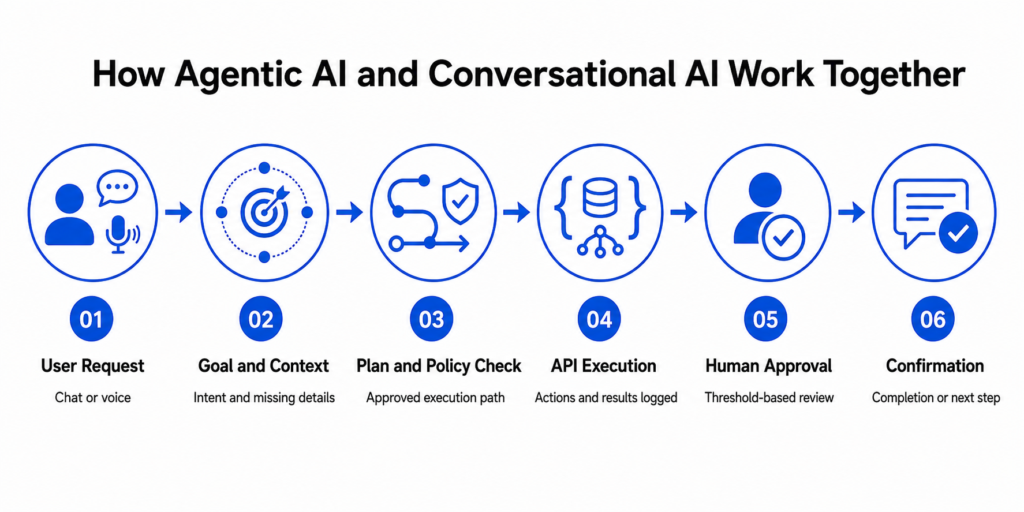
This model separates interaction quality from execution authority, so dialogue changes retain existing agent permissions. Controlled actions receive explicit access to each required system.
Complex workflows use specialized agents when responsibilities require separate tools or controls. One agent verifies identity, another applies business rules, and another updates the system of record. A shared orchestration layer coordinates their sequence, permissions, state, and exceptions. Centralized controls and a complete task history preserve ownership across the multi-agent workflow.
Selection Criteria for Each Architecture
Workflow responsibility defines the architecture, and product labels provide no substitute for required information delivery, action completion, and combined responsibility.
Conversational AI criteria
- The primary goal involves answering, collecting, or guiding.
- Requests follow predictable patterns.
- A person or fixed automation completes the final action.
- A small number of read-only integrations can satisfy the request.
- The business needs a controlled dialogue more than adaptive execution.
Agentic AI criteria
- The system completes a multi-step task.
- The work spans several business applications.
- Conditions can change during execution.
- The system selects actions based on policy and context.
- The business can define permissions, approvals, and completion criteria.
Combined architecture criteria
- Users need natural dialogue and a completed outcome.
- The workflow begins through chat or voice.
- Backend execution requires several tools.
- The user needs updates, clarification, or confirmation during the task.
- Exceptions require a clear transfer to a person.
Architecture evaluation records six decisions:
- The required output is an answer, a completed result, or both.
- The workflow identifies every system that the AI accesses.
- The action design records whether the business can reverse an incorrect action.
- The policy assigns human approval to defined actions.
- The completion criteria specify how the system verifies the result.
- The escalation policy defines each transfer of responsibility to a person.
These decisions define the architecture and expose its integration, governance, and operating requirements.
Production Requirements Beyond the AI Model
Model capability represents one part of a production system, and reliable operation also requires identity, data, permissions, tests, monitoring, and recovery controls.
Identity and permissions
Private-data access and record changes require verified user identity, and the system also requires a service identity for every connected application.
Role-based access limits each agent to the data and actions required by its workflow. Separate permissions govern read, create, update, approve, and delete operations.
Data and integrations
Each workflow requires authoritative data sources and clear ownership. Its configuration identifies the CRM, ERP, database, knowledge source, or application that holds the current record.
Integrations return structured success and failure states. The agent cannot verify an outcome when an API provides an ambiguous response or a disconnected system contains outdated data.
AI agent framework evaluation covers authentication, tool controls, state management, observability, deployment support, and long-term maintenance. Operating safeguards require configuration beyond the development framework.
Action boundaries
Action boundaries define permitted operations, prohibited operations, and approval points. These rules cover transaction values, account types, data classes, tool permissions, and legal or operational exceptions.
Uncertainty handling defines when the agent pauses a task, requests missing information, retries a failed tool, or transfers the case with its completed context.
Testing and evaluation
Conversational testing measures intent recognition, answer accuracy, relevance, and handoff quality. Agentic testing also measures task completion, tool-call accuracy, policy compliance, escalation accuracy, and recovery success.
Test coverage includes normal requests, incomplete data, conflicting instructions, unavailable tools, duplicate events, expired sessions, and unauthorized actions, with a defined expected result for each case.
Monitoring and auditability
Operations teams require records of the agent’s inputs, selected tools, action results, approvals, errors, and final status. These records support incident review, compliance checks, performance analysis, and user support.
Monitoring detects repeated failures, unusual tool activity, policy violations, rising escalation rates, and incomplete workflows. Version records connect each production result to the relevant prompt, model, tool configuration, and policy set.
Team readiness and operating ownership
Production deployment assigns named owners to the workflow, integrations, access policies, evaluations, and incident response. Employees who approve actions or receive escalations require training on system authority, evidence, and failure paths.
A limited pilot records when the system acts, pauses, retries, or transfers responsibility. Operating processes cover exception review, policy updates, and evidence requirements for wider workflow scope or greater autonomy.
Hudasoft’s Agentic AI Implementation Method
At Hudasoft, we define the workflow, agent authority, integrations, controls, and evaluation criteria. Completed evaluation evidence governs autonomy expansion. Our agentic AI development services connect each technical decision to a specific business outcome, operating boundary, and review responsibility.
Workflow and outcome definition
The team identifies the required business result, involved systems, decision points, exceptions, and completion evidence. This scope assigns each task to the agent, employees, or fixed software rules.
Agent authority boundaries
The implementation defines permitted actions, restricted operations, approval thresholds, escalation conditions, and access levels. Each tool receives the minimum permissions that the approved workflow needs.
Enterprise system integration
The agent connects with approved CRMs, ERPs, databases, APIs, knowledge sources, and internal applications. Each connection includes authentication, structured error handling, and a defined system of record.
Controlled testing and evaluation
Testing covers tool selection, action accuracy, policy compliance, failure recovery, escalation behavior, and task completion. The evaluation criteria reflect the workflow’s operational and technical risks.
Phased production deployment
The initial release limits the agent to a defined workflow and authority level, and monitoring records task accuracy, control compliance, and exception-transfer context. Verified results provide evidence for changes to scope or autonomy.
Final Considerations for Agentic AI vs Conversational AI
The central distinction in agentic AI vs conversational AI concerns the responsibility that the system accepts. Conversational AI owns the interaction, including intent recognition, dialogue, and guidance. Agentic AI owns task progression, tool use, and outcome verification within assigned limits.
Workflow requirements determine whether the system uses one capability or both. A combined system covers requests that require natural communication and cross-system action. Action risk, permissions, integrations, approval points, and human accountability define whether the system answers, acts, or coordinates both responsibilities.
Frequently Asked Questions
Is conversational AI a type of agentic AI?
Conversational AI and agentic AI describe different capability classes because conversational capability covers language understanding and dialogue management. An architecture qualifies as agentic when it supports goal-directed planning, controlled tool use, and outcome verification.
Can conversational AI perform business actions?
Conversational AI performs business actions through APIs or predefined workflows, and a narrow action represents tool integration. Agentic capability adds adaptive planning, workflow state, multi-step execution, and responsibility for confirming the result.
Can agentic AI work without a chatbot or voice interface?
Agentic AI works without a chatbot or voice interface, and an application event, schedule, queue, sensor, or database change starts the workflow. Back-office agents complete tasks through connected systems without direct conversation with an end user.
Is every AI voice agent agentic?
An AI voice agent qualifies as agentic when it plans steps, performs approved actions across connected tools, verifies results, and escalates defined exceptions. Systems limited to questions, data collection, or call routing remain conversational voice agents.
Can an existing chatbot gain agentic capabilities?
An existing chatbot gains agentic capabilities when its architecture adds planning, tool access, permissions, workflow state, evaluation, monitoring, and human approval controls. Tested workflow requirements and risk thresholds set its authority level.

