


Business data may work well inside a CRM, ERP, DMS, or reporting dashboard and still fail inside an AI application. Employees understand undocumented rules, recognize unusual records, and know which system contains the most reliable information. An AI system does not receive that knowledge automatically.
AI data preparation converts business information into controlled inputs for a defined prediction, answer, recommendation, or action. The work includes source selection, quality analysis, entity resolution, transformation, security, and evaluation.
The objective is not to clean every record across the company. The objective is to prepare the right evidence for one AI use case and prove that the system can use it under real operating conditions.
Key Takeaways
A successful preparation process connects the intended AI behavior with the business records, definitions, permissions, and evaluation evidence that support it.
- Define the AI task and decision point before selecting data.
- Confirm which information exists when the system must produce an output.
- Assign ownership to individual fields rather than assuming one system owns the complete record.
- Preserve the meaning of missing values, unusual events, and operational exceptions.
- Apply different preparation rules to predictive models, RAG applications, generative AI, agents, and computer vision.
- Use independent evaluation data that represents real users, workflows, and failure conditions.
- Stop or reduce the project scope when the available evidence cannot support the promised behavior.
- Monitor source data and preparation rules after deployment.
What Is AI Data Preparation?
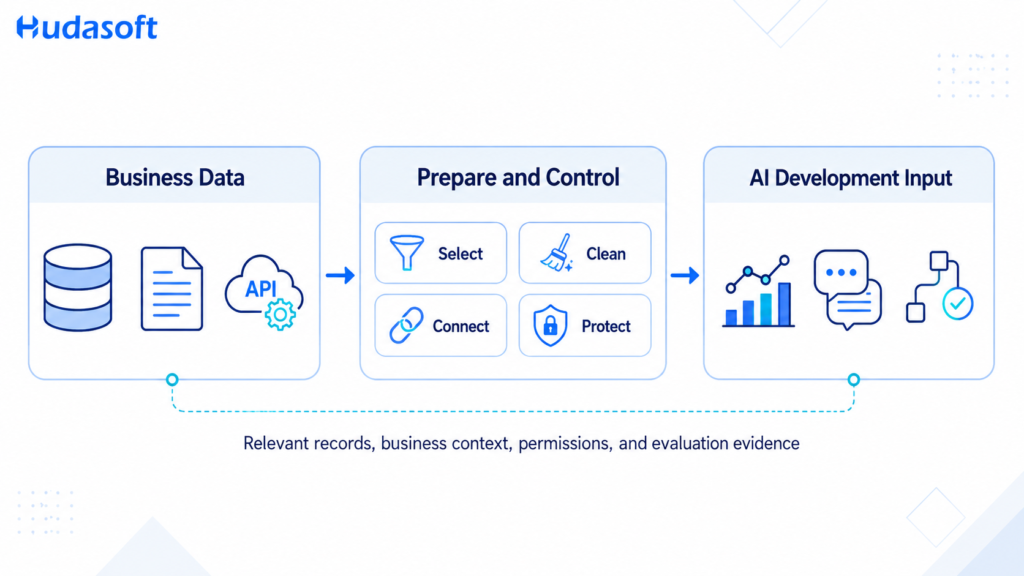
AI data preparation is the process of converting raw business information into a dataset, knowledge source, or data service that an AI system can use for a specific task.
The work starts with the business use case. It determines which records matter, what each record represents, when the information becomes available, which system owns each value, and who can access it. Technical work then corrects errors, reconciles entities, transforms inputs, applies controls, and creates evaluation data.
The output depends on the selected AI workload. A forecasting model may need historical customer snapshots. A RAG assistant may need approved document sections with source and permission metadata. An AI agent may need authenticated access to live systems, workflow state, and controlled actions.
AI Data Preparation vs Data Cleaning
Data cleaning fixes quality problems within records. It can correct invalid dates, normalize phone formats, remove confirmed duplicates, resolve category spelling, and identify missing values.
Data preparation covers a wider decision space. It determines whether the records belong in the project, whether they represent the correct business event, and whether the application can access the same information in production.
A clean customer table can still create unreliable AI output if it combines unrelated people or uses a customer status that employees update only after an outcome occurs.
AI Data Preparation vs Data Preprocessing
Data preprocessing converts selected information into a format that an algorithm can process. It may encode categories, scale numerical values, tokenize text, resize images, divide documents into retrieval units, or generate embeddings.
Data preparation establishes the business meaning and permitted use of the information. Preprocessing applies technical transformations after the team has defined those conditions.
Why Business Data Can Fail Inside an AI System
Operational software stores information to support transactions, communication, reporting, or workflow management. It rarely captures every rule that employees use to interpret the records.
AI projects fail when the development team transfers the data without transferring this context. Six gaps cause many of these problems.
| Context gap | What the system needs to know | Risk if the gap remains |
| Identity | Which records belong to the same customer, account, asset, or transaction | False matches, duplicate profiles, and incomplete histories |
| Time | When an event happened and which facts existed at the decision point | Historical leakage and incorrect event sequences |
| Authority | Which source owns each important value | Conflicting facts and inconsistent outputs |
| Availability | Whether the live application can access the information when required | Successful testing followed by production failure |
| Permission | Which user can view a record or perform an action | Unauthorized disclosure or system changes |
| Evidence | What proves that an answer, prediction, or action is correct | Evaluation results that do not reflect real quality |
Identity Changes Across Business Systems
One customer may have separate records in sales, service, billing, and support applications. Shared household contact details can also connect several people to one phone number or address.
The preparation process needs stable identifiers or a controlled matching method. It must preserve uncertain matches instead of forcing every record into a single profile.
Business Events Need Reliable Time Boundaries
An AI model must use information that existed at the moment of the target decision. Current database values do not always represent the earlier state.
For example, a CRM may show a lead as closed. That field cannot help a model predict whether the lead would close if the team updated it after the sale. The preparation process must reconstruct the information available at the original scoring time.
Source Authority Can Change by Attribute
One system may own contact consent while another owns payment status. A third application may contain the current appointment schedule.
The team should assign authority at field level. This prevents an older copied value from replacing the current source record.
Production Access Can Differ From Development Access
A manually exported dataset may support a successful prototype. The production application may need an API, event stream, or scheduled pipeline that the source system cannot provide.
Source feasibility must cover both historical extraction and live access. These requirements can influence the wider AI development cost because they affect integration, data engineering, security, and testing scope.
Define the Data Requirements for the AI Use Case
A data inventory does not explain how an AI system will use the information. Teams need a shared specification that connects the business task with its required evidence.
An AI data contract serves this purpose. It documents the use case, record definition, source ownership, timing, permissions, expected output, and acceptance criteria.
| Contract element | Required decision | Example for a service assistant |
| Business task | What will the system answer, predict, recommend, or complete? | Help a customer request a service appointment |
| Primary user | Who receives or approves the output? | Authenticated vehicle owner |
| Unit of analysis | What does one case represent? | One vehicle-service request |
| Decision point | When must the system respond? | During the scheduling conversation |
| Available evidence | Which information exists at that moment? | Vehicle, mileage, service history, symptoms, and availability |
| Excluded evidence | Which information appears later or creates leakage? | Completed repair outcome |
| Source authority | Which platform owns each required value? | DMS owns completed service history |
| Refresh requirement | How current must the information remain? | Appointment capacity requires current availability |
| Permission rule | Who may access or modify the record? | Customer can access only linked vehicles |
| Output structure | What must the system return? | Service category, proposed time, and confirmation status |
| Escalation rule | When must the system transfer the case? | Uncertain identity, safety concern, or unsupported repair advice |
| Acceptance criteria | What proves acceptable behavior? | Correct vehicle, valid slot, approved information, and one booking |
The contract keeps the use case narrow enough to test. It also exposes missing information before the team invests in model configuration or application development.
Define the Unit of Analysis
The unit of analysis specifies what one record or evaluation case represents. It may represent one customer, vehicle, transaction, repair order, document section, image, or workflow request.
An unclear unit can create duplicate counting and incorrect relationships. A dealership may have several customers connected to one vehicle, several vehicles connected to one household, and several repair orders connected to each vehicle.
The project must choose the entity that matches the intended output. A vehicle-maintenance prediction needs a vehicle-level record. A customer-retention model may need an account or household view. A service assistant needs the relationship between the authenticated customer, selected vehicle, and active request.
Define Success and Failure Conditions
A technical accuracy score does not describe every useful or harmful outcome.
The contract should identify:
- Correct output
- Acceptable partial output
- Missing-information response
- Human escalation
- Prohibited output
- Unauthorized action
- Duplicate action
- Untraceable answer
- Source-system failure
These conditions guide data selection and evaluation design. They also give business owners a clear basis for release approval.
How AI Data Preparation Works Through Four Release Gates
A preparation checklist can show completed activity without showing whether the data supports development. Release gates create explicit approval points. Each gate resolves a different type of uncertainty.
Release Gate 1 Maps the Use Case and Evidence Boundary
The first gate defines which information belongs inside the project. The team connects every proposed output with the evidence required to produce or evaluate it.
Map the Decision Point
Identify the exact moment when the system must answer, predict, recommend, or act. Then list the information available at that time.
A lead-scoring model may run when a lead enters the CRM. It cannot use follow-up events that occur during the next seven days. A service assistant may check appointment availability during the conversation. It cannot treat a proposed booking as confirmed work.
This distinction creates a historical cutoff for predictive systems and an evidence boundary for retrieval and agent applications.
Build a Field-Level Source Map
List each required field with its source, owner, history, access method, refresh schedule, and known limitations.
A high-level inventory that lists only “CRM” or “ERP” can hide important dependencies. A CRM may expose contact records through an API while storing call recordings and attachments in a separate platform. Those sources have different access and privacy requirements.
The source map should record:
- Required field or content
- Business definition
- Source system
- System owner
- Historical coverage
- Update frequency
- Production access method
- Retention policy
- Permission classification
- Known quality issue
- Alternative source
Test Source Feasibility
Review a representative sample rather than relying only on stakeholder assumptions.
The test should confirm that:
- The required records exist
- Historical coverage matches the use case
- Important fields contain usable values
- Stable identifiers or matching signals exist
- Production access can meet the required timing
- The organization can use the information for the proposed task
The first gate passes when the team can link every promised system behavior with accessible and permitted evidence.
Release Gate 2 Creates a Consistent Business Record
The second gate converts fragmented source information into a record that preserves business meaning. This work combines technical analysis with process knowledge.
Profile Data by Segment and Time
Data profiling measures record counts, missing values, duplicate candidates, invalid formats, value distributions, category frequency, relationship failures, and historical coverage.
Overall averages can hide concentrated problems. A company may have mileage data for most vehicles, while one location lost this field after a software migration. A model trained on the combined data could perform differently for that location.
Profile important fields by:
- Source
- Location
- Business unit
- Product or service category
- Customer group
- Historical period
- Workflow status
- Data-entry method
The analysis should explain where a problem occurs and which use-case requirement it affects.
Clean Confirmed Errors Without Erasing Valid Exceptions
Correction rules need a business reason.
A high repair amount may represent valid commercial vehicle work. A zero-value repair order may represent warranty coverage. An old customer address may remain necessary for a historical transaction.
The cleaning process should:
- Correct confirmed format errors
- Remove verified duplicates
- Preserve original values where auditability matters
- Separate invalid values from valid exceptions
- Record each transformation
- Send uncertain cases to the appropriate owner
Broad deletion rules can remove rare events that the AI system must handle in production.
Resolve Entity Conflicts
Entity resolution connects records that represent the same customer, organization, vehicle, product, or transaction.
Stable internal IDs provide the strongest match. When those IDs do not exist across systems, the team may combine several signals:
- Account number
- Phone
- Address
- Vehicle identification number
- Product code
- Transaction reference
- Event timing
The matching process should produce confirmed, probable, uncertain, and rejected matches. A person should review uncertain matches that affect customer communication, financial information, account access, or system actions.
Assign Attribute-Level Source Ownership
A canonical business record does not require one database to own every value. It requires a documented rule for selecting the appropriate source.
For example:
- CRM owns communication preferences
- ERP owns invoice status
- DMS owns vehicle transactions and completed repair orders
- Scheduling platform owns current appointment capacity
- Approved policy repository owns operating rules
When two sources conflict, the pipeline should apply the ownership rule or flag the record for review.
Standardize Business Definitions
Departments often use the same term for different conditions.
Sales may define an active customer through recent communication. Finance may use an open account. Service may use a recent repair order. The project needs one definition tied to the selected use case.
Document each important term with:
- Plain-language meaning
- Calculation logic
- Source
- Valid values
- Effective date
- Exceptions
- Responsible owner
This glossary prevents developers, business reviewers, and the production system from interpreting the same field differently.
Preserve Lineage
Lineage records how each important value reached the prepared dataset.
The record should identify:
- Original source
- Extraction time
- Matching rule
- Cleaning rule
- Transformation
- Business definition
- Current dataset version
The second gate passes when the team can explain what each record represents, where its values came from, and which uncertainties remain.
Release Gate 3 Adapts the Information to the AI Workload
The third gate converts the consistent business record into the format that the selected AI capability requires.
Structured records may need historical snapshots, categorical encoding, time windows, or calculated features. Documents may need extraction, hierarchy detection, metadata, and retrieval units. AI agents may need live APIs, current workflow state, and action controls.
The team should keep original source values available and document every workload-specific transformation. This makes errors easier to trace and prevents the model-ready format from replacing the business record.
This stage also aligns preparation with AI integration services when the production application must retrieve current information or write controlled updates to existing systems.
Release Gate 4 Validates the Data and Approves Development
The fourth gate determines whether the prepared information can support meaningful development and evaluation.
Separate Development and Evaluation Data
Create independent records for development, validation, and final evaluation. The split method should match the business process.
Use:
- Chronological splits for forecasting
- Entity-level splits when related customer or asset records must stay together
- Location holdouts when the system must generalize across sites
- Independent question sets for RAG evaluation
- Reserved workflow scenarios for AI agents
- Difficult capture conditions for computer vision
Apply learned transformations only to the development partition. Scikit-learn explains that pipelines can prevent test information from influencing fitted preprocessing steps.
Build Evaluation Cases Around User Situations
Row count alone does not measure evaluation coverage. The evaluation set must represent the situations that users and operations teams will encounter.
Include:
- Common requests
- Rare valid events
- Conflicting sources
- Missing identifiers
- Stale information
- Restricted records
- Unsupported requests
- Source-system failures
- Uncertain matches
- Human escalation cases
Each case should define the expected output, acceptable alternative, prohibited behavior, required evidence, and escalation condition.
Define Release Rejection Conditions
The project should pause or reduce scope when:
- The required outcome has no reliable record
- Historical information cannot represent the decision point
- Critical entities cannot reach acceptable match confidence
- Production systems cannot provide the required inputs
- Source permissions conflict with the intended output
- Documents lack authoritative owners or effective dates
- Evaluation cases cannot determine a correct result
- Important user or operating conditions lack enough coverage
- The business has not assigned an owner for uncertain outcomes
The corrective action may require new data collection, improved integrations, narrower automation, or a different AI approach.
Approve Known Limitations
Some limitations do not block development. The team must document their operational effect.
For each accepted limitation, record:
- Affected user or scenario
- Expected failure
- Safe system response
- Human review requirement
- Monitoring method
- Responsible owner
- Review date
The fourth gate passes when business, data, security, and development owners approve the evidence, evaluation coverage, and operating limits.
How Preparation Changes by AI Workload
Each AI workload uses business information in a different way. One universal transformation pipeline cannot serve every model, assistant, and agent.
| AI workload | Primary input | Main preparation requirement | Major risk |
| Predictive machine learning | Historical structured records | Decision-time snapshots and reliable target outcomes | Leakage and unstable features |
| RAG application | Approved business documents and records | Retrieval structure, authority, metadata, and permissions | Stale or irrelevant evidence |
| Generative AI application | Representative prompts, sources, and expected outputs | Output criteria and safety cases | Unsupported or unsafe responses |
| AI agent | Live state, business rules, APIs, and permissions | Controlled system access and action validation | Incorrect or duplicate actions |
| Computer vision | Images or video with capture context | Consistent annotations and real operating conditions | Poor performance outside clean samples |
Predictive Machine Learning
A predictive dataset should represent what the business knew each time it could have made the target decision.
A churn project may need one customer snapshot per scoring date. Each snapshot could include activity during a defined observation period and an outcome during a later forecast period. Current customer status must not overwrite the historical state.
Preparation should define:
- Prediction unit
- Observation window
- Forecast horizon
- Target event
- Feature availability time
- Historical exclusions
- Evaluation split
Feature calculations must remain consistent during development and production. A model trained with one definition of customer activity will not behave consistently if the live pipeline applies another.
These controls support predictive analytics systems that connect model output with a defined planning or operational decision.
RAG and Knowledge Assistants
A retrieval-augmented generation application searches approved information and supplies relevant evidence to a language model. AWS identifies APIs, databases, and document repositories as common external sources for RAG systems.
The preparation process should record:
- Document owner
- Source authority
- Publication date
- Effective date
- Expiration date
- Applicable location or product
- Heading hierarchy
- Related sections
- Tables and attachments
- Superseded versions
- Permission category
- Citation metadata
Retrieval units should preserve meaning. A warranty rule must remain connected to its applicable model, period, exclusions, and approval conditions. A generic character limit may separate the main rule from the exception that changes its meaning.
RAG evaluation should test retrieval and generation separately. A wrong answer may result from missing source content, weak retrieval, or response generation. Separate measures help the team locate the failure.
Generative AI Applications
A generative application may summarize records, draft content, extract fields, classify requests, or create structured responses.
Preparation should include representative inputs and clear output requirements. The evaluation data should cover:
- Typical requests
- Ambiguous instructions
- Missing information
- Conflicting source content
- Restricted topics
- Required response formats
- Factual support
- Human review cases
- Refusal conditions
The definition of a correct output depends on the task. A data-extraction system needs field-level accuracy. A summary tool needs factual coverage and source consistency. A drafting assistant needs content, brand, legal, and review requirements.
AI Agents
An AI agent uses information to select or complete actions. The data requirements therefore extend beyond documents and historical records.
An agent may need:
- Current workflow state
- Tool input and output schemas
- Entity identifiers
- User identity
- Service-account permissions
- Permitted actions
- Approval thresholds
- Retry rules
- Failure responses
- Audit events
- Escalation paths
A scheduling agent must confirm the customer, requested service, available slot, and final approval before it writes a booking. It should check the result of a failed or timed-out request before trying again.
Each connected system and permitted action adds evaluation cases. These factors also contribute to AI agent development cost because the project must implement and test identity, permissions, error handling, and system responses.
Computer Vision
Computer vision systems need images or video that represent the conditions of the production environment.
Record relevant capture details such as:
- Camera or sensor
- Resolution
- Angle
- Distance
- Lighting
- Location
- Weather
- Object condition
- Obstruction
- Annotation confidence
A vehicle-damage system trained only on clear, well-lit images may fail when users submit photos with glare, shadows, cropped panels, or partial damage.
Evaluation should group performance by capture condition and object type. One overall score can hide poor results within an important operating environment.
Structured and Unstructured Business Data Require Different Treatment
Business AI projects often combine structured, semi-structured, and unstructured information. Each format carries different preparation requirements.
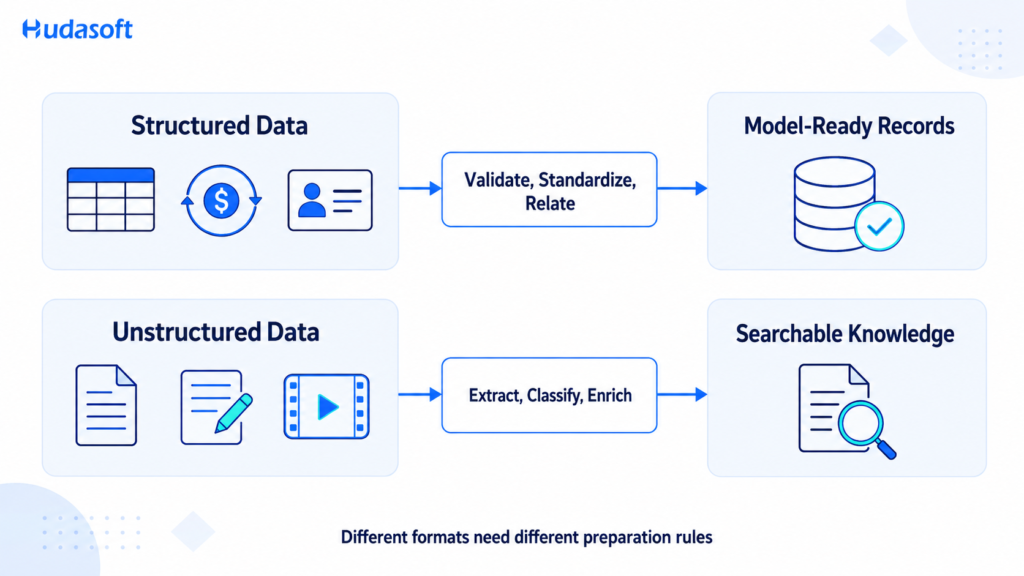
Structured Data
Structured data uses defined fields and relationships. Examples include transactions, inventory, appointments, repair orders, account balances, and customer records.
Preparation focuses on:
- Data types
- Missing values
- Unique identifiers
- Entity relationships
- Historical state
- Category definitions
- Numerical units
- Time intervals
- Source ownership
A valid database schema does not guarantee correct business meaning. The preparation process still needs to validate how employees create and update each field.
Semi-Structured Data
Semi-structured data contains recognizable fields without a fixed table design. JSON responses, system logs, emails, web events, and form submissions fit this category.
Preparation may need to:
- Parse nested fields
- Normalize event names
- preserve event order
- interpret status codes
- separate content from technical metadata
- identify repeated or failed events
- handle schema versions
Logs can provide valuable workflow evidence. They can also record retries, technical noise, and incomplete events that require interpretation.
Unstructured Data
Unstructured data includes documents, notes, transcripts, images, audio, and video.
Preparation can involve:
- Text or speech extraction
- Language detection
- Section identification
- Document classification
- Metadata enrichment
- Duplicate detection
- Sensitive-content review
- Version control
- Retrieval segmentation
- Annotation
The application may need relationships across all three formats. An AI service assistant could read a structured customer record, retrieve an unstructured warranty document, interpret a technician note, and submit a structured appointment request.
Hudasoft’s Approach to Preparing Dealership Data for an AI Service Assistant
A dealership service assistant needs more than access to customer data. It needs clear source ownership, reliable entity relationships, approved service information, current availability, and controlled booking actions.
Hudasoft would start by defining what the assistant can answer and which actions it can complete. The source map may include customer and vehicle records from the DMS, communication preferences from the CRM, current capacity from the scheduling platform, completed repair orders, warranty terms, maintenance schedules, manufacturer manuals, and technician notes.
The DMS may own vehicle transactions and completed service history, while the CRM manages leads and communication. This distinction matters because a DMS and CRM can contain overlapping customer details without supporting the same operational purpose. The preparation process would connect customers, vehicles, repair orders, and appointments through stable identifiers. It would send uncertain matches to a service advisor.
Service records also require status context. Customer complaints, technician observations, recommended work, approved repairs, completed services, declined work, and warranty-covered work represent different events. Combining these states could cause the assistant to describe recommended maintenance as completed service.
Manufacturer documents would retain the applicable model year, powertrain, market, document version, section, and exceptions. Evaluation cases would cover duplicate profiles, several vehicles within one household, incomplete service history, warranty restrictions, unavailable appointment times, scheduling failures, and safety-related questions.
The assistant would transfer identity, authorization, safety, or technical-advice cases when the prepared evidence could not support a reliable response.
What Data Preparation Can Automate and What Requires Human Review
Automation improves consistency for rules that the team can define and test. Human review remains necessary when a decision depends on operational meaning, uncertainty, authority, or risk.
| Activity | Suitable automation | Human responsibility |
| Schema checks | Validate fields, types, formats, and relationships | Decide whether a source change affects the use case |
| Data profiling | Measure missingness, distributions, and duplicate candidates | Explain unusual patterns and process changes |
| Entity resolution | Score matches and identify candidates | Approve uncertain or high-impact matches |
| Document processing | Extract text, headings, and metadata | Confirm authority, applicability, and exceptions |
| Sensitive-data detection | Identify common personal or restricted fields | Assess contextual disclosure and permitted use |
| Labeling | Suggest labels or derive them from reliable events | Define labels and review ambiguous cases |
| Evaluation | Run repeatable tests and regression checks | Approve limitations and release conditions |
| Monitoring | Detect quality, schema, and source changes | Investigate failures and approve corrections |
Google’s People + AI Guidebook recommends clear instructions, suitable reviewer expertise, representative participation, and disagreement analysis for human labeling work.
What the AI Development Team Should Receive
The development team needs the business and technical decisions behind the prepared information. A dataset without this context can create inconsistent transformations, evaluation errors, and production assumptions.
The handoff package should include:
- Approved use-case definition
- AI data contract
- Source inventory
- Attribute ownership map
- Entity definitions and relationships
- Business glossary
- Historical cutoff rules
- Cleaning and transformation specifications
- Document-processing rules
- Labeling guidelines
- Permission matrix
- Development data
- Independent evaluation data
- Scenario coverage
- Known limitations
- Lineage records
- Pipeline instructions
- Monitoring requirements
- Named business and technical owners
These materials give the team a stable basis for architecture, development, and testing. They also allow AI development services to focus on a defined workflow rather than spending the development stage resolving basic questions about data meaning and ownership.
Maintaining Prepared Data After Deployment
Production data changes even when the AI application code remains the same. Teams introduce fields, replace systems, revise policies, change workflows, and merge business records.
Monitoring should cover:
- Source schema changes
- Missing-field trends
- New or removed categories
- Entity-match confidence
- Data distribution changes
- Document age and expiration
- Permission changes
- Retrieval quality
- Transformation failures
- Evaluation regressions
- Agent action failures
- Human escalation patterns
Each alert needs a named owner and response procedure. A schema change requires technical review. An expired policy needs a business owner. A permission failure may require security and application teams.
Version the data contract, source mappings, transformation logic, evaluation cases, and production configuration together. This history helps the team determine whether a quality change came through the source, data pipeline, retrieval process, model, prompt, or application integration.
Conclusion: Preparing Business Data for Reliable AI Development
Business data becomes useful for AI when the development team can explain what each record represents, when the information becomes available, which source owns it, who may access it, and what evidence defines a correct result.
A structured preparation process resolves these questions before they become model, retrieval, or integration failures. The four release gates connect the business use case with source feasibility, record consistency, workload requirements, and evaluation evidence.
The result gives business owners clear project boundaries and gives developers reliable inputs for architecture, testing, and production monitoring. It also creates a repeatable process for managing data changes after deployment.
Frequently Asked Questions
How much business data is needed to start an AI development project?
The required amount depends on the use case, variation in the workflow, and selected AI approach. A team can start a feasibility test with a focused sample that represents common cases, important groups, and known exceptions.
Predictive projects need enough historical outcomes to measure performance across relevant conditions. RAG projects need authoritative source content and representative questions. Agent projects need workflow states, tool responses, errors, approvals, and escalation cases.
Relevant coverage matters more than record volume alone.
How long does business data preparation usually take?
The timeline depends on the number of sources, historical coverage, data quality, identity conflicts, labeling needs, access approvals, and evaluation requirements.
A project with one documented database and stable identifiers may require limited preparation. A project that depends on several legacy systems, conflicting definitions, and restricted documents will require more investigation.
A source inventory, representative profile, and AI data contract provide the information needed for a reliable estimate.
Is data preparation required when using a pretrained model or AI API?
Yes. A pretrained model removes the need to train a foundation model. It does not define which company records the application can use or how it should interpret them.
The project still needs approved sources, business definitions, permissions, document structure, evaluation cases, and production update rules. The application also needs controls for unsupported requests and sensitive information.
Can synthetic data replace limited business data?
Synthetic data can supplement limited records, support early experiments, and create examples of uncommon scenarios. It cannot confirm production performance unless the generated records preserve the important relationships and failure conditions found in real operations.
Teams should validate synthetic data against real samples and document which conditions it cannot reproduce. Final evaluation should use real operational cases whenever access and privacy requirements allow it.
Does a company need a data warehouse before implementing AI?
A company does not always need a data warehouse. An AI application can use approved APIs, operational databases, document repositories, event streams, or controlled extracts.
A warehouse can help when the project needs consistent historical information across several systems. The architecture should address the use case’s access, timing, security, and history requirements rather than treating a warehouse as a universal prerequisite.

