


Fleet operations create a continuous stream of vehicle, driver, route, fuel, maintenance, and delivery data. AI in fleet management turns that data into predictions, recommendations, and approved operational actions. The technology can help teams identify maintenance risks, adjust routes, monitor safety events, allocate vehicles, and reduce routine administrative work.
The financial context makes each decision important. The American Transportation Research Institute calculated an industry-average truck operating cost of $2.336 per mile in 2025. Avoidable mileage, unplanned downtime, extended idling, and weak asset allocation can therefore affect operating margins across a large fleet.
Key Takeaways
- Fleet AI converts vehicle, driver, route, fuel, and maintenance data into predictions, recommendations, and operational alerts.
- Common applications include predictive maintenance, route optimization, driver safety monitoring, fuel analysis, asset allocation, and customer updates.
- Connected systems can create work orders, update routes, send notifications, and direct exceptions to the responsible fleet manager.
- Reliable results require accurate data, compatible software integrations, measurable performance targets, and decision controls based on operational risk.
What AI in Fleet Management Actually Does
Fleet software has tracked vehicles and recorded operating events for years. Artificial intelligence adds models that identify patterns, estimate future outcomes, rank options, and interpret complex inputs. Some systems also connect those outputs with operational workflows.
This distinction separates several capabilities that vendors often group under one label.
Prediction
Predictive models estimate what may happen next. They can assess the probability of a component failure, late arrival, safety event, unusual fuel use, or capacity shortage.
A prediction supports planning when it includes enough context. A maintenance alert should identify the affected vehicle, relevant readings, confidence level, and recommended inspection window. A score without operational context gives the maintenance team little direction.
Recommendation
Optimization models compare available options against business constraints. A routing model may consider vehicle location, delivery windows, road conditions, driver hours, vehicle capacity, and service priorities.
The model then recommends a route or assignment. A dispatcher can review the recommendation when the decision affects customers, driver schedules, or regulated working limits.
Automated action
Automation connects a model output with another system. A high-confidence maintenance signal may create a review task in a maintenance platform. An updated ETA may trigger a customer notification. A route exception may enter a dispatcher queue.
The workflow needs clear conditions, permissions, and exception paths. These controls prevent an uncertain prediction from creating an unsuitable action.
Agentic action
An AI agent can complete a sequence that requires several systems and changing information. A fleet agent could retrieve vehicle status, check driver availability, compare service commitments, propose a reassignment, and update connected records after approval.
Agents need narrow responsibilities and documented tool access. Fleet teams should define which actions require approval, which conditions require escalation, and which records the agent may change.
| Capability | Typical input | AI output | Operational response |
| Prediction | Diagnostic and historical records | Failure probability | Schedule an inspection |
| Optimization | Routes, traffic, capacity, and constraints | Ranked operating plan | Review a route or assignment |
| Automation | Event, rule, and system status | Workflow instruction | Create a task or update a record |
| Agentic action | Goal, tools, policies, and live context | Multistep execution plan | Approve, execute, monitor, or escalate |
How Fleet Data Becomes a Decision
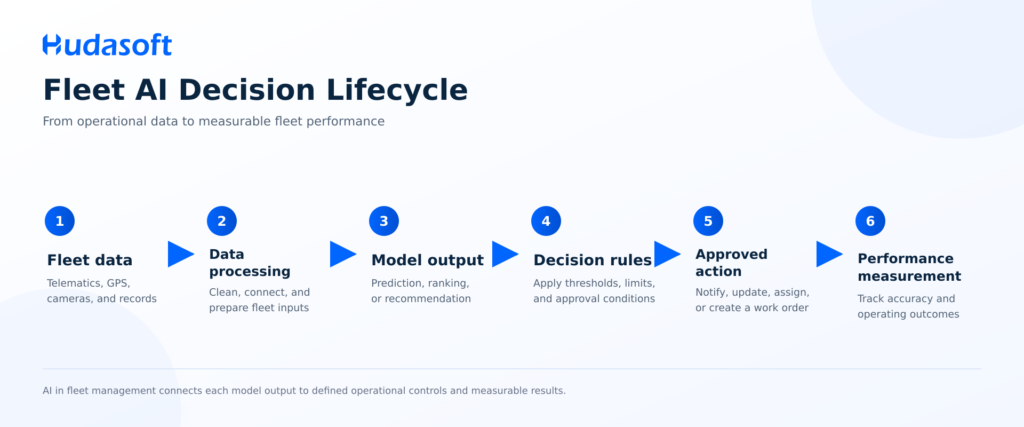
An AI model represents one part of the operating system. The complete process starts with data and ends with a measurable fleet outcome.
Data collection
Each use case requires specific inputs. Fleet systems commonly collect information from:
- GPS and telematics devices
- Engine control modules and diagnostic codes
- Electronic logging devices
- Fuel cards and fuel sensors
- Dashcams and other vehicle cameras
- Inspection and maintenance histories
- Transportation management systems
- Enterprise resource planning systems
- Customer and delivery applications
- Traffic, weather, and mapping services
More data does not automatically improve a model. The source must represent the event or decision that the team wants to improve.
Data preparation and context
Fleet records often use different identifiers for the same vehicle, driver, trip, or maintenance event. Teams must match those records before a model can interpret the full operating context.
The preparation process also checks timestamps, missing values, sensor quality, duplicate events, measurement units, and access rights. It should preserve the conditions that influenced an outcome. Weather, load, route type, vehicle age, and duty cycle may explain why similar vehicles produced different results.
Organizations with several disconnected platforms may need AI integration services to establish reliable data flows, authentication, and write-back controls. This work allows an approved model to exchange information with telematics, maintenance, dispatch, and reporting systems.
Models and decision logic
Different problems require different technical methods.
- Machine learning can identify patterns associated with failures, demand, delays, or unusual consumption.
- Optimization models can rank routes, schedules, loads, and vehicle assignments against defined constraints.
- Computer vision can examine road video, driver behavior, vehicle damage, or site conditions.
- Anomaly detection can flag readings or transactions that differ from normal operating patterns.
- Language models can summarize records, answer fleet questions, and support document-heavy workflows.
The system may combine several methods. A maintenance workflow could use anomaly detection to identify unusual readings, a predictive model to estimate failure risk, and business rules to route the case to the correct maintenance owner.
Workflow execution
APIs and workflow services convert a model output into an operational step. The system may send an alert, open a work order, update an estimated arrival time, assign an exception, or prepare a report.
Each connection needs minimum necessary permissions. A reporting assistant may need read access only. A scheduling agent may need permission to create a draft appointment and no authority to approve repair spending.
Feedback and monitoring
Fleet teams should compare model outputs with actual outcomes. Maintenance staff can record whether an inspection confirmed the predicted issue. Safety reviewers can mark valid and invalid camera alerts. Dispatchers can document why they accepted or rejected a route recommendation.
This feedback supports performance monitoring. It also shows when new routes, vehicles, regulations, operating regions, or driver patterns have changed the model’s working conditions.
Where AI Changes Fleet Operations
Fleet AI creates value when it improves a defined decision or workflow. The following areas connect common data sources with operational actions and measurable indicators.
| Fleet workflow | Data analyzed | AI function | Possible action | KPI to monitor |
| Vehicle maintenance | Diagnostics, mileage, inspections, service history | Failure and anomaly prediction | Create an inspection request | Unplanned downtime |
| Routing and dispatch | GPS, traffic, weather, capacity, delivery windows | Route and schedule optimization | Recommend a new route | On-time arrival rate |
| Driver safety | Video, speed, braking, acceleration, location | Risk and event detection | Send an alert for review | Valid safety event rate |
| Fuel management | Idling, route, load, speed, vehicle condition | Consumption analysis | Identify avoidable fuel use | Fuel cost per mile |
| Asset utilization | Availability, demand, vehicle type, service status | Allocation optimization | Reassign an available asset | Utilization rate |
| Load matching | Capacity, location, lane, rate, driver hours | Opportunity ranking | Recommend a load | Empty miles |
| Customer communication | Vehicle location, stop status, traffic | ETA prediction | Send a status update | ETA accuracy |
| Compliance administration | Logs, inspections, records, policy rules | Exception detection | Create a review task | Resolution time |
Predictive maintenance
Fixed service intervals remain useful for required inspections and standard maintenance. Predictive models add condition-based information from diagnostic codes, temperatures, vibration, battery readings, mileage, and repair history.
The model can prioritize vehicles that show an unusual pattern. Maintenance teams can inspect those vehicles within an appropriate service window. The model should support the maintenance decision and preserve the technician’s authority over diagnosis and repair.
Fleets with specialized equipment or uncommon duty cycles may require predictive analytics services that develop and validate models against their own diagnostic records, maintenance outcomes, operating conditions, and failure definitions.
Routing and dispatch
Route planning must account for more than distance. Delivery windows, vehicle limits, road restrictions, driver hours, depot schedules, traffic, weather, and customer priorities can change the preferred route.
AI-supported optimization can recalculate available options when those conditions change. The dispatcher can approve a recommendation when the route affects service commitments or driver schedules. Low-risk changes may follow an approved automation policy.
Driver safety
Computer vision and telematics can identify events such as distraction, speeding, harsh braking, unsafe following distance, or lane departure. The system can send immediate driver alerts or place an event in a manager’s review queue.
NHTSA reported that crashes involving distracted drivers claimed 3,208 lives in 2024. This national figure does not measure commercial fleets alone. It shows why fleet safety systems need accurate event detection, timely review, and clear coaching procedures.
Camera systems can also produce false alerts. Fleets should measure precision, review context, and give drivers a process for disputing an incorrect event. A safety score should never replace an investigation when the decision affects employment or discipline.
Fuel and idle management
Fuel analysis connects consumption with routes, idling, speed, load, driver behavior, and vehicle condition. The model can identify vehicles or trips that use more fuel than comparable operations.
The US Department of Energy reports that long-haul heavy-duty trucks consume more than one billion gallons of fuel each year during rest-stop idling. Fleet teams can use telematics and operating context to separate avoidable idling from idling that supports safety, passenger comfort, equipment, or job-site work.
The system should assign each event to a useful category. That approach helps managers address routing delays, loading queues, driver practices, or equipment needs without treating every idle period as waste.
Asset utilization and load matching
Allocation models compare vehicle type, availability, location, capacity, maintenance status, and expected demand. They can recommend the most suitable asset for a job or identify underused vehicles.
Freight operations can extend this analysis to load matching. A model can consider driver hours, equipment type, pickup location, lane conditions, customer requirements, and downstream positioning. The final recommendation should reflect the network effect rather than the immediate load alone.
Customer and administrative workflows
AI can predict arrival times using vehicle position, trip progress, traffic, stop duration, and historical route performance. A connected workflow can send an updated ETA when the confidence and delay threshold meet an approved rule.
Language models can also summarize incident reports, service histories, inspection notes, and daily exceptions. Staff should verify generated summaries when they support compliance, billing, safety, or customer commitments.
What AI Automation for Fleet Management Can Control
Fleet workflows carry different levels of risk. An organization should match decision authority with the financial, safety, legal, and customer consequence of an incorrect action.
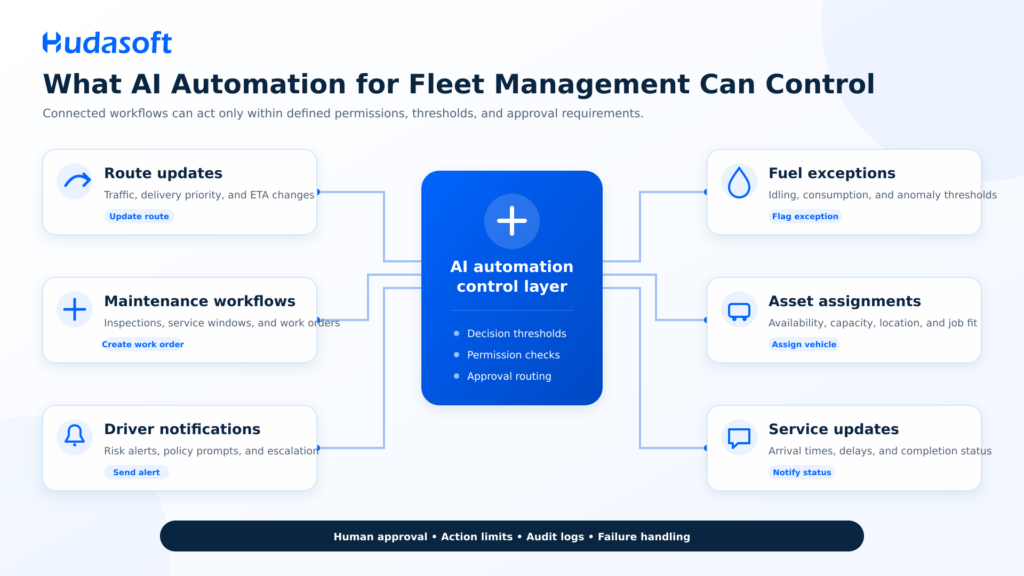
Advisory workflows
An advisory system presents information without changing an operating record. Common examples include:
- Maintenance risk scores
- Route recommendations
- Driver coaching priorities
- Vehicle replacement analysis
- Fuel exceptions
- Demand forecasts
The responsible employee decides what to do next. This level suits early pilots and decisions that require professional judgment.
Approval-based workflows
An approval-based system prepares an action and sends it to an authorized person. It may propose a route change, maintenance appointment, vehicle reassignment, or customer notification.
The interface should display the supporting facts, model confidence, affected records, and expected consequence. The reviewer also needs a clear way to reject or revise the action.
Low-risk automated workflows
Some routine actions have defined conditions and limited consequences. A fleet may automate work-order drafts, standard status messages, data reconciliation, scheduled reports, and exception-ticket routing.
The workflow should record the trigger, action, affected system, timestamp, and result. When an action fails, the workflow should direct it to a person and stop automatic retries after a defined limit.
Decisions that need human authority
Fleet teams should retain human review for safety-critical dispatch decisions, employee discipline, regulatory determinations, high-value spending, and actions based on uncertain data.
The same principle applies when several valid objectives conflict. A route may reduce fuel consumption and create a late delivery. A vehicle reassignment may improve utilization and disrupt a maintenance plan. A person may need to decide which outcome carries priority.
How AI Fleet Management Creates Business Value
An AI project needs baseline measurements before development begins. Teams should define the current cost, delay, event rate, or workload and track the same indicator during the pilot.
Vehicle availability
Maintenance programs can track:
- Unplanned downtime
- Roadside repair frequency
- Mean time between failures
- Maintenance completion time
- Repeat repair rate
A prediction creates value only when the team can inspect and service the vehicle within a useful window.
Operating efficiency
Dispatch and planning teams can track:
- Empty miles
- Miles per stop
- Vehicle utilization
- On-time arrival rate
- Dispatch response time
- Route completion variance
The team should compare similar routes, vehicle classes, seasons, and operating conditions. An unadjusted comparison may credit the model for a result that another operational change produced.
Cost control
Financial indicators may include:
- Fuel cost per mile
- Maintenance cost per vehicle
- Cost per delivery or service call
- Administrative hours per trip
- Overtime associated with exceptions
- Towing and emergency repair costs
The measurement plan should include integration, support, model monitoring, and user training costs. A narrow savings calculation can overstate the return.
Safety and service quality
Safety and customer teams can track:
- Valid safety events
- False-alert rate
- Coaching completion rate
- Repeat high-risk behavior
- ETA accuracy
- Customer exception volume
- Status inquiry volume
These indicators connect the technical output with an operating result. Model accuracy alone does not confirm safer driving or better service.
Requirements for a Reliable Fleet AI System
Fleet data affects vehicles, employees, customers, and regulated records. The implementation needs technical controls and clear operating ownership.
Relevant and consistent data
The project team should define the event, outcome, and decision before selecting data. A maintenance model needs confirmed service outcomes. A routing model needs actual arrival times and route constraints. A safety model needs reviewed events rather than raw camera triggers alone.
Teams should also examine missing records, sensor changes, inconsistent identifiers, and data collection gaps. These issues can create patterns that do not represent the real operation.
Connections with existing systems
The solution may need access to telematics, maintenance software, TMS, ERP, CRM, ELD, fuel, mapping, and identity platforms. Each connection should define read access, write access, update frequency, authentication, and failure handling.
Hudasoft’s fleet management solution combines vehicle tracking, fuel monitoring, maintenance scheduling, driver behavior records, route planning, and performance reporting. AI features can use this operational layer or connect with another established fleet stack through controlled interfaces.
Clear decision ownership
Every model output needs an owner. The operating procedure should identify who reviews it, how quickly they respond, which evidence they need, and who handles an escalation.
Ownership also applies after deployment. Teams need responsibility for data quality, model performance, integration health, user access, and policy updates.
Driver privacy and transparency
Fleet operators should document why they collect location, video, or behavior data. They should restrict access, define retention periods, protect exports, and explain review procedures to affected employees.
Applicable requirements can differ by state, employment context, industry, and data type. Organizations should obtain qualified legal guidance for their specific monitoring program.
Model and alert validation
A pilot should test realistic routes, vehicles, drivers, weather, loads, and exceptions. The evaluation should measure false positives, missed events, latency, reliability, and operational usefulness.
Teams should also test failure conditions. The workflow needs a defined response when a sensor stops reporting, an API fails, a model returns low confidence, or a downstream system rejects an update.
Security and resilience
Fleet integrations should use restricted credentials, role-based access, encrypted connections, and recorded system actions. High-risk changes may require an approval checkpoint or separate authorization.
The operating team also needs a manual fallback. Dispatch, maintenance, and safety work must continue when the AI service or integration becomes unavailable.
How to Implement AI in an Existing Fleet
A focused implementation limits technical risk and produces clearer evidence. Teams can use the following sequence to move one operational use case into production.
1. Select one operating problem
Choose a frequent problem with a defined owner and measurable consequence. Examples include unplanned battery failures, excessive idle time, late service arrivals, manual maintenance triage, or inaccurate ETAs.
Avoid a broad objective such as improving the entire fleet. The project needs a specific decision or workflow.
2. Map the current workflow
Document the people, systems, data, decisions, exceptions, and approval points. Identify where the current process loses time or information.
This map also shows whether the problem requires AI. A deterministic business rule may solve a stable and predictable workflow with less complexity.
3. Establish baseline metrics
Measure current performance over a representative period. Record differences across vehicle classes, routes, depots, seasons, and operating regions.
An AI implementation plan should define the baseline, target, data sources, system connections, owners, validation method, and deployment limits before development starts.
4. Choose the required capability
Determine whether the workflow needs a prediction, optimization model, language interface, workflow automation, or AI agent. Select the least complex capability that can meet the operating requirement.
That decision defines the AI development services scope, including model development, interface design, decision logic, system integration, and workflow implementation.
5. Build and test the connection
Connect only the data and systems required for the pilot. Test record matching, update frequency, permissions, latency, failure handling, and audit logs.
The team should also compare model outputs with decisions from experienced fleet personnel. Differences can reveal missing constraints or unclear operating rules.
6. Run a controlled pilot
Limit the first deployment to a vehicle group, route type, depot, or workflow. Give users a clear way to review outputs and report incorrect results.
The pilot should run long enough to capture relevant events and operating conditions. A short test may miss infrequent failures or seasonal route patterns.
7. Expand with monitoring
Expand the solution when it meets the agreed thresholds for accuracy, reliability, adoption, and operating results. Continue to monitor data quality, model performance, integration failures, overrides, and user feedback.
New vehicles, routes, equipment, policies, and business priorities can change the operating context. The team should review the model when these changes affect its inputs or decisions.
Build, Buy, or Integrate a Fleet AI Solution
The right delivery model depends on workflow complexity, available software, integration needs, data ownership, and required control.
| Approach | Best fit | Main advantage | Main limitation |
| Packaged fleet platform | Standard tracking, maintenance, safety, and reporting | Faster setup with defined features | Limited proprietary workflow support |
| Specialized AI tool | One focused problem such as video safety | Deeper capability in one operating area | Creates another vendor and data connection |
| Custom AI integration | Existing platforms need shared intelligence | Preserves current software investments | Requires interface and monitoring ownership |
| Custom AI application | Proprietary process creates operational value | Matches the fleet’s data and decision rules | Requires greater delivery responsibility |
When packaged software fits
A packaged platform fits standard fleet workflows with supported devices and predictable requirements. It may cover tracking, maintenance reminders, driver behavior, fuel reporting, and route planning without custom model development.
Teams should still assess data ownership, API access, configuration limits, reporting, security, and contract terms.
When custom development fits
Custom development fits specialized assets, proprietary dispatch rules, uncommon duty cycles, multiple disconnected systems, or complex approval paths. It can also support a customer-facing product that needs fleet intelligence within its own interface.
Enterprise AI development services can cover the application, data layer, integrations, permissions, testing, monitoring, and operating controls required across a larger organization.
When an AI agent fits
An agent fits a workflow that requires changing evidence, several tools, multiple steps, and exception handling. The agent should work toward a defined completion condition and stay within explicit decision limits.
Fleet coordination may require an agent to review a disruption, check vehicle and driver status, compare alternatives, prepare updates, and send unresolved cases to a dispatcher. AI agent development services support this type of connected workflow when a simple rule or single model call cannot complete the task reliably.
How to Evaluate AI in Fleet Management Services
A provider should explain how its solution connects a fleet problem with data, models, systems, controls, and operating metrics. A feature list alone does not show whether the implementation can work in the target environment.
Use the following questions during evaluation:
- Which fleet decision or workflow will the system improve?
- Which data sources does the solution require?
- Can it connect with the current telematics and management platforms?
- How does the provider test prediction quality?
- How does the system measure false alerts and missed events?
- Which actions require human approval?
- Which records can the system read or change?
- How does the provider handle driver and customer data?
- Does the system record recommendations, approvals, actions, and failures?
- How will the team monitor performance after launch?
- What manual fallback supports an outage?
- Which customization limits apply?
- Who owns integration maintenance?
- Which business metrics define success?
- What support follows deployment?
The provider should demonstrate the workflow with representative data and exceptions. A polished demo using ideal inputs does not establish production reliability.
Emerging AI Capabilities for Fleet Operations
Several developments extend fleet intelligence beyond dashboards and isolated predictions. Their value will depend on data access, integration quality, and safe decision authority.
Conversational fleet intelligence
Language interfaces can help managers ask questions across fleet records. A user might request vehicles with repeated battery alerts, routes with increasing idle time, or trips that missed delivery windows.
The assistant should show supporting records when the answer influences an operating decision. It also needs access controls that match the user’s role.
Agentic fleet workflows
Agents can coordinate tasks across telematics, maintenance, dispatch, communications, and reporting tools. They may track a multistep task, respond to new information, and escalate an exception.
Production use requires tool restrictions, approval rules, action logs, completion checks, and recovery procedures. These controls keep the agent inside the assigned workflow.
Electric fleet optimization
Electric fleets add battery state, charger availability, charging duration, energy price, route elevation, weather, payload, and depot capacity to the planning process.
Models can support charging schedules, range estimates, vehicle assignment, and route energy planning. The system should preserve operating reserves and account for charger outages or unexpected route changes.
Network-wide optimization
A local decision can affect the wider fleet. Accepting a load changes vehicle position. Reassigning an asset affects maintenance availability. Holding a driver for one customer may affect another service commitment.
Network models can evaluate these downstream effects across several time periods. They still need defined business priorities because profitability, service, safety, and workforce constraints may point toward different choices.
Fleet-management AI also differs from autonomous driving. Fleet systems plan and coordinate vehicles, people, maintenance, and service workflows. Autonomous-driving systems control vehicle movement and respond to the road environment. The systems share some data and technologies. They carry different responsibilities and risks.
Conclusion
AI in fleet management creates value when it improves a defined operating decision. Fleet data supplies context, models predict or rank outcomes, integrations connect the results with daily work, and governance limits the available actions. Baseline metrics then show whether the system improves uptime, utilization, safety, fuel control, or service performance.
A fleet should start with one measurable workflow and expand only after the system proves its accuracy and operational reliability. Hudasoft develops connected fleet and AI systems for organizations that require specialized data access, custom decision logic, existing-platform integration, or controlled multistep automation.
Frequently Asked Questions
Can AI work with an existing fleet management or telematics platform?
AI can work with an existing fleet management or telematics platform when the platform provides suitable APIs, data exports, or approved database access. The integration must map vehicle, driver, trip, and event identifiers consistently. It should also define update frequency, permissions, error handling, and write-back rules for each connected workflow.
How much historical fleet data does an AI model need?
The amount of historical fleet data depends on the event frequency, model type, operating variation, and required confidence. A common maintenance event may provide enough examples sooner than a rare component failure. Data quality and confirmed outcomes matter more than record volume alone. A pilot can establish whether the available history supports the intended prediction.
Does AI replace fleet managers and dispatchers?
AI does not replace the full responsibility of fleet managers and dispatchers. It can reduce monitoring, analysis, reporting, and coordination work. People still need to manage exceptions, resolve conflicting priorities, communicate with drivers and customers, and retain authority over high-consequence decisions.
How should companies handle driver privacy when using AI cameras?
Companies should define the monitoring purpose, restrict video access, set retention periods, secure exports, document review procedures, and explain the program to drivers. They should also establish a process for reviewing disputed events. Legal requirements vary across jurisdictions and employment settings, so the organization should seek qualified advice for its program.
Which fleet process should a company automate first?
A company should first automate a frequent and measurable process with reliable data, limited operational risk, a clear owner, and a manual fallback. Maintenance triage, routine customer status updates, idle-time exception review, and report preparation can provide suitable starting points when the existing systems contain the required information.

