


Small language models are the future of agentic AI because many agent workflows depend on focused and repeated model calls. Smaller models can support some of these responsibilities with lower infrastructure demands when they meet the required accuracy, latency and reliability thresholds.
NVIDIA Research advanced this position in a 2025 paper focused on the capabilities, operational suitability and economics of small language models. The researchers support assigning specialized models to suitable tasks within a controlled agentic system.
The practical question concerns workload fit. Teams need to identify which agent responsibilities have clear boundaries, measurable outputs and manageable failure consequences. They must then validate the selected model against real task data before approving production use.
Key Takeaways
- One agent task can trigger several model calls for interpretation, retrieval, tool use and result checking.
- Narrow responsibilities with defined outputs create the strongest opportunity for specialized models.
- General benchmark scores cannot establish whether an SLM can handle a specific production task.
- Routing, validation, fallback and monitoring determine the performance of the complete agent.
- Teams should test one bounded agent node before expanding SLM usage across the system.
The Case That Small Language Models Are the Future of Agentic AI
The phrase comes from a NVIDIA Research position paper published in 2025. Its authors argue that SLMs already possess enough capability for many specialized tasks inside agentic systems. They also identify advantages involving latency, computing requirements, deployment flexibility and operating economics.
An SLM in this context means a language model that can operate within more limited infrastructure than a large general-purpose model. Architecture, hardware, quantization and runtime requirements influence whether a model fits that category. A fixed parameter threshold cannot represent every deployment environment.
The research focuses on the work a model performs inside an agent. An agent may use a language model to classify a request, prepare a retrieval query, choose a tool, format function arguments or inspect a result. Many of these responsibilities repeat frequently and produce outputs that software can validate.
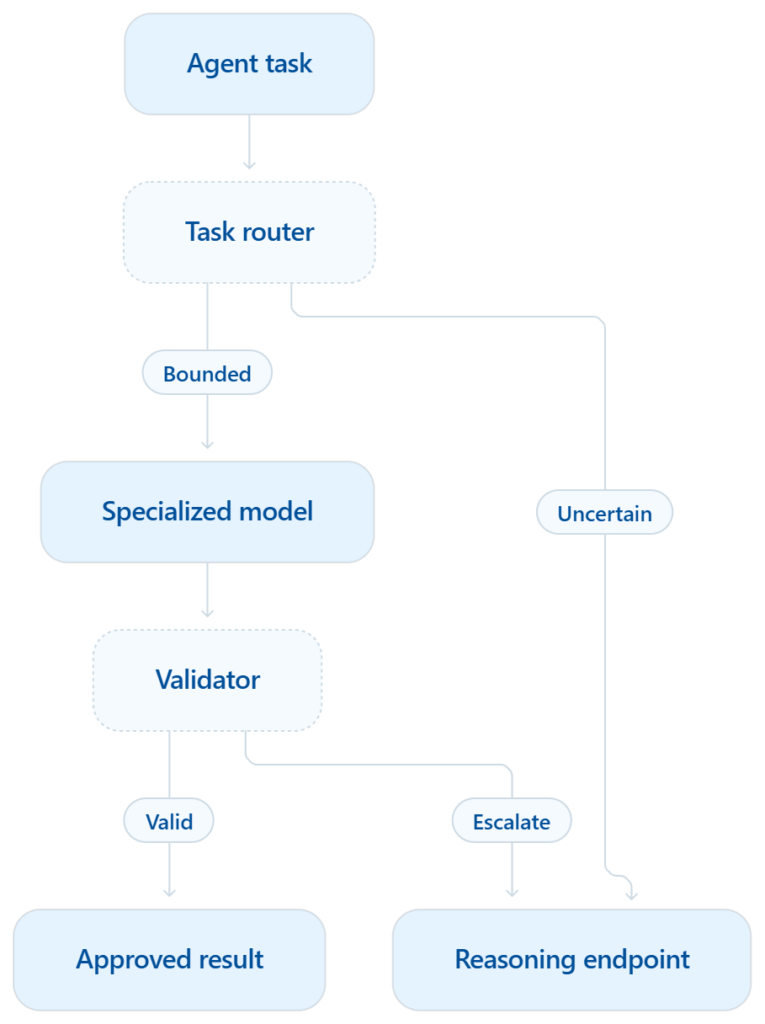
The paper also describes heterogeneous agentic systems that assign different model endpoints to different responsibilities. A specialized model can handle a bounded task, and the system can redirect uncertain work to an endpoint with broader reasoning capabilities.
In an interview with Arize AI, paper author Peter Belcak describes the research as a position piece that organizes available evidence and industry observations. The paper presents a technical direction rather than a universal deployment rule.
A production decision therefore requires task-specific evidence. Teams must confirm that an SLM can complete its assigned responsibility within the required quality and risk limits.
Agent Workloads Change the Value of Model Scale
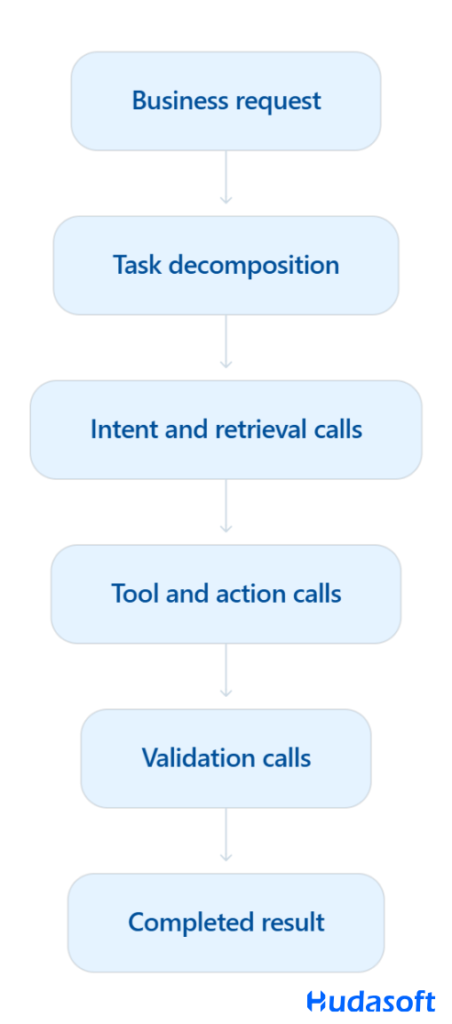
A basic model interaction may involve one prompt and one response. An agent can call a model several times while completing one business request.
Consider an agent that processes a service request. It may need to:
- Identify the request type.
- Extract the customer and product details.
- Retrieve the applicable policy.
- Select an approved business function.
- Prepare valid tool arguments.
- Inspect the tool result.
- Confirm whether the action completed successfully.
Some stages may run more than once when the agent receives incomplete information or an unexpected tool response.
This pattern creates model-call amplification. One business request can produce several interpretation, retrieval, execution and validation calls. Every invocation contributes to total latency, infrastructure demand and operating expense.
The required capability also changes across the workflow. A request classifier may choose among twelve approved categories. A tool-argument generator may need to return five fields under a fixed schema. These responsibilities rely on constrained outputs rather than broad conversational knowledge.
The economics operate at the workflow level. A small difference on one call may appear insignificant. That difference can become material when an agent repeats the call across thousands of tasks.
Repeated planning, retrieval, tool-selection and verification calls can increase ongoing AI agent development cost because model usage, monitoring and infrastructure continue after deployment. Cost per completed task provides more useful evidence than the price of one model call.
Five Workload Conditions That Favor Specialized Models
An SLM becomes a credible candidate when the task gives engineers clear boundaries and measurable outcomes. The following conditions help teams identify suitable responsibilities without making assumptions based on model size alone.
The Task Repeats With Limited Variation
Repetition creates an opportunity for specialization. Users may describe the same underlying request in different words, while the system still expects one of several approved outcomes.
A task also needs manageable exceptions. Frequent novel inputs, undocumented policies or changing completion rules weaken its suitability for a narrowly specialized model.
The Output Follows a Defined Contract
A defined output contract allows automated validation. The contract may require:
- One label from an approved category list
- A JSON object that follows a fixed schema
- A tool name from a permitted function registry
- Required parameters with valid data types
- A pass, correct or escalate result
Structured outputs create a clear boundary between the model and application code. The surrounding software can reject missing fields, invalid values and unauthorized actions before another system receives them.
Free-form tasks require different evaluation methods because a schema cannot measure audience fit, reasoning quality or contextual judgment on its own.
The Workflow Needs Fast Intermediate Decisions
Users experience the total time that an agent takes to complete its work. Several slow intermediate calls can increase the final response time.
Routing, classification and validation often operate inside longer execution loops. These nodes may run repeatedly when an agent revises a query or checks a failed tool result.
A smaller model creates value only when it preserves the required quality. A fast call that produces retries, corrections or unnecessary escalation can slow the complete workflow.
The Agent Generates High Invocation Volume
High-volume tasks magnify infrastructure requirements. A model that handles one classification for each request may process millions of classifications across a large operation.
Volume also increases the value of inference efficiency and serving capacity. Teams can allocate more resources to rare, complex work and optimize the responsibilities that run frequently.
Cost cannot serve as the only acceptance criterion. An inexpensive endpoint that creates invalid actions or manual rework may increase the final process cost.
Representative Data Can Support Specialization
Task-specific AI models need examples that reflect the actual operating environment. The dataset should include routine requests, incomplete input, unusual wording, policy exceptions and known failure patterns.
Training and evaluation data serve different purposes. Training examples can adapt the model’s behavior. A separate evaluation set measures how the model handles unseen cases.
Teams need representative examples of standard requests, exceptions and failure conditions, which makes AI data preparation part of the specialization process. Weak labels, duplicate examples and missing edge cases can produce misleading evaluation results.
An Agent-Node Suitability Map for SLM Evaluation
Teams can evaluate individual responsibilities instead of treating the entire agent as one model task.
The following illustrative example maps the nodes of a service-request agent. It is intended only to show how teams can evaluate different agent responsibilities and does not prove that every SLM can handle these tasks.
| Agent node | Expected output | Why specialization may work | Required control | Escalation signal |
| Intent classification | Approved request category | The system limits the output set | Category and confidence validation | Unknown or conflicting intent |
| Retrieval query creation | Search-ready query | The task follows a repeatable transformation | Retrieval-quality test | Empty or irrelevant results |
| Document extraction | Structured fields | The output follows a defined schema | Type and completeness checks | Missing or inconsistent fields |
| Tool selection | Approved tool name | The agent uses a limited function registry | Permission validation | No safe tool match |
| Tool argument creation | Valid structured parameters | The task requires an exact output contract | Schema and business-rule validation | Invalid or high-risk request |
| Result verification | Pass, correct or escalate | The workflow defines completion criteria | Independent state check | Conflicting or uncertain evidence |
A model may perform well on intent classification and struggle with tool selection. Another model may generate valid JSON and still choose the wrong business action. Each node needs its own evaluation set and acceptance threshold.
This task-level approach also prevents a broad benchmark from controlling the decision. A general reasoning score provides limited evidence about tool selection under a specific function registry.
Research on small language models for agentic systems proposes production measures such as schema validity, executable tool calls, latency and cost per successful task. These measurements connect model performance with the work the agent must complete.
Model Routing Connects Node Capability With Workflow Performance
A specialized model requires a routing and control layer. The surrounding system must assign tasks, validate outputs and redirect work when a result falls outside approved conditions.
A focused routing design can include:
- A task classifier that identifies the required responsibility
- A specialized endpoint for bounded work
- A validator that checks the output contract
- A fallback route for uncertain or invalid results
- An approval step for consequential actions
- Logs that record model, tool and routing decisions
The router needs explicit rules. It may use task type, input completeness, confidence, risk level or a previous failure state. Application code should enforce permissions, transaction limits and prohibited actions.
The validator provides another control point. It can reject malformed JSON, missing parameters, unauthorized tool names and values that violate business rules. Semantic correctness still requires policy checks and verification against the current system state.
Fallback volume also affects the result. A specialized endpoint provides limited value when it transfers most requests elsewhere. The team should record why each escalation occurred and determine whether the model, router, dataset or task definition caused it.
Model routing forms one layer of the wider agentic AI architecture, which also manages context, state, tools, permissions, execution and human oversight. The routing layer focuses specifically on assigning each model an appropriate responsibility.
Production Evidence Must Decide Whether an SLM Is Ready
A leaderboard cannot approve a model for production. Teams need evidence tied to the exact agent node, input distribution and consequence of failure.
Task Completion Measures
The evaluation should begin with the result that the node must produce.
Relevant measures may include:
- Correct classification rate
- Required-field completion
- Accurate entity extraction
- Correct retrieval query generation
- Successful result verification
- Appropriate escalation under uncertainty
Keep routine and difficult input in separate reporting categories. A combined average can hide weak performance on rare cases that carry greater consequences.
Tool and Output Reliability Measures
Tool use requires more than syntactically valid text. The model must choose an approved function and supply correct arguments.
Teams should track:
- Executable tool-call rate
- Schema-valid output rate
- Missing argument rate
- Invalid value rate
- Unauthorized tool attempts
- Correction frequency
- Tool-selection accuracy
A 2026 Amazon Science publication on SLM tool calling examines targeted fine-tuning for focused agent tasks. Its narrow experimental scope shows why each performance claim needs a clear task, dataset and evaluation method.
Workflow Performance Measures
Node-level accuracy cannot show whether the complete agent improved. Teams should also measure:
- End-to-end task completion
- Cost per successful task
- Fallback rate
- Human escalation rate
- Average correction attempts
- p50 and p95 completion latency
- Failure rate by input category
A faster model call can create more retries. A cheaper endpoint can increase manual review. Workflow-level evidence captures these downstream effects.
Model inference represents one operating component. The broader AI development cost can include data engineering, model adaptation, system integration, evaluation infrastructure, security and monitoring.
Long-Tail and High-Risk Evaluation
The test data should cover more than successful historical cases. Include:
- Ambiguous requests
- Missing required information
- Conflicting instructions
- Unsupported languages or formats
- Unexpected tool responses
- Attempts to access unauthorized functions
- Requests with high financial or operational consequences
The model should escalate whenever the system cannot verify a safe result. Confidence alone cannot establish correctness.
Why Strong Benchmarks Can Still Produce Weak Agent Performance
A model can perform well in a published evaluation and fail inside a business workflow. Six common gaps explain why benchmark results need task-level verification.
The Benchmark Measures a Different Task
General benchmarks may test broad knowledge, reasoning or language generation. An agent node may require exact tool selection, policy interpretation or field extraction.
Teams should examine the benchmark inputs, scoring method, tool definitions and error categories before applying the results to another workload.
The Task Boundary Contains Hidden Variation
A task may appear narrow during planning and reveal more complexity during testing.
A service request can involve multiple products, overlapping policies, missing account information and exceptions that employees resolve through experience. The model needs a clear escalation route for cases outside its assigned responsibility.
The Dataset Misses Real Input Patterns
A clean evaluation set can create an optimistic result. Production users introduce abbreviations, typing errors, incomplete context and conflicting details.
The dataset should reflect actual variation without exposing sensitive information. It also needs separate examples for policy exceptions and rare failure modes.
The Supporting System Adds Engineering Overhead
A multi-model approach may require several endpoints, routing logic, validators, deployment pipelines and monitoring views. Each component introduces implementation and maintenance work.
The system also needs version control, security testing, capacity planning and rollback support. A cost assessment should include these responsibilities.
The Fallback Rate Removes the Expected Gain
A model may succeed on routine input and escalate every difficult case. That pattern can create value when routine work represents most traffic.
Frequent escalation reduces the expected gain. Teams should track fallback reasons and include the cost of the final resolution path.
The Workflow Changes After Deployment
Business rules, APIs, forms, terminology and customer behavior can change. These changes may reduce performance even when the team keeps the same model version.
Monitoring should detect shifts in schema failures, fallback volume, task completion and input categories. A material change in the responsibility should trigger reevaluation.
A Controlled Validation Path for One Agent Node
A limited production test provides stronger evidence than a complete system redesign. Teams can start with one frequent responsibility that has a stable output contract.
1. Select a Bounded Responsibility
Choose a node with:
- A clear input
- A defined output
- A measurable completion condition
- Sufficient request volume
- Manageable failure consequences
- An established escalation route
Classification, structured extraction and query transformation often provide clear evaluation boundaries.
2. Establish the Current Baseline
Measure the existing execution path before introducing another endpoint. Record its completion rate, latency, correction demand, fallback volume and operating expense.
The baseline gives the team a consistent reference for the candidate model.
3. Build a Representative Evaluation Set
Separate the data into routine, incomplete, ambiguous, adversarial and high-risk categories. Keep the final evaluation examples outside the training dataset.
This separation provides a more realistic view of how the model handles unseen inputs.
4. Place the Candidate Behind a Validator
Run the model without direct authority over production actions during the initial test.
The validator should inspect the output structure, required values, permissions and business constraints. It should reject invalid output and record the exact failure reason.
5. Introduce Limited Production Traffic
Route a controlled share of suitable tasks to the candidate while retaining the established fallback path.
Review results by input category. A single average can hide a problem concentrated within one product, language or request type.
6. Expand After the Model Meets Acceptance Thresholds
Approve wider usage only when the candidate meets the previously defined task and workflow measures. The results should remain stable across routine, difficult and high-risk input categories.
Implementing this validation path requires coordination across model testing, routing, tool permissions and production monitoring. Hudasoft’s agentic AI development services address these connected engineering responsibilities for organizations developing controlled agent workflows.
What the SLM Shift Means for Future Agentic Products
The growing role of SLMs points toward model portfolios organized around specific responsibilities. One product may use separate endpoints for classification, retrieval preparation, tool interaction and complex reasoning.
This direction can change several parts of agent development.
First, teams will evaluate models at the node level. A model may qualify for one responsibility and fail another. Task-specific evidence will guide deployment decisions.
Second, routing policies will become important production components. Teams will need to version, test and monitor the rules that send work to each endpoint.
Third, local and edge deployment may support selected workloads where hardware, connectivity and model capability allow it. On-device inference can reduce dependence on a remote model endpoint. External data sources and cloud tools will still require connectivity.
Fourth, operating economics will focus more closely on completed outcomes. Token price, hardware use and latency remain useful measures. Cost per successful task provides a fuller view because it also captures retries, fallback and human review.
Fifth, observability will need to follow the complete execution path. Teams must connect model decisions with tool calls, validation results, escalations and final outcomes.
These changes support wider use of specialized models without assigning the same model strategy to every task.
Smaller Models Will Expand Through Measured Specialization
Small language models have a credible role inside agentic systems when teams assign them responsibilities with clear boundaries, representative data and measurable outputs.
Repeated nodes such as classification, structured extraction, query preparation and constrained tool interaction create practical opportunities. Each candidate still requires evaluation against the real workload.
Model routing, deterministic validation and fallback protect the wider system when a specialized endpoint encounters uncertainty. Workflow metrics then show whether the change improves quality, latency and operating cost.
The process should begin with one agent node, an established baseline and an explicit acceptance threshold. This approach produces production evidence without committing the complete system to one model strategy.
Hudasoft develops AI systems around defined workflows, controlled tool access, measurable acceptance criteria and production monitoring. These responsibilities determine whether a language model can support reliable business execution.
Frequently Asked Questions
Can small language models reduce hallucinations in AI agents?
Small language models do not reduce hallucinations automatically. Narrow task boundaries, grounded context, representative data, constrained outputs, validation and escalation can reduce unsupported responses. Teams should measure incorrect claims and actions on a task-specific evaluation set.
Can small language models power AI agents without internet access?
Small language models can power selected agent capabilities without internet access when the model, runtime, data and required tools operate locally. An agent still needs connectivity when it calls cloud APIs, searches online sources or accesses remote business systems.
Do small language models improve data privacy for enterprise AI agents?
Small language models can support local or private deployment, which may reduce data transfers to external model providers. Privacy still depends on access controls, encryption, secure logging, retention policies, model hosting and tool permissions.
What hardware does an SLM-powered agent need for local deployment?
The hardware requirements for an SLM-powered agent depend on model size, quantization, context length, concurrent usage and latency expectations. Teams should test memory use, throughput and response time on the intended device or server before approving local deployment.
Do small language models need fine-tuning for agentic tool calling?
Small language models do not always require fine-tuning for agentic tool calling. Some models can follow tool schemas through prompting and constrained decoding. Domain-specific tools, complex arguments or strict reliability requirements may require targeted training and task-specific evaluation.

