


That lost lead is the hidden cost of clinging to old ways. The reality is that the auto market is booming, but the modern buyer is ruthless: 95% do deep online research and expect the frictionless speed of Amazon. If your auto dealership is operating with fragmented systems and paper forms, you’re not just missing an opportunity; you’re facing a direct revenue drain.
This year, delay is business suicide. We know that 78% of qualified leads choose the dealer that responds first, and those who don’t embrace car dealership digital transformation are seeing their profit leak away through wasted staff time, manual errors, and high customer turnover. Modernization is no longer a luxury; it is the ultimate competitive weapon.
In this deep dive into auto dealership digital transformation, we will expose the true cost of inefficiency and show you the exact strategies from instant AI chat to unified management systems that the most profitable dealers are using right now to secure higher conversions and dominate the market in 2026.
Automotive Dealership Digital Transformation at a Glance
Automotoive dealership digital transformation is the process of replacing manual, disconnected dealership operations with integrated digital systems across sales, service, inventory, and finance. For a dealership in 2026, this means:
- A unified DMS that gives every department real-time access to the same customer and vehicle data
- AI-powered lead response that engages every inquiry within seconds, not hours
- Digital F&I workflows that eliminate paper contracts and reduce credit approval time by 25%
- Automated inventory management that reduces holding costs and prevents double-selling
- Mobile-first customer tools that keep the dealership connected to the buyer between purchases
- Analytics platforms that surface actionable insights from your own CRM and DMS data in real time
The dealerships executing this correctly are reporting 32% higher conversions, 50% gains in staff efficiency, and a measurable reduction in the cost of acquiring and retaining customers.
What is an Auto Dealership Digital Transformation?
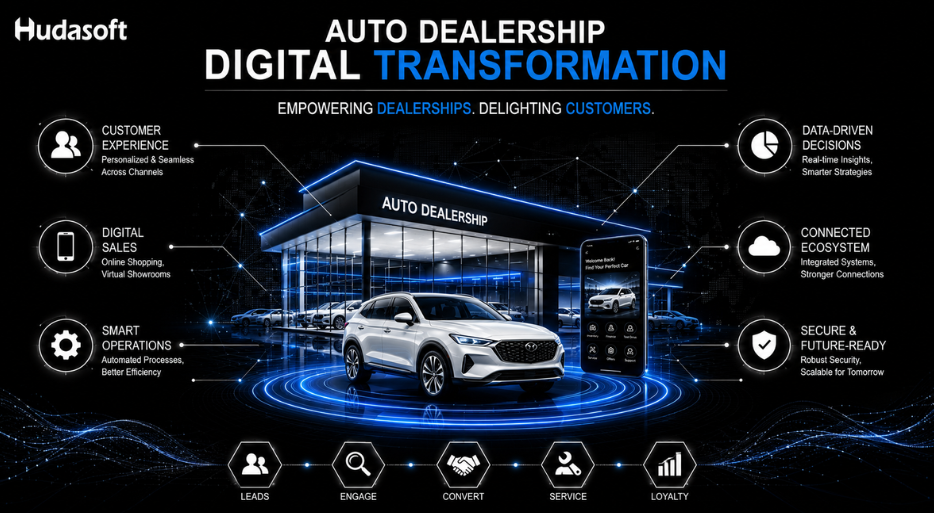
Auto dealership digital transformation is simply rethinking how your dealership works by using smart technology to make everything easier. It’s not just about having a website; it’s about swapping out old, manual steps like paper files and fragmented computer programs for seamless digital processes.
The goal is to connect all parts of the dealership sales, finance, and service into one smooth system. This benefits everyone: your team works smarter, and the customer gets a fast, simple, and connected car-buying and ownership experience.
7 Advantages of Digital Transformation in Dealerships
Digital transformation in dealerships directly impacts the numbers that matter. The global dealership digital transformation services market is valued at $16.91 billion in 2026 and is projected to reach $33.47 billion by 2034, reflecting how fast dealerships worldwide are moving away from fragmented operations toward integrated digital systems.
Every benefit below maps directly to a measurable outcome across revenue, retention, and operational efficiency.
1. Faster Lead Response with AI-Powered Automation
Speed is the single biggest revenue lever in automotive retail. Research shows 78% of customers buy from the dealer that responds first, yet only 13.2% of dealerships respond to a lead within 5 minutes and over 75% take more than an hour.
Purpose-built AI development services such as intelligent chatbots and automated CRM workflows eliminate that gap by responding to every inquiry within seconds, qualifying the lead, and routing it to the right salesperson, around the clock, without adding headcount.
2. Higher Inventory Accuracy and Smarter Stock Decisions
Fragmented inventory systems cost dealerships real money through double-selling, dead stock, and missed turn opportunities. Unified digital platforms give every department real-time visibility into what is on the lot, what is in transit, and what is moving fastest in the local market.
AI-driven inventory tools are projected to improve dealership inventory turnover efficiency by 18% and reduce holding costs by 12% by 2028, making integrated inventory management one of the highest-ROI investments a dealer group can make today.
3. Streamlined F&I and Service Operations
Paper-based F&I workflows and manual service write-ups are two of the biggest sources of profit leakage in a dealership. Over 12,000 dealerships have already integrated digital F&I platforms, reducing average credit approval processing time by 25%.
On the service side, 68% of customers now prefer dealerships that offer digital service updates and remote approval, which shortens service cycles, increases upsell acceptance, and builds the kind of transparency that drives repeat visits.
4. Personalised Customer Experience Through AI Consulting
Modern buyers expect personalisation at every touchpoint. According to Cox Automotive’s Car Buyer Journey Study, customer satisfaction reached an all-time high of 76%, with AI-powered personalisation credited as a primary driver.
Dealerships using AI consulting services build recommendation engines and behaviour-based communication sequences that treat each customer as an individual. Personalised service communications have also been shown to reduce customer opt-outs 4x compared to generic messaging, directly protecting future appointment and service revenue.
5. Mobile-First Service and Sales Touchpoints
Over 54% of automotive shoppers now use mobile more than desktop for vehicle research, and that number continues to climb. A purpose-built application developed through mobile app development services keeps your dealership connected to the customer between purchases through service reminders, real-time repair status updates, loyalty offers, and digital approval workflows.
Removing friction from the post-sale relationship is one of the most consistent drivers of fixed ops revenue growth for dealerships that have made the shift.
6. Scalable Operations Without Proportional Overhead
Scaling a dealership group without scaling administrative cost is only possible through digital infrastructure. Dealerships using cloud-based DMS platforms have reported a 40% reduction in system downtime and a 22% increase in operational efficiency.
For multi-rooftop dealer groups, one centralised data environment managing inventory, customer records, and reporting across every location eliminates the redundant manual processes that quietly drain margin at each site.
7. Data-Driven Decisions Across Every Department
Gut-feel decisions in inventory, marketing spend, and staffing are among the most common reasons dealerships underperform against their market potential. Integrated platforms supported by structured AI services surface actionable insights from your own DMS, CRM, and service data.
Dealerships leveraging AI-driven analytics report 32% higher conversions, 70% faster response times, and 25% recovery of dormant leads, outcomes that compound over time as the system learns from your specific customer base and market patterns.
Challenges of Dealership Digital Transformation in the Automotive Industry
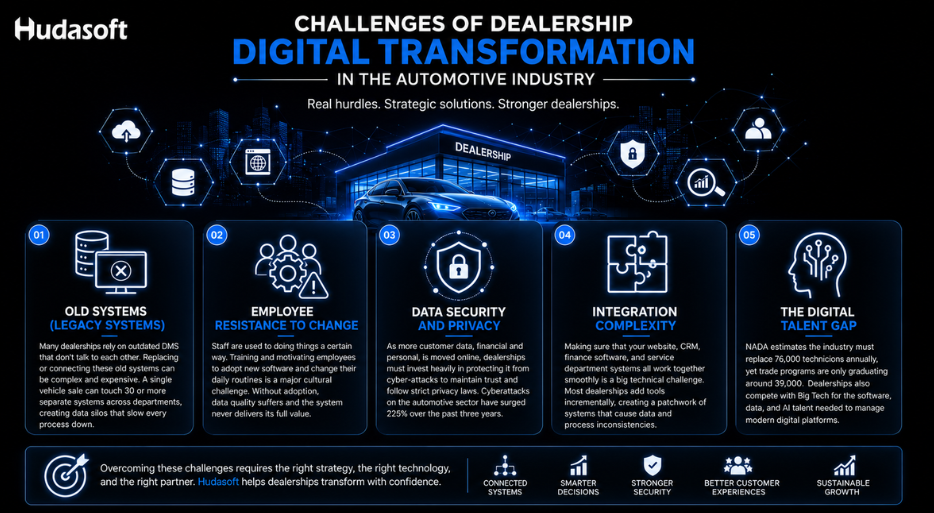
While the benefits are clear, the path to automotive dealership digital transformation has real hurdles. In 2026, dealerships are navigating rising costs, tighter margins, evolving customer expectations, and increasing operational pressure across every department. Understanding where resistance comes from is the first step toward building a strategy that actually sticks.
Old Systems (Legacy Systems)
Many dealerships rely on outdated computer systems (DMS) that don’t talk to each other. Replacing or connecting these old systems can be complex and expensive. A single vehicle sale can touch 30 or more separate systems across departments, creating data silos that slow every process down.
The complexity is not just technical. It disrupts daily workflows during the transition period, which is why many dealerships delay the decision until competitive pressure forces their hand. The longer that delay, the wider the gap between their operations and what modern buyers expect.
Employee Resistance to Change
Staff are used to doing things a certain way. Training and motivating employees to adopt new software and change their daily routines is a major cultural challenge. Salespeople, service advisors, and F&I managers who have operated the same way for years tend to work around new tools rather than adopt them.
This means data quality suffers and the system never delivers its full value. Transformation initiatives that skip structured, role-specific training consistently fail to generate the ROI that the technology is capable of delivering.
Data Security and Privacy
As more customer data, financial and personal, is moved online, dealerships must invest heavily in protecting it from cyber-attacks to maintain trust and follow strict privacy laws. Cyberattacks on the automotive sector have surged 225% over the past three years, and the CDK Global ransomware attack alone caused an estimated $1 billion in losses across thousands of dealerships.
Compliance with state-level data privacy laws adds another layer of operational complexity that cannot be managed without a dedicated security framework in place.
Integration Complexity
Making sure that your website, CRM, finance software, and service department systems all work together smoothly is a big technical challenge. Most dealerships add tools incrementally, which creates a patchwork of systems that pass data inconsistently or require manual intervention to sync.
The result is duplicate records, reporting gaps, and customer-facing errors that damage trust at exactly the moments that matter most in the buying and ownership journey.
The Digital Talent Gap
This challenge has become one of the most pressing for dealerships in 2026. NADA estimates the industry must replace 76,000 technicians annually, yet trade programs are only graduating around 39,000.
Beyond the service bay, dealerships now compete with Big Tech and aerospace firms for the software, data, and AI talent needed to manage modern digital platforms. Dealerships that treat digital roles as secondary to sales and service headcount will consistently fall behind in both technology adoption and operational execution.
Examples of Dealership Transformation
To see how automotive dealership digital transformation works in practice, look at these successful examples:
1. Dealership management systems (DMS)
A modern DMS is the digital hub of a dealership. Instead of sales, service, and finance having their own separate computer programs, a unified DMS puts all customer and vehicle data in one place. This creates a “single source of truth,” meaning every employee sees the same, correct information, leading to faster service and zero confusion.
2. Hub-and-spoke operational models
This model changes the dealership’s physical structure. A large, expensive “Hub” acts as the central inventory, processing, and service center. Smaller, more affordable “Spokes” are satellite sales showrooms or convenient local service drop-off points closer to where customers live. This model lowers operating costs while expanding the dealer’s reach.
3. Service center transformation
The service department is transforming into a profit powerhouse. Digital tools allow technicians to send customers video inspections of their car, explaining needed repairs clearly. Customers can then approve or decline the work digitally on their phone, speeding up the repair time and dramatically increasing customer trust and service revenue.
4. New buying experiences for customers
The sales process is becoming hybrid, and dealerships that have adopted digital buying tools are reporting measurably shorter transaction times, higher customer satisfaction scores, and fewer deal fall-throughs compared to those still relying on fully in-person processes.
- Virtual Showrooms: Customers can browse inventory using 360-degree views or AR (Augmented Reality) from home.
- Online Transaction Tools: Allowing buyers to configure payments, value trade-ins, and apply for credit online means they can complete up to 80% of the transaction before setting foot on the lot. The final visit is just a quick paperwork sign-off and key handover.
5. Direct-to-consumer models
While traditionally used by manufacturers like Tesla, some franchised auto dealerships are adopting elements of this model by creating separate digital storefronts where a buyer can complete the entire car purchase online, including home delivery. This provides ultimate convenience and caters to the segment of customers who want to avoid the showroom entirely.
How Digital Tools Transform Auto Dealer Operations
76% of dealerships plan to increase their AI budgets in 2026, making this the first true AI operations year for automotive retail. The shift is no longer about having a website or a CRM in isolation. It is about deploying the right combination of tools across every department and making them work as a single connected system. Here is how each tool category is transforming dealership operations on the ground.
AI Voice Agents and Chatbots
Lead response speed determines who wins the sale, and human teams cannot maintain 24/7 availability at scale. AI voice agents are the number one technology investment priority for dealerships in 2026, with 74% of dealers actively deploying them to automate inbound call management, lead qualification, and service scheduling. These tools respond to every inquiry within seconds regardless of the time of day, ensuring no lead goes cold while sales staff are occupied or offline.
CRM Platforms
85% of dealerships already use CRM software, but the gap between basic CRM usage and AI-enhanced CRM is where the real operational difference lies. Modern AI-integrated CRM workflows surface high-intent leads, automate follow-up sequences, and flag customers showing early signs of churn before they stop returning for service. CRM reactivation campaigns built on this data can re-engage 20 to 50% of dormant contacts with win-back ROI as high as 100 to 1.
AI-Powered Inventory Management
Inventory sitting on the lot costs money every day. AI-powered inventory tools give dealerships real-time visibility into competitive pricing, transaction history, and demand forecasting by model and trim. Automated inventory management tools reduce vehicle holding costs by 15 to 20% while increasing sales volume by approximately 4.5%. With dealer inventory sitting at roughly 2.1 million units in early 2026, precise AI-driven stock management is the difference between efficient turnover and margin erosion on aged units.
Digital F&I Platforms
F&I is one of the highest-margin departments in any dealership and one of the most paper-dependent. Digital F&I platforms eliminate manual credit processing, paper contracts, and in-person approval bottlenecks. Over 12,000 dealerships have already integrated these platforms, reducing average credit approval processing time by 25%. For customers, the result is a faster, more transparent experience. For the dealership, it is fewer deal fall-throughs and higher per-unit profitability.
Mobile Applications
Post-sale is where most dealerships lose the customer relationship. A purpose-built mobile application keeps the dealership connected to the customer through service reminders, real-time repair status updates, digital approval workflows, and loyalty offers. Service customers generate 67% higher lifetime value than one-time buyers, and mobile tools are the most direct way to protect that relationship between vehicle purchases.
Analytics and Reporting Platforms
Pricing decisions, staffing levels, and marketing spend based on gut feel consistently underperform against data-driven operations. 62% of dealerships are investing in pricing and analytics platforms in 2026 specifically to eliminate this gap. Integrated AI analytics platforms surface actionable insights from DMS, CRM, and service data in real time, giving department heads a live view of where margin is being made, where it is leaking, and where the next opportunity sits.
How Dealerships Can Accelerate the ROI of DMS Systems
A Dealership Management System (DMS) is the central, digital brain of the modern auto dealership, connecting sales, service, and finance. However, simply buying a new DMS doesn’t guarantee a return on investment (ROI). To truly accelerate your DMS’s value and boost your dealership’s digital transformation success, you must ensure the system is fully integrated and used correctly.
Here are the key strategies for maximizing the ROI of your DMS investment:
Mandate Full, Consistent Adoption
The biggest killer of DMS ROI is partial use. If the sales team uses the DMS for leads but the service team uses a separate spreadsheet for scheduling, the data becomes fragmented. Require all departments to enter and retrieve all customer and vehicle data only through the DMS. This creates the “single source of truth” necessary for true efficiency.
Invest in Continuous Training
A DMS is a complex tool. Training shouldn’t stop after the initial install. Provide ongoing, role-specific training for sales staff, service advisors, and accounting teams. When employees know how to use the advanced features like automated service reminders or inventory analysis, they can drive real results.
Leverage Integrated Analytics
Modern DMS platforms offer powerful reporting tools. Don’t just pull basic sales reports. Use the system’s analytics to:
- Identify Bottlenecks: Pinpoint exactly where deals slow down (e.g., F&I or trade appraisals).
- Optimize Inventory: Use data to stock vehicles that sell fastest in your local market.
- Track Profit Leakage: Find hidden costs, like excessive credit check fees or unused add-on applications, and eliminate them.
Go Truly Paperless
Many dealerships keep the DMS for tracking but still rely on printing forms for F&I or service sign-offs. Use the DMS’s digital contracting and document management tools (often a key feature of automotive dealership digital transformation) to eliminate printing, storage, and retrieval costs, saving both time and money.
Integrate Third-Party Tools
A modern DMS should not operate alone. Ensure your system seamlessly connects with your CRM, digital marketing platforms, and OEM portals. This prevents staff from manually moving data between systems, which saves time and eliminates costly errors, making the whole dealership’s digital transformation process much smoother.
Case Study
This is what auto dealership digital transformation looks like when it is executed correctly.
A US-based dealership group was running multiple locations with no centralized system connecting sales, service, and inventory. Salespeople were working off spreadsheets, service advisors had no visibility into vehicle history, and management had no real-time picture of performance across locations.
Manual data entry was creating inventory errors, deal jackets were paper-based, and pulling a complete performance report took days and still came back incomplete. Fragmented systems were silently draining efficiency, margin, and customer trust, which is the exact problem that kills profitability before leadership even identifies it.
Hudasoft built DealerERP, a custom AI-powered platform that centralized sales, service, inventory, and finance into one connected system. The platform replaced manual data entry and spreadsheet reporting entirely. Every department now operates from a live, verified source of truth, with:
- AI-powered sales tracking that calculates real-time pace against targets across all locations
- Predictive analytics that forecasts future performance using historical DMS and market data
- Unified dashboards giving management instant KPI visibility across every department and location
- Automated inventory management that eliminates double-selling and reduces carrying costs
- Integrated service workflows connecting technician job cards, customer approvals, and parts in one place
| Result Metric | Improvement | What This Means for the Dealership |
| Sales Team Efficiency | 50% increase | Staff spend less time on paperwork and more time selling cars, leading to higher conversion rates. |
| Service Cycle Times | 35% reduction | Customers get their cars back faster through automated service scheduling and quicker internal job hand-offs. |
| Inventory Accuracy | 30% improvement | Real-time stock monitoring prevents double-selling cars and ensures the sales team always knows what vehicles are truly available. |
Conclusion
The journey through auto dealership digital transformation is more than just a tech upgrade; it is the essential strategy for survival and success in 2026. The facts are clear: the modern customer demands speed, transparency, and a single, effortless experience across every touchpoint.
The time for delay is over. Dealerships that continue to struggle with fragmented systems, manual paperwork, and slow customer responses are actively losing money, sacrificing valuable leads and profit margins.
By investing in core systems like a unified DMS and adopting modern tools like AI chatbots and mobile service apps, the automotive dealership can achieve powerful results, as shown by the dealership management solution major increases in staff efficiency, faster service times, and higher inventory accuracy.
Ultimately, this dealership’s digital transformation is about building trust. By simplifying the process and removing friction, you move away from old, high-pressure models and create the loyalty that drives repeat business and sustained profitability. The future of the car dealership is digital, and those who lead the charge today will dominate the market tomorrow.
Frequently Asked Questions
What does digital transformation mean for a car dealership?
Digital transformation for a car dealership means replacing disconnected, manual processes across sales, service, finance, and inventory with a single connected digital system. It is not just about having a website. It means your CRM, DMS, F&I platform, and service management tools all share the same data in real time, so every department operates from one verified source of truth instead of separate spreadsheets and paper files.
Where should a dealership start with digital transformation?
Start with the area causing the most measurable revenue loss. For most dealerships that is lead response. Research shows:
– 78% of customers buy from the dealer that responds first
– Only 13.2% of dealerships respond to a lead within 5 minutes
– The average response time across the industry is 42 hours
Fix that first with an AI-powered CRM or chatbot, then build toward a unified DMS that connects every department.
How long does auto dealership digital transformation take?
It depends on the size and complexity of the operation. A focused single-function deployment such as an AI lead response tool or digital F&I platform can be live within weeks. A full DMS implementation connecting sales, service, inventory, and finance typically runs 3 to 6 months for a single-rooftop dealership and 6 to 12 months for a multi-location dealer group.
What is the ROI of digital transformation for dealerships?
ROI varies by what you implement and how completely it is adopted. Based on current industry data:
– Dealerships using digital retailing tools generate 47.9% more high-quality leads
– AI-driven analytics report 32% higher conversions and 70% faster response times
– Automated inventory management reduces holding costs by 15 to 20% while increasing sales volume by 4.5%
– Marketing automation delivers an average 544% ROI over three years
The biggest ROI killer is partial adoption where tools are purchased but not fully used across all departments.
Can small dealerships afford digital transformation?
Yes. Digital transformation does not require a full enterprise overhaul from day one. Small and independent dealerships can start with affordable, high-impact tools:
– AI chatbots for after-hours lead capture
– Cloud-based CRM for lead tracking and follow-up
– Digital service scheduling and approval workflows
– Mobile-first customer communication tools
54% of dealer website traffic happens outside business hours, meaning after-hours lead capture alone can recover significant revenue that most small dealerships are currently losing to competitors who respond faster.
Does digital transformation eliminate the need for in-person sales staff?
No. Digital tools handle the parts of the process that customers find most frustrating, paperwork, financing applications, approvals, and scheduling. Sales staff still drive test drives, relationship building, and deal negotiation. What changes is that your team spends less time on administrative tasks and more time on activities that actually close deals. Dealerships that implemented unified DMS platforms reported a 50% increase in sales team efficiency without reducing headcount.
What is the biggest risk of automotive dealership digital transformation?
Partial adoption. The biggest ROI killer in automotive dealership transformation is not the technology itself but departments continuing to use old systems alongside the new one. When the sales team uses the DMS but the service team still runs a separate spreadsheet, data becomes fragmented and the system never delivers its full value. Every major implementation failure traces back to the same root cause: insufficient training and no mandate for full adoption across every department.

