


Quick Answer:
AI agent development cost in 2026 ranges from $8,000 for a basic rule-based chatbot to $500,000+ for a full enterprise multi-agent platform.
Most mid-market projects land between $40,000 and $150,000.
After launch, budget $4,200 to $18,000 per month for operational costs: LLM API usage, cloud infrastructure, monitoring, and maintenance.
Five variables drive the final number: agent type, number of system integrations, compliance requirements, LLM selection, and whether the team is in-house, outsourced, or offshore.
Budgeting for an AI agent in 2026 should be straightforward. In practice, most decision-makers get either a vague range that means nothing, or a firm number that falls apart the moment scoping begins.
The problem is not a lack of information. It is a lack of structured, specific information tied to actual variables: agent type, integration count, compliance requirements, team model, and ongoing operational spend. Those five factors determine 90% of the final cost, and most pricing guides address maybe two of them.
This guide covers AI agent development cost across every dimension that matters. It includes a master cost table by agent type, a phase-by-phase breakdown from discovery through annual maintenance, industry-specific pricing across nine sectors, the hidden monthly costs most vendors omit, a team model comparison, available pricing structures, and the questions to ask any vendor before signing. All figures reflect 2026 US market rates drawn from publicly available industry data.
AI Agent Development Cost at a Glance
All figures reflect 2026 US market rates across a range of project complexities.
| Agent Type | Build Cost (USD) | Monthly OpEx | Typical Timeline |
| Rule-based / simple chatbot | $8,000 – $30,000 | $500 – $2,000 | 4 – 8 weeks |
| Contextual / model-based agent | $30,000 – $80,000 | $1,500 – $4,000 | 6 – 12 weeks |
| LLM-powered task agent | $50,000 – $120,000 | $2,000 – $6,000 | 8 – 14 weeks |
| RAG-based knowledge agent | $50,000 – $150,000 | $3,000 – $9,000 | 12 – 20 weeks |
| Goal-based / autonomous agent | $80,000 – $200,000 | $3,500 – $10,000 | 12 – 22 weeks |
| Multi-agent system | $150,000 – $350,000 | $8,000 – $20,000 | 16 – 28 weeks |
| Enterprise agentic AI platform | $300,000 – $500,000+ | $10,000 – $25,000+ | 24 – 40+ weeks |
Build cost includes design, development, integration, testing, and initial deployment. Monthly OpEx (Operational Expenditure) covers LLM API usage, vector database hosting, cloud infrastructure, monitoring, and prompt tuning. Timelines assume an experienced external team; in-house builds typically run 30 to 50 percent longer.
On 2027 pricing: LLM costs are falling as provider competition intensifies. Entry-tier agent development is declining roughly 15 to 20 percent year over year. Enterprise-grade builds are not on the same trajectory because integration depth and compliance requirements are growing alongside capability.
How Much Does an AI Agent MVP or Proof of Concept Cost?
Most organizations do not start with a full agent build. They start with a question: does this actually work for our specific workflow before we commit serious budget to it? A proof of concept and an MVP are the two structured ways to answer that question, and they serve different purposes at different stages of the decision process.
The table below gives you the numbers before the explanation.
| Stage | Build Cost | Timeline | What You Get |
| Proof of Concept (POC) | $8,000 – $25,000 | 3 – 5 weeks | Single workflow, controlled data, internal validation only |
| Prototype | $15,000 – $35,000 | 4 – 7 weeks | Functional demo with limited integrations, stakeholder review |
| MVP | $25,000 – $60,000 | 6 – 12 weeks | Production-ready core feature set, live integrations, real users |
| Full Custom Agent | $50,000 – $500,000+ | 12 – 40+ weeks | Complete build across all workflows and integrations |
Proof of Concept ($8,000 – $25,000)
A POC answers one question: can an AI agent handle this specific task on our data? It runs on a controlled dataset, covers a single workflow, and produces output that the internal team reviews and validates. It does not connect to live systems, it does not go in front of real users, and it does not carry production-grade testing.
The value of a POC is the technical evidence it produces before the organization commits to a full build. Teams that skip this stage and go straight to a full build tend to discover data or integration problems mid-project, which costs significantly more to resolve than a structured POC would have.
Common use cases at POC stage: Testing LLM accuracy on internal documents, validating that a DMS or CRM can supply the data the agent needs, confirming that a voice interface handles domain-specific terminology correctly.
What drives POC cost: Data preparation time, LLM selection and prompt engineering, internal evaluation framework setup.
Prototype ($15,000 – $35,000)
A prototype takes the POC one step further. It connects to one or two live systems, handles a wider range of inputs, and produces output that stakeholders outside the technical team can review. It is not production-ready, but it demonstrates what the finished agent will do and surfaces integration challenges before the full build begins.
Prototypes are particularly useful for organizations that need internal sign-off before committing budget to a full engagement. A working demo moves stakeholder decisions faster than written proposals, and it surfaces integration gaps that only appear when the agent connects to live data.
Common use cases at prototype stage: A dealership lead agent connected to live CRM data, a support agent handling real ticket categories against a limited knowledge base, an HR onboarding agent walking through the first three steps of a new hire workflow.
What drives prototype cost: Number of live integrations, scope of inputs the agent must handle, fidelity of the user interface for stakeholder review.
MVP ($25,000 – $60,000)
An MVP goes into production. Real users interact with it, it connects to live systems, and it handles the core workflow the agent was designed for. It does not cover every edge case, every integration, or every user scenario. It covers enough to generate real usage data and measure whether the agent delivers the ROI the business case projected.
The 6 to 12 week timeline assumes a well-defined scope agreed before development starts. Scope changes after kickoff are the most consistent reason MVP builds exceed their budget and timeline. Organizations that define the MVP around one measurable workflow get more usable data from this stage than those who treat it as a scaled-down version of the full build.
Common use cases at MVP stage: A customer support agent handling one ticket category at full volume, a property management agent managing maintenance request intake across one portfolio, a sales intelligence agent scoring and prioritizing inbound leads for one territory.
What drives MVP cost: Number of production integrations, QA depth required for live users, LLM selection and prompt tuning for real-world input variance.
When to Choose Each Stage
Not every project needs to start at POC. Organizations with clean, structured data, a single well-defined workflow, and internal alignment on the use case can move directly to MVP without a POC phase. The POC stage makes sense when the data readiness is uncertain, when the use case has not been validated technically, or when internal stakeholders need evidence before approving budget.
A common sequencing mistake is building an MVP scope on a POC budget. The two stages have different testing requirements, different integration depths, and different quality standards. Mixing them produces something too limited for production and too costly for a validation exercise.
AI Agent Development Cost by Type
In 2026, “AI agent” describes everything from a simple decision-tree bot to a fully autonomous platform managing multi-step enterprise workflows. The cost difference between those two ends is roughly 60x, which makes agent type selection the single most consequential budget decision in any project.
Rule-Based / Simple Reflex Agent ($8,000 – $30,000)
Rule-based agents run on predefined logic: an input arrives, it matches a rule, and a predetermined output is returned. No LLM reasoning is involved, no memory is maintained, and the system does not learn from interactions.
Best for: FAQ bots, ticket routing, basic lead qualification, internal HR self-service with fixed question sets.
Cost drivers: A bare-bones build runs around $8,000. Adding a custom UI, CRM integrations, or multi-language support pushes the figure to $25,000 to $30,000. Each integration is additive.
Limitation: Any input outside the programmed logic breaks the agent. These systems do not adapt or improve without manual rule updates.
2027 outlook: No-code platforms are rapidly commoditizing this tier. Custom-coded rule-based agents will be the exception rather than the standard for most business use cases by 2027.
Contextual / Model-Based Agent ($30,000 – $80,000)
A contextual agent tracks session history and uses prior inputs to shape its responses. Unlike a rule-based system, it handles multi-turn conversations and adjusts within a session based on what has already been said, making it suitable for workflows where continuity matters.
Best for: Customer onboarding flows, internal knowledge assistants, support agents where conversation continuity matters.
Cost drivers: Memory architecture, session state management, and integration with existing knowledge bases each add engineering complexity beyond the rule-based tier.
LLM-Powered Task Agent ($50,000 – $120,000)
This tier introduces a large language model as the reasoning layer. The agent interprets natural language, works through a defined problem, and completes a specific task. It tolerates ambiguous inputs, generates drafts, pulls structured data from unstructured sources, and executes single-task automation against external tools.
Best for: Document summarization, email drafting, support response generation, contract extraction, lead scoring.
Cost drivers: Tool integrations, prompt engineering depth, and the QA investment needed to prevent hallucinations in production. Most businesses exploring AI agent development services for the first time start at this tier.
Geography is also a significant factor here. Custom AI agent development costs for a US-based senior team on this scope typically run $80,000 to $120,000. A comparable nearshore team generally delivers the same scope for $40,000 to $70,000.
RAG-Based Knowledge Agent ($50,000 – $150,000)
A RAG agent retrieves relevant content from your documents or databases before generating a response, grounding its output in your internal data rather than relying on the LLM’s general training. This architecture directly reduces hallucination risk for domain-specific queries where accuracy against proprietary content is essential.
Best for: Internal knowledge management, documentation Q&A, compliance queries, technical support against proprietary content.
Cost drivers: The knowledge ingestion pipeline, vector database setup and hosting (Pinecone, Weaviate, ChromaDB), embedding generation, and content filtering all contribute to both build and operational cost. Vector database infrastructure alone typically adds $2,000 to $20,000 per year.
Goal-Based / Autonomous Agent ($80,000 – $200,000)
A goal-based agent does not wait for step-by-step prompting. It assesses available actions against a defined objective, selects the most viable path, and executes autonomously. Multi-step workflows, shifting conditions, and tool-use decisions all happen without a human in the loop at each step.
Best for: Cross-system task automation, autonomous research workflows, multi-step approvals, predictive maintenance with automatic escalation.
Cost drivers: Planning logic, fallback handling, tool orchestration, and safety guardrails significantly expand the QA surface compared to task agents. Human-in-the-loop checkpoints, while reducing autonomy risk, add further engineering overhead.
Multi-Agent System ($150,000 – $350,000)
A multi-agent system runs multiple specialized agents under a shared orchestration layer. One agent plans, another retrieves data, a third executes, a fourth validates. They communicate, hand off tasks, and collectively handle workflows that exceed what a single agent can manage reliably.
Best for: Autonomous sales pipelines, end-to-end HR onboarding, multi-source research workflows, supply chain decision systems.
Cost drivers: Coordination logic, task decomposition, failure handling when a chain breaks, and evaluation complexity. Agent-to-agent interactions can produce unexpected outputs that require more intensive testing than single-agent builds.
2027 outlook: Orchestration frameworks are maturing. Multi-agent development costs for well-defined use cases are expected to drop 20 to 30 percent by 2027 as tooling matures and production experience accumulates.
Enterprise Agentic AI Platform ($300,000 – $500,000+)
Enterprise platforms integrate across existing infrastructure: ERP, EHR, CRM, proprietary data lakes, and legacy APIs. They run autonomously across full business processes with human-in-the-loop checkpoints, compliance infrastructure, and SLA-backed monitoring baked in.
Best for: Organization-wide workflow automation, agentic ERP layers, autonomous finance operations, large-scale AI transformation initiatives.
Cost drivers: Each enterprise system integration (SAP, Salesforce, Epic, Workday) adds 2 to 4 weeks of engineering. Compliance infrastructure for SOC 2, HIPAA, or FedRAMP adds $30,000 to $60,000 on its own. At this tier, the engagement functions as a program, not a project.
AI Agent Development Cost by Phase
Total project cost accumulates across phases, each carrying its own complexity and risk. Knowing where the money goes at each stage helps prevent surprises mid-build and gives procurement teams a defensible budget structure.
Phase 1: Discovery and Planning ($5,000 – $15,000)
Discovery produces three things: a requirements document, an architecture overview, and a data readiness assessment. It maps data sources, identifies integration points, and establishes measurable success criteria before any development begins. Budget overruns in AI agent projects trace most often to rushed discovery; ambiguous requirements become scope creep that costs far more to unwind mid-build than it would have cost to resolve upfront.
Cost drivers: Vague requirements, missing data, stakeholder misalignment, regulatory complexity.
Phase 2: Data Collection and Preparation ($10,000 – $70,000)
The $60,000 swing in this range reflects a straightforward split. Organizations with structured, API-accessible data move through quickly and cheaply. Those carrying years of fragmented, unstructured content with no governance framework face a substantially more expensive preparation effort, and data quality problems caught here are far less costly to fix than the same problems surfacing during model training.
Cost drivers: Data volume, labeling complexity, regulatory requirements (GDPR, HIPAA), number of source systems.
Phase 3: Model Setup and Training ($15,000 – $100,000)
Model setup covers LLM selection, fine-tuning on domain-specific data where needed, and configuration of the core intelligence layer. The large majority of business AI agents use a pre-trained model (GPT-4o, Claude, Gemini, or LLaMA) adapted through prompt engineering rather than trained from scratch. Building a custom model from scratch is rarely cost-justified for commercial use cases and extends timelines substantially.
Cost drivers: Model capability requirements, fine-tuning data quality, training iteration count, proprietary vs. open-source selection.
Phase 4: Integration and Workflow Orchestration ($20,000 – $50,000)
Integration connects the agent to external systems: APIs, databases, CRMs, ERPs, authentication layers, and the orchestration logic that sequences actions. A single standard API integration costs $1,800 to $4,300; complex or legacy connections run $4,000 to $8,500 each. Finalizing the integration list before scoping begins is one of the more effective ways to control this phase’s final cost.
Cost drivers: Integration count, legacy system complexity, authentication requirements, data synchronization, framework selection.
Phase 5: Testing and Validation ($5,000 – $50,000)
Testing an AI agent covers more than code verification. Behavioral accuracy, edge case handling, hallucination prevention, regression testing across updates, security review, and human-in-the-loop evaluation all fall within scope here. Production defects in AI systems cost significantly more to remediate than defects caught during testing, yet this phase consistently receives less budget than its risk profile warrants.
Cost drivers: Agent complexity, edge case volume, accuracy requirements in regulated contexts, manual vs. automated QA ratio.
Phase 6: Deployment and Monitoring ($10,000 – $30,000)
Getting the agent into production involves cloud infrastructure setup, CI/CD pipeline configuration, containerization, load balancing, and observability tooling that tracks agent performance once live. The right monitoring stack here prevents far more expensive firefighting later.
Cost drivers: Cloud provider, traffic volume, uptime SLA requirements, model size, monitoring tooling selection.
Phase 7: Maintenance and Scaling ($10,000 – $50,000+ per year)
Post-launch maintenance includes model retraining as data evolves, prompt tuning, performance optimization, security updates, compliance reviews, and feature additions. Annual maintenance generally runs 15 to 25 percent of the initial build cost, though systems with significant user growth or frequent underlying model updates can exceed that band.
Cost drivers: Data change rate, user growth, model deprecation cycles, compliance evolution, feature roadmap.
Phase-by-Phase Cost Summary
| Phase | Cost Range | Complexity |
| Discovery and planning | $5,000 – $15,000 | Low |
| Data collection and preparation | $10,000 – $70,000 | Medium to High |
| Model setup and training | $15,000 – $100,000 | Medium |
| Integration and orchestration | $20,000 – $50,000 | High |
| Testing and validation | $5,000 – $50,000 | High |
| Deployment and monitoring | $10,000 – $30,000 | Medium |
| Annual maintenance | $10,000 – $50,000+ | Ongoing |
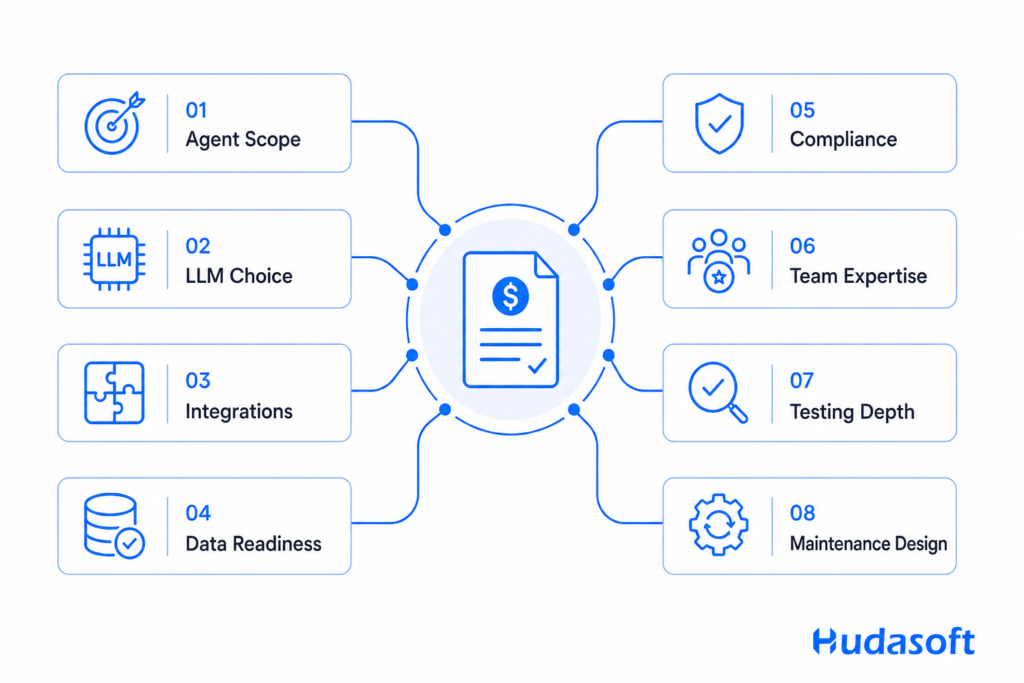
8 Factors That Determine Your Final AI Agent Development Cost Estimate
Two organizations can request quotes on the same agent type and receive numbers that differ by $100,000. These eight variables account for that gap.
1. Agent Complexity and Scope
A narrowly scoped agent built around one workflow costs substantially less than a system designed to handle varied scenarios.
Budget and timeline requirements also shift considerably by organization size, and the cost of AI agent development for small businesses follows a different set of constraints than mid-market or enterprise planning.
Mid-project scope expansion is the most consistent cause of budget overruns across AI agent projects, and locking scope before development starts is the single most effective cost control measure available.
2. LLM Selection
Proprietary models (GPT-4o, Claude Sonnet, Gemini Pro) charge per token and carry ongoing operational costs that scale directly with usage. Open-source alternatives such as LLaMA 3 and Mistral eliminate per-token fees but require self-hosted infrastructure.
The decision affects both the build cost, since integration complexity varies by model, and the monthly OpEx over the agent’s operational life.
3. Number and Complexity of Integrations
Every external system the agent reads from or writes to adds engineering time: authentication setup, data schema mapping, error handling, and test coverage. Moving from a standalone agent to one connected across four enterprise systems multiplies integration complexity four to five times. The integration list is worth finalizing before any estimate is requested.
4. Data Readiness
Organizations with clean, structured, API-accessible data move through development faster and at lower cost. Those requiring a dedicated data preparation phase before training or RAG setup should budget 20 to 40 percent more on both cost and timeline. Pre-project investment in data organization is one of the higher-ROI activities available before development begins.
5. Compliance and Security Requirements
Regulated industries carry a compliance premium that is material. HIPAA compliance requires PHI isolation, audit logging, encryption at rest and in transit, and business associate agreements with every vendor in the stack. SOC 2 Type II certification alone adds $30,000 to $60,000.
Identifying compliance obligations during scoping, rather than mid-build, prevents a category of cost surprises that derails more AI agent projects than most teams anticipate.
6. Team Location and Seniority
Upwork’s published data shows AI and ML engineers billing at $50 to $200 per hour, with a platform median of $100 per hour.
Senior ML engineers on managed staffing platforms average $118 to $195 per hour. US-based agency project rates run $150 to $250 per hour, nearshore teams in Eastern Europe and Latin America charge $60 to $100 per hour, and offshore teams in South Asia range from $25 to $60 per hour.
The rate differential is real, but a poorly architected agent requiring a rebuild costs more in total than a well-built one at a higher initial hourly rate.
7. Testing and Evaluation Depth
Adversarial testing covering hallucination detection, edge case handling, and failure modes adds 15 to 25 percent to development time. For agents in regulated industries or making decisions with material business consequences, this investment is not discretionary.
8. Maintenance Architecture
An agent built with an abstraction layer between its logic and the underlying LLM costs modestly more upfront and considerably less to maintain when the base model is deprecated or updated.
Foundation model deprecation is a routine event across all major providers, not an edge case, and factoring for it during initial architecture decisions reduces 3-year total cost of ownership substantially.
How Interface Type Affects AI Agent Development Cost
Most agent cost breakdowns focus on the LLM, integrations, and orchestration logic. The interface layer sits on top of all of that and carries its own build cost depending on what the agent needs to do.
| Interface Type | Additional Build Cost | Monthly OpEx Add-on | Primary Technical Requirement |
| Text chat (web or app) | $1,500 – $4,000 | $100 – $400 | UI components, session state, conversation rendering |
| Voice interface | $8,000 – $20,000 | $800 – $3,000 | STT/TTS integration, telephony platform, latency tuning |
| Document and image input | $4,000 – $10,000 | $300 – $1,200 | OCR pipeline, file parsing, multimodal model configuration |
| Admin dashboard and reporting | $5,000 – $15,000 | $200 – $600 | Data visualization layer, role-based access, export handling |
| Multi-interface (2 or more) | $15,000 – $40,000 | $1,200 – $4,500 | Cross-channel session continuity, unified state management |
These figures represent the interface layer cost only and add to the agent build cost.
Text Chat ($1,500 – $4,000)
A text chat interface handles multi-turn conversation rendering, session state, and basic UI components like message threading and input handling. A web-embedded widget costs toward the lower end of this range. A mobile-optimized interface with custom branding and conversation history storage pushes toward the upper end.
Monthly operational cost stays low at this tier. No telephony charges, no speech processing API fees. For agents where the primary channel is a browser or app, text chat is the most cost-efficient interface option.
Common deployments: Customer support portals, HR self-service tools, internal knowledge assistants, sales qualification flows.
Key cost drivers: Custom UI design fidelity, conversation history storage, mobile responsiveness, branding requirements.
Voice Interface ($8,000 – $20,000)
Voice adds three engineering layers that text chat does not require: speech-to-text converts caller audio into text, text-to-speech converts the agent response back into audio, and a telephony platform connects the call to the agent infrastructure. Each layer carries a build cost and an ongoing per-minute operational charge.
Latency is the primary quality variable. Tuning the pipeline to achieve a response time below 1.5 seconds requires dedicated engineering during QA. Multi-language support and high concurrent call volumes add further to both build cost and monthly OpEx.
Common deployments: Inbound service scheduling, after-hours call handling, lead qualification, appointment reminders.
Key cost drivers: STT/TTS API selection, telephony platform integration, latency optimization, multi-language support, concurrent call capacity.
Document and Image Input ($4,000 – $10,000)
Document and image interfaces let users submit PDFs, contracts, invoices, or photos that the agent processes and responds to. An OCR pipeline extracts text from scanned documents, a file parsing layer handles structured formats, and a multimodal model configuration handles image inputs.
Clean, text-based PDFs cost toward the lower end. Scanned documents with variable formatting, mixed-language content, or embedded tables require a more robust parsing pipeline and land toward the upper end.
Common deployments: Legal document review, invoice processing, insurance claims intake, property inspection reports.
Key cost drivers: OCR accuracy requirements, file format variety, scanned vs. native PDF handling, document size limits.
Admin Dashboard and Reporting ($5,000 – $15,000)
An admin dashboard gives the operations team visibility into conversation volumes, resolution rates, escalation frequency, and cost per interaction. Build cost scales with how many data sources feed the dashboard and how much interactivity the reporting layer needs.
A static weekly summary from one data source is a contained build. An interactive dashboard with real-time metrics, role-based access, and CSV export across multiple agent deployments requires substantially more engineering work.
Common deployments: Operations monitoring, executive reporting, compliance audit views, multi-location performance tracking.
Key cost drivers: Data source count, real-time vs. batch reporting, role-based access configuration, BI tool integration.
Multi-Interface Deployments ($15,000 – $40,000)
Organizations deploying the same agent across voice, chat, and document input face an engineering challenge beyond adding individual interface costs. The agent needs consistent session state across channels and output formatted appropriately for each one.
Cross-channel session continuity is the primary cost driver. Without it, the agent treats each channel as a separate conversation and loses context when the user switches. Building this layer correctly from the start costs less than retrofitting it after each interface deploys independently.
Common deployments: Enterprise customer service platforms, multi-location dealership operations, property management groups handling tenant communication across phone, portal, and email.
Key cost drivers: Cross-channel session management, unified state architecture, channel-specific output formatting, concurrent load balancing.
AI Agent Development Cost by Industry
Industry context shapes AI agent cost as directly as technical complexity. Compliance requirements, integration depth, and accuracy standards vary significantly across sectors, each affecting both build spend and ongoing operational cost.
Industry Cost Summary
| Industry | Typical Build Cost | Key Cost Driver |
| Healthcare | $100,000 – $400,000 | HIPAA compliance + EHR integration |
| Financial services | $120,000 – $500,000+ | Regulatory compliance + audit trails |
| Retail and e-commerce | $40,000 – $200,000 | Scale + real-time personalization |
| Manufacturing | $80,000 – $300,000 | OT integration + edge deployment |
| Human resources | $50,000 – $150,000 | HRIS integration + PII handling |
| Legal and professional services | $100,000 – $300,000 | Accuracy requirements + citation grounding |
| Automotive and mobility | $60,000 – $300,000 | DMS integration + real-time telematics |
| PropTech | $50,000 – $250,000 | PMS integration + MLS connectivity |
| Sports tech | $40,000 – $180,000 | Live data APIs + real-time infrastructure |
Healthcare ($100,000 – $400,000)
Of all sectors, healthcare carries the highest combined compliance and integration burden for AI agent deployments. HIPAA mandates PHI data isolation, role-based access controls, audit trails, encryption at rest and in transit, and business associate agreements with every vendor in the technology stack. EHR integrations with Epic, Cerner, and Meditech are among the most technically demanding enterprise connections available, adding 6 to 12 weeks to standard timelines.
Common use cases: Patient intake, clinical documentation, prior authorization, care navigation, appointment scheduling.
Key cost drivers: HIPAA compliance infrastructure, EHR integration depth, clinical accuracy requirements, PHI handling architecture.
Financial Services ($120,000 – $500,000+)
Financial services AI agents sit at the intersection of multiple overlapping regulatory frameworks. SEC, FINRA, and AML/KYC obligations, combined with real-time data dependencies and strict auditability standards, mean compliance infrastructure for a production-grade fintech agent frequently runs $50,000 to $100,000 before a line of agent logic is written.
Common use cases: Fraud detection, compliance Q&A, loan processing, trading intelligence, customer advisory automation.
Key cost drivers: Regulatory compliance infrastructure, real-time data integration, explainability requirements, audit trail architecture.
Retail and E-commerce ($40,000 – $200,000)
Retail agents face lower compliance overhead than healthcare or financial services, though concurrency requirements and personalization demands introduce their own cost pressures. A customer support agent for a high-traffic platform must sustain thousands of simultaneous sessions while maintaining consistent accuracy, which drives both infrastructure spend and testing investment upward.
Common use cases: Customer support, order and returns handling, product recommendations, inventory assistance, personalized shopping.
Key cost drivers: Concurrency capacity, catalog integration, real-time personalization architecture, safety guardrails.
Manufacturing and Supply Chain ($80,000 – $300,000)
Manufacturing agents frequently need to read from PLCs, SCADA systems, and industrial IoT sensors that were designed without external software integration in mind. Edge deployment, running the agent on-premises rather than cloud-hosted, is often required for latency or security reasons and adds meaningfully to infrastructure spend.
Common use cases: Predictive maintenance, procurement automation, supplier Q&A, quality control, supply chain monitoring.
Key cost drivers: OT system integration complexity, edge deployment requirements, real-time decision logic, ERP connectivity.
Human Resources ($50,000 – $150,000)
HR agents process sensitive employee data, which creates privacy obligations even when formal regulatory frameworks like HIPAA are not in scope. Global organizations typically require multi-language support, adding complexity to both LLM configuration and testing coverage that does not appear in domestic-only deployments.
Common use cases: Recruitment screening, onboarding automation, policy Q&A, performance review support, benefits guidance.
Key cost drivers: HRIS integrations (Workday, SAP SuccessFactors, BambooHR), multi-language support, PII handling, sensitivity guardrails.
Legal and Professional Services ($100,000 – $300,000)
Accuracy requirements in legal contexts leave little tolerance for hallucination. A RAG architecture with citation grounding, where every response identifies its specific source document, is standard practice because outputs must be traceable and verifiable. Jurisdiction-specific logic adds a further layer of build complexity that varies by geography of deployment.
Common use cases: Contract review, regulatory monitoring, legal research, policy search, document classification.
Key cost drivers: High-accuracy RAG, citation grounding architecture, jurisdiction-specific logic, accuracy validation standards.
Automotive and Mobility ($60,000 – $300,000)
Automotive is one of the fastest-moving AI agent adoption sectors in 2026. Digital Dealer’s 2026 industry survey found 74% of dealerships are actively investing in AI voice agents for lead response, inbound call management, and service scheduling, making it the single most targeted AI investment category across the sector.
AI agent applications in this industry span three distinct operational layers: auto dealership digital transformation, fleet management, and ride hailing and dispatch.
For dealership deployments, agents handle inventory Q&A, lead qualification, service appointment booking, and customer follow-up across sales, service, and finance departments. Integration with dealer management systems (CDK Global, Tekion, Reynolds and Reynolds) is the primary cost driver, adding 4 to 8 weeks of engineering time per DMS connection.
Fleet management agents track vehicles in real time, monitor driver behavior, schedule preventive maintenance, optimize routing, and flag fuel anomalies autonomously. Published industry case data documents 18% fuel cost reduction and 24% improvement in on-time delivery rates from production fleet agent deployments.
Ride hailing and dispatch agents automate trip assignment, dynamic pricing, driver allocation, and passenger communication across multi-vehicle operations.
Common use cases: AI voice agents for inbound dealer calls, inventory search and availability agents, service scheduling automation, fleet predictive maintenance agents, route optimization agents, automated ride dispatch systems.
Key cost drivers: DMS integration complexity (CDK, Tekion, Reynolds), real-time GPS and telematics data feeds, multi-location fleet scale, dispatch logic for concurrent ride allocation, driver behavior monitoring infrastructure.
PropTech ($50,000 – $250,000)
PropTech is one of the higher-growth AI agent adoption categories in 2026. Buildium’s 2026 industry report found property management AI adoption jumped from 20% in 2024 to 58% in 2025, with AI adopters projecting 31% portfolio growth compared to 12% for non-adopters.
AI agents in property management handle tenant screening, rent collection reminders, maintenance request triage, lease renewal workflows, and supplier coordination.
Real estate CRM agents qualify inbound leads, match buyers to listings, automate follow-up sequences, and track pipeline progression without manual intervention.
Construction management agents monitor project timelines, flag budget overruns, coordinate procurement, and surface scheduling conflicts across multi-site builds. The primary integration complexity comes from connecting agents to property management platforms (AppFolio, Yardi, Buildium), MLS systems, and accounting tools simultaneously.
Common use cases: Tenant screening and onboarding agents, automated rent collection and arrears follow-up, maintenance request routing, lead qualification and listing match agents, construction project monitoring, budget variance alerting.
Key cost drivers: Property management platform integrations (AppFolio, Yardi, Buildium), MLS and listing feed connectivity, multi-portfolio scale requirements, document processing for lease abstraction, compliance with local tenancy regulations.
Sports Tech ($40,000 – $180,000)
AI agent deployment in sports technology is growing across club operations, fan engagement, athlete performance, and ecommerce. A high-quality sports platform with AI modules and real-time data integration costs $25,000 to $180,000 in 2026 depending on feature depth and live data requirements.
Sports management agents handle registration workflows, bracket scheduling, fixture conflict resolution, and results publishing autonomously across leagues and tournaments.
Performance analysis agents process match footage, player statistics, and biometric data to surface coaching insights without manual data compilation.
For sports ecommerce, agents power personalized product recommendations, inventory-aware promotions, order management, and customer support across multi-vendor platforms. Live sports data API integrations (Sportradar, Stats Perform, Opta) are the primary technical cost driver, as real-time feeds require low-latency infrastructure and reliable failover handling.
Common use cases: Tournament scheduling and bracket management agents, player registration and profile management, AI-powered match analysis and reporting, fan engagement and Q&A agents, ecommerce personalization agents, inventory and order management automation.
Key cost drivers: Live sports data API integrations (Sportradar, Stats Perform), real-time match data latency requirements, multi-sport and multi-league configuration, OTT streaming infrastructure where applicable, ecommerce catalog and payment gateway connections.
AI Agent Development Cost by Use Case
Industry tables show where costs land based on your sector. But most buyers approach this with a specific workflow in mind, not an industry label. The table below maps cost directly to the job the agent performs.
| Use Case | Build Cost | Monthly OpEx | Primary Cost Driver |
| Customer Support Agent | $40,000 – $120,000 | $2,000 – $5,000 | Volume infrastructure and concurrent session handling |
| Sales Intelligence Agent | $60,000 – $130,000 | $2,500 – $7,000 | CRM integration depth and real-time lead scoring logic |
| HR Onboarding Agent | $50,000 – $100,000 | $1,500 – $4,500 | HRIS integrations and multi-language support |
| Legal Document Review Agent | $100,000 – $200,000 | $3,000 – $10,000 | High-accuracy RAG with citation grounding |
| Marketing Automation Agent | $55,000 – $140,000 | $2,000 – $5,500 | Multi-channel API connections and campaign logic |
| Data Analysis and Reporting Agent | $70,000 – $170,000 | $2,500 – $7,000 | ETL pipeline complexity and visualization layer |
| Logistics and Supply Chain Agent | $70,000 – $160,000 | $2,500 – $6,500 | Real-time tracking feeds and multi-vendor logic |
| Dealership Voice and Lead Agent | $60,000 – $130,000 | $2,000 – $5,500 | DMS integration and voice infrastructure |
| Property Management Agent | $55,000 – $140,000 | $2,000 – $5,500 | PMS integrations and tenancy regulation compliance |
| Finance and Compliance Agent | $100,000 – $250,000 | $3,500 – $10,000 | Regulatory audit trail and explainability requirements |
Customer Support Agent ($40,000 – $120,000)
A single-channel support agent handling standard queries sits at the lower end of this range. Costs rise when the agent manages high concurrent session volumes, routes escalations mid-conversation, and operates across email, chat, and voice at the same time.
Multi-channel deployments require separate integration work per channel, and each adds its own testing surface. Teams that skip load testing at this stage typically face infrastructure rebuilds within six months of launch.
Common use cases: Inbound ticket handling, order status queries, return and refund processing, escalation routing, after-hours support coverage.
Key cost drivers: Concurrent session infrastructure, escalation logic, multi-channel integration, response accuracy QA at scale.
Sales Intelligence Agent ($60,000 – $130,000)
A sales intelligence agent reads pipeline data, scores leads, and surfaces deal risks without waiting for a rep to pull reports manually. The engineering cost concentrates in how deeply the agent connects to existing sales infrastructure, not in the reasoning layer itself.
A read-only agent that surfaces insights is a materially simpler build than one that updates CRM records, triggers outreach sequences, and logs activity autonomously. That distinction alone can shift the final number by $30,000 to $50,000.
Common use cases: Lead scoring and prioritization, deal health monitoring, pipeline gap analysis, automated follow-up drafting, competitive signal tracking.
Key cost drivers: CRM integration depth (Salesforce, HubSpot), read vs. write access architecture, real-time scoring logic, data enrichment API connections.
HR Onboarding Agent ($50,000 – $100,000)
HR onboarding agents handle document collection, policy Q&A, system access requests, and checklist progression across new hire workflows. The underlying logic is mostly sequential, which keeps build complexity moderate compared to other agent types.
Global deployments push the cost toward the upper range. Each additional language requires separate configuration, and jurisdiction-specific compliance rules need individual testing before the agent can go live in that region.
Common use cases: New hire document collection, policy and benefits Q&A, IT access request routing, onboarding checklist progression, probation period tracking.
Key cost drivers: HRIS integrations (Workday, BambooHR, SAP SuccessFactors), multi-language configuration, PII handling architecture, jurisdiction-specific compliance variations.
Legal Document Review Agent ($100,000 – $200,000)
Legal review agents require every response to trace back to a specific source clause. A RAG architecture with citation grounding handles this, but the validation work to confirm that grounding holds under edge cases adds 20 to 30 percent to standard QA timelines.
Jurisdiction-specific rule logic compounds that cost further. Each geography of deployment introduces its own regulatory layer, and those layers need separate configuration and testing before the agent can operate reliably in that market.
Common use cases: Contract clause extraction and review, regulatory compliance Q&A, document classification, policy gap analysis, due diligence support.
Key cost drivers: High-accuracy RAG with citation grounding, jurisdiction-specific rule logic, hallucination prevention architecture, accuracy validation standards, document ingestion pipeline.
Marketing Automation Agent ($55,000 – $140,000)
Marketing agents connect to more external platforms than most other agent types. Ad platforms, email tools, CMS systems, analytics dashboards, and social channels each require a separate integration, and build cost scales directly with that connection count.
A single-channel agent managing email sequences is a contained build. One orchestrating campaign logic across five platforms simultaneously sits firmly at the upper end of this range, with most of the added cost sitting in integration and cross-platform testing.
Common use cases: Email sequence generation and scheduling, campaign performance monitoring, content brief drafting, A/B test analysis, audience segmentation updates.
Key cost drivers: Multi-channel API integrations, campaign orchestration logic, content generation quality controls, analytics platform connectivity.
Data Analysis and Reporting Agent ($70,000 – $170,000)
Data analysis agents pull from multiple sources, run structured analysis, and generate summaries or dashboards on a scheduled or on-demand basis. Engineering complexity concentrates in the data layer, specifically how clean the sources are and how many systems feed the agent.
An agent reading from a single structured database is a straightforward build. One aggregating across a data warehouse, multiple APIs, and inconsistent schemas requires substantial ETL work before the agent logic itself can be written.
Common use cases: Automated weekly and monthly reporting, KPI monitoring and anomaly alerting, ad-hoc data Q&A, executive dashboard generation, cross-source trend analysis.
Key cost drivers: ETL pipeline complexity, data source count and schema consistency, visualization layer requirements, query accuracy validation.
Logistics and Supply Chain Agent ($70,000 – $160,000)
Logistics agents monitor shipments, flag delivery exceptions, coordinate with suppliers, and surface inventory risks from live data feeds. The cost in this category comes from those real-time data dependencies, not from complex reasoning logic.
The agent needs live feeds from carrier APIs, warehouse management systems, and inventory platforms. It also needs to handle feed interruptions without producing false alerts or missed escalations, which requires dedicated failure-state engineering that teams often underestimate in initial scoping.
Common use cases: Shipment tracking and exception alerting, purchase order status monitoring, supplier communication automation, inventory reorder triggering, delivery ETA updates.
Key cost drivers: Real-time carrier and tracking API integrations, multi-vendor coordination logic, exception handling architecture, WMS and ERP connectivity.
Dealership Voice and Lead Agent ($60,000 – $130,000)
Dealership agents handle service scheduling calls, inventory queries, and inbound lead qualification across a multi-location group. DMS integration is the primary cost variable in this category. Standard API connections to modern DMS platforms add $4,000 to $6,000 per connection.
Legacy systems requiring custom connectors add $8,000 to $12,000 per connection. Voice infrastructure adds another $8,000 to $15,000 depending on telephony platform and call volume, which is why dealership groups with older DMS configurations consistently land at the upper end of this range.
Common use cases: Inbound service scheduling calls, inventory and availability Q&A, lead qualification and routing, appointment confirmation and reminders, after-hours call handling.
Key cost drivers: DMS integration complexity (CDK Global, Tekion, Reynolds and Reynolds), voice infrastructure and telephony platform, multi-location configuration, call volume concurrency.
Property Management Agent ($55,000 – $140,000)
Property management agents handle tenant communication, maintenance request routing, and lease administration workflows. A single-property operator using one PMS is a contained build that lands toward the lower end of this range.
A multi-portfolio operator running AppFolio alongside Yardi, with separate accounting and compliance tools, faces an integration surface that accounts for most of the upper-range cost. Each additional platform adds its own connection, data mapping, and test coverage requirements.
Common use cases: Tenant maintenance request triage and routing, rent payment reminders, lease renewal workflow automation, vacancy listing updates, supplier and contractor coordination.
Key cost drivers: PMS integrations (AppFolio, Yardi, Buildium), multi-portfolio configuration, local tenancy regulation compliance, document processing for lease abstraction.
Finance and Compliance Agent ($100,000 – $250,000)
Finance and compliance agents process transactions, flag anomalies, monitor regulatory obligations, and generate audit-ready reports. Every decision the agent makes must be traceable, and that traceability infrastructure needs to be built in from the start.
Retrofitting explainability into an agent after the initial build typically costs more than building it correctly the first time. Organizations operating across multiple regulatory frameworks (SEC, AML, SOC 2) face overlapping compliance surfaces that each add engineering overhead during both development and testing.
Common use cases: Transaction anomaly detection, regulatory obligation monitoring, audit report generation, budget variance alerting, expense policy compliance checking.
Key cost drivers: Regulatory audit trail infrastructure (SEC, AML, SOC 2), explainability and decision traceability requirements, real-time transaction data feeds, compliance overlap across multiple frameworks.
LLM Selection and Monthly API Cost at Different Usage Volumes
LLM selection appears as a cost factor in most agent guides without showing what the difference looks like in actual dollars. The table below uses verified August 2026 API rates across three usage volumes. Each query assumes 1,000 input tokens and 500 output tokens.
| Model | Input/Output per 1M tokens | Est. cost per query | 10K queries/mo | 50K queries/mo | 100K queries/mo |
| GPT-4o (OpenAI) | $2.50 / $10.00 | $0.0075 | $75 | $375 | $750 |
| Claude Sonnet 4.6 (Anthropic) | $3.00 / $15.00 | $0.0105 | $105 | $525 | $1,050 |
| Gemini 2.5 Pro (Google) | $1.00 / $10.00 | $0.006 | $60 | $300 | $600 |
| Claude Haiku 4.5 (Anthropic) | $1.00 / $5.00 | $0.0035 | $35 | $175 | $350 |
| GPT-4o mini (OpenAI) | $0.15 / $0.60 | $0.00045 | $4.50 | $22.50 | $45 |
| LLaMA 3 (self-hosted) | No API fee | GPU infra only | $200 – $600 | $200 – $600 | $300 – $900 |
Prices reflect standard tier rates as of August 2026. Batch API discounts reduce both input and output costs by 50%. Prompt caching cuts repeated input costs by up to 90% on eligible workloads.
Proprietary API Models
GPT-4o and Claude Sonnet 4.6 cover the majority of production task agent deployments in 2026. GPT-4o costs less per token on both input and output. Claude Sonnet 4.6 carries a higher output rate but includes a 1M token context window at standard pricing with no long-context surcharge. Agents that process large documents or hold extended conversation state benefit from that ceiling removal.
Gemini 2.5 Pro has the lowest input rate among flagship options at $1.00 per million tokens. Output tokens price at $10.00 per million, the same as GPT-4o. For agents that read significantly more than they generate, such as document analysis, contract review, and knowledge retrieval, Gemini 2.5 Pro produces a lower monthly bill at equivalent query volumes.
Best for: Production agents requiring high accuracy and vendor support with no infrastructure management. Per-token costs scale directly with query volume.
Budget-Tier API Models
GPT-4o mini and Claude Haiku 4.5 handle simpler reasoning tasks at a fraction of flagship model costs. At 100,000 queries per month, GPT-4o mini costs $45 compared to $750 for GPT-4o. For agents managing FAQ responses, ticket routing, or classification tasks, budget-tier models process those queries accurately at a much lower per-query cost.
Most production teams route queries by complexity. Complex multi-step tasks go to a flagship model and simpler queries go to a budget-tier model. Teams that implement this routing typically cut total monthly LLM spend by 40 to 60 percent without degrading output quality on the simpler query category.
Best for: High-volume agents where query complexity varies and not every interaction requires flagship-level reasoning.
Self-Hosted Open-Source Models
LLaMA 3 and Mistral remove per-token API fees entirely. Cost shifts to GPU infrastructure, specifically compute rented on AWS, GCP, or a dedicated GPU cloud provider. A basic self-hosted deployment at moderate query volume costs $200 to $600 per month in infrastructure, and that figure stays relatively flat as query volume grows.
Self-hosting becomes the cheaper path when monthly API spend crosses $800 to $1,000. At GPT-4o rates, that threshold hits around 100,000 to 130,000 queries per month. Below that volume, the engineering time required to deploy, monitor, and maintain a self-hosted model adds cost that API pricing does not carry.
Best for: High-volume deployments in non-regulated environments where engineering capacity exists to manage infrastructure and monthly query volume justifies the fixed compute cost.
Hidden Costs Most Vendors Never Mention
Build cost is what appears in the proposal. The costs below accumulate in the monthly invoice once the agent is live, and underestimating post-launch spend is among the most common reasons AI agent ROI projections fail to hold in production.
Monthly Operational Cost Summary
| Cost Category | Monthly Range |
| LLM API usage | $1,000 – $5,000 |
| Vector database and retrieval | $500 – $2,500 |
| Cloud infrastructure | $1,000 – $5,000 |
| Monitoring and observability | $200 – $1,000 |
| Prompt tuning and maintenance | $1,000 – $2,500 |
| Security and access control | $500 – $2,000 |
| Total monthly operational cost | $4,200 – $18,000 |
On a $100,000 build, the 3-year total cost of ownership lands between $251,200 and $748,000 when operational costs are factored in. That figure belongs in every internal business case before a project is approved.
LLM API Usage ($1,000 – $5,000 per month)
Proprietary LLM providers charge per token, and those charges accumulate faster than most teams anticipate. Input tokens, output tokens, retries, extended context windows for multi-turn sessions, and chain-of-thought reasoning all add to the total. A deployment with 1,000 active daily users in conversational sessions can consume millions of tokens per month, landing at $1,000 to $5,000 at moderate usage levels. Enterprise-scale deployments exceed that range significantly.
Caching common responses, routing simpler queries to lighter models, and optimizing prompt length can cut token costs by 30 to 50 percent without degrading output quality.
Vector Database and Retrieval Infrastructure ($500 – $2,500 per month)
RAG-based agents depend on a vector database for embedding storage and semantic retrieval. Hosted services such as Pinecone and Weaviate charge based on vector count and query volume. A mid-sized knowledge base under regular query load runs $500 to $2,500 per month.
Cloud Infrastructure ($1,000 – $5,000 per month)
Compute, storage, and networking costs vary based on hosting model, traffic volume, and whether GPU instances are running for self-hosted models. Standard deployments start around $1,000 per month, while high-availability enterprise configurations with failover requirements run $5,000 or more.
Monitoring and Observability ($200 – $1,000 per month)
Latency, error rates, hallucination frequency, user satisfaction, and model drift all require continuous tracking in production. LangSmith, Helicone, and custom dashboards range from $200 to $1,000 per month depending on trace volume and the depth of alerting configured.
Prompt Tuning and Behavior Maintenance ($1,000 – $2,500 per month)
Agent behavior requires regular adjustment as usage patterns shift, edge cases surface, and underlying models update. Ten to 20 engineering hours per month dedicated to prompt review, testing, and refinement is a realistic ongoing budget line, not a one-time expense.
Security and Access Control ($500 – $2,000 per month)
Role-based access controls, encrypted storage, API rate limiting, audit logging, and active security monitoring all carry recurring costs. Gartner’s 2026 enterprise research found 88% of organizations deploying AI agents reported security incidents in production. For any agent handling business-critical or sensitive data, security spend is structural, not optional.
In-House vs. Outsourcing vs. Offshore: Real Agent Development Cost Comparison
Who builds your agent has as much impact on total cost as what you build. Each option carries a distinct cost structure, quality risk profile, and time-to-value curve.
A Quick Comparison Table
| Factor | In-House | Agency | Offshore |
| Time to first agent | 6 – 12 months | 12 – 20 weeks | 12 – 24 weeks |
| Quality consistency | High (with right hires) | High (established process) | Variable |
| IP ownership | Full | Negotiated | Negotiated |
| Long-term cost at scale | Most efficient | Less efficient | Depends on quality |
| Best fit | Long-term, multi-agent programs | First deployment, speed | Budget-constrained with vetting |
Building In-House
In-house development provides full IP ownership, direct technical control, and long-term cost efficiency at scale. Getting there requires a substantial upfront commitment. A minimal functional AI agent team needs at least an AI/ML engineer, a backend engineer, and a DevOps or MLOps specialist.
Based on Upwork’s published data, with ML engineer platform medians at $100 per hour and senior engineers averaging $118 to $195 per hour on managed platforms, a full-time dedicated team runs $400,000 to $700,000 in year-one compensation before benefits, tooling, and infrastructure. Team ramp-up adds another 6 to 12 months before the team is effective on complex agent work.
Best for: Organizations with a long-term AI roadmap covering 8 or more agents over 3 or more years, with the runway to absorb the team-building period.
Outsourcing to a Specialist Firm
Engaging a specialist in AI development services brings an already-assembled team, established delivery processes, and production AI agent experience. For first deployments, outsourcing is the more cost-effective path in nearly all cases, with a specialist firm delivering a production agent in 12 to 20 weeks at a fraction of the year-one cost of assembling an internal team.
Best for: First AI agent projects, organizations without existing AI infrastructure, time-sensitive initiatives, and those planning to transfer maintenance to an internal team after the initial build.
Offshore Development
Offshore teams in South Asia and Southeast Asia bill at $25 to $60 per hour, well below US agency rates of $150 to $250 per hour.
On a $150,000 project, an offshore team with equivalent capability may deliver the same scope for $60,000 to $80,000. That cost difference is real, but so is the quality variance across offshore providers. A poorly architected agent requiring a rebuild costs more in total than one delivered correctly at a higher initial rate, and offshore engagements carry elevated quality risk on complex builds with compliance requirements. A 3 to 4 week paid proof-of-concept at $5,000 to $10,000 provides direct evidence of the team’s capability before a full-project commitment is made.
Best for: Budget-constrained projects with well-defined, lower-complexity scope and a vetting process in place before engagement.
Who You Need to Build an AI Agent: Team Roles and 2026 US Rates
Most cost estimates show a total project number without breaking down who actually builds the agent and what each person costs. The table below lists every role a production AI agent build requires, their function in the project, and verified 2026 US market rates for both contract and agency engagements.
| Role | What They Do | Contract Rate (US) | Agency Rate (US) |
| AI/ML Engineer | LLM selection, prompt engineering, model fine-tuning, agent logic | $95 – $185/hr | $120 – $220/hr |
| Data Engineer | Data pipeline setup, ETL, embedding generation, vector DB configuration | $80 – $150/hr | $100 – $180/hr |
| Backend Engineer | API integrations, orchestration framework setup, server-side logic | $75 – $140/hr | $95 – $165/hr |
| DevOps/MLOps Engineer | Cloud infrastructure, CI/CD pipelines, containerization, model monitoring | $85 – $130/hr | $110 – $160/hr |
| QA Engineer | Behavioral testing, hallucination detection, edge case validation, regression | $45 – $90/hr | $60 – $110/hr |
| UI/UX Designer | Interface design for chat, voice, dashboard, and document input surfaces | $50 – $120/hr | $70 – $140/hr |
| Product Manager | Scope management, stakeholder alignment, delivery coordination | $80 – $150/hr | $100 – $170/hr |
Contract rates reflect direct freelance or platform-based engagements. Agency rates include team coordination, project management overhead, and delivery accountability. All figures reflect 2026 US market data sourced from Glassdoor, Kore1, and ZipRecruiter salary reports.
AI/ML Engineer ($95 – $185/hr contract)
The AI/ML engineer owns the intelligence layer of the build. This includes selecting the right LLM for the use case, writing and refining prompts, configuring the agent’s reasoning logic, and fine-tuning models on domain-specific data where the use case requires it.
On most builds, this role carries the highest hourly rate and the longest engagement across the project timeline. Specialists with LLM fine-tuning or multi-agent orchestration experience command 30 to 45 percent above the baseline range, per Signify Technology’s 2026 US market benchmarks.
On a 12-week project at 30 hours per week, a mid-range AI/ML engineer at $140 per hour contributes approximately $50,400 to the total build cost before any other role is added.
Data Engineer ($80 – $150/hr contract)
The data engineer builds the pipelines that feed the agent. For RAG-based agents, this includes embedding generation, vector database setup, and the ingestion pipeline that keeps the knowledge base current.
For task agents connected to enterprise systems, this role handles data schema mapping and transformation logic between source systems and the agent’s input format. Organizations that bring a data engineer in during discovery rather than mid-build consistently spend less on this phase, because data quality problems found early cost a fraction of what they cost to fix after model configuration has begun.
Backend Engineer ($75 – $140/hr contract)
The backend engineer connects the agent to external systems. API integrations with CRMs, DMSs, ERPs, and third-party data providers all fall within this role’s scope. On builds using orchestration frameworks like LangChain, LangGraph, or CrewAI, this role also configures the framework and writes the server-side logic that sequences agent actions.
Integration count directly determines how much of this role’s time a project consumes. A single standard REST API integration takes two to four days. A legacy system requiring a custom connector takes one to two weeks. Projects with four or more integrations typically require a dedicated backend engineer for the full project duration.
DevOps/MLOps Engineer ($85 – $130/hr contract)
The DevOps/MLOps engineer gets the agent into production and keeps it running reliably. This covers cloud infrastructure provisioning, containerization, CI/CD pipeline configuration, and the observability tooling that tracks latency, error rates, and model drift in production.
Contract rates for MLOps engineers reflect a tight hiring market. AI/ML job postings grew 89 percent in the first half of 2025, per Signify Technology, and MLOps profiles are among the most difficult to fill quickly. Builds that resource this role late in the project frequently face delays at the deployment phase.
QA Engineer ($45 – $90/hr contract)
AI agent QA covers more ground than standard software testing. In addition to functional verification, this role runs behavioral accuracy tests, checks hallucination frequency across edge case inputs, validates that integrations handle error states correctly, and runs regression tests after each prompt or model update.
At the lower end of the hourly range, QA engineers handle manual test execution on well-defined scenarios. Engineers toward the upper end bring automation framework experience and the ability to design evaluation pipelines that run continuously in production. Per Kore1’s 2026 QA salary data, the BLS projects 15 percent growth for software QA roles through 2034, driven largely by AI system complexity.
UI/UX Designer ($50 – $120/hr contract)
The designer scopes the interface the user interacts with. For text-based agents, this covers conversation flow, error state messaging, and accessibility. For voice agents, it covers acoustic experience, pause behavior, and fallback handling.
Dashboard and reporting interfaces add data visualization design and role-based access layout on top of standard UI work. Interface refinement typically continues into the QA phase as real user inputs surface gaps that were not visible during initial wireframing.
Product Manager ($80 – $150/hr contract)
The product manager holds scope, manages stakeholder communication, and keeps the delivery timeline on track. On AI agent builds, this role carries additional responsibility for defining evaluation criteria upfront — specifically, how the team determines whether the agent performs well enough to go to production.
For projects under $80,000, product management is often handled by a senior engineer or agency engagement lead. Dedicated product management becomes cost-justified on multi-phase builds or any project where multiple internal stakeholders need regular alignment.
AI Agent Pricing Models in 2026 and 2027
The pricing structure of an engagement affects total cost as much as the build itself. Different models distribute risk differently between buyer and vendor, and understanding them before signing any contract protects your budget significantly.
Fixed-Fee Custom Build
A defined scope at an agreed price. Build cost is predictable, IP ownership goes to the buyer, and ongoing costs are limited to infrastructure and maintenance. This model requires well-defined requirements before development starts and a vendor confident enough in their process to commit to a fixed number.
Best for: Organizations with stable, clearly scoped requirements and a preference for budget certainty.
Time and Materials
Engineering hours billed as the project progresses. Flexible, but creates budget exposure. AI projects are particularly prone to scope expansion under this model, since capability boundaries only become clear during development.
Best for: Exploratory builds where requirements are expected to shift, or ongoing engagements with an established partner.
SaaS Platform Subscription
Pre-built agent platforms at $50 to $500 per user per month. Fast to deploy, limited on customization, and dependent on the vendor’s product roadmap. Dimension Market Research reports ready-to-deploy agents account for 77.3% of the US AI agent market, reflecting the dominance of this model for standard use cases.
Best for: Standard use cases where custom capability is not a requirement.
Per-Conversation or Per-Task Pricing
Usage-based pricing billed per interaction or task. Low at low volume, linear as usage scales. Budget risk increases as adoption grows, so negotiate usage ceilings before signing.
Best for: Early-stage deployments with unpredictable volume.
Hybrid Model
A one-time custom build paired with a monthly maintenance and infrastructure retainer. Provides IP ownership, predictable recurring costs, and an ongoing support relationship.
Best for: Organizations that want ownership and direct technical control with the convenience of managed support.
How to Reduce AI Agent Development Costs Without Cutting Quality
Several architectural and scoping decisions made early in a project consistently reduce total spend without degrading what gets built.
Scope tightly for version one. A single-workflow agent built well costs 30 to 50 percent less than a broad agent built to a lower standard. Expand after the first version demonstrates ROI.
Use pre-trained models. Building from scratch adds months and significant cost for marginal gains in most business scenarios. Fine-tuning a pre-trained model on domain-specific data is the standard cost-efficient approach.
Prepare data before development begins. Data cleaning done during the build is substantially more expensive than data preparation treated as a separate pre-project activity.
Build on established frameworks. LangChain, LangGraph, LlamaIndex, and CrewAI provide production-ready agent infrastructure. Before selecting one, it helps to compare AI agents by framework to match the right architecture to your use case.
Use open-source models where compliance permits. A self-hosted LLaMA 3 or Mistral model can reduce ongoing API costs by 60 to 80 percent for appropriate use cases.
Build vs Buy: Which Approach Fits Your Budget
| Factor | SaaS Platform | Custom Build | Hybrid |
| Time to deploy | Days to weeks | 12 – 40 weeks | 2 – 8 weeks |
| Customization | Limited | Full control | Moderate |
| Vendor lock-in | High | None | Moderate |
| Best fit | Standard use cases, predictable workflows | Unique workflows, regulated industries, proprietary data | Use case validation, fast initial deployment |
A SaaS platform suits use cases that fit the vendor’s predefined capability set without requiring deep integration with internal systems.
Custom development is warranted when workflows are specific to the operation, when compliance control over the full stack is required, or when IP ownership is non-negotiable.
A hybrid approach works well for organizations that want to validate a use case on a platform first and migrate to a custom build once actual requirements are understood.
What to Ask Any AI Agent Development Vendor Before Signing
Before committing to any vendor, get written answers to each of these questions. They protect your budget, your IP, and your timeline.
1. Is this fixed-fee or time and materials? Get the scope definition in writing, including what triggers additional charges.
2. Who owns the IP? Code, prompts, fine-tuned model weights, and training data should belong to your organization. Confirm this in the contract before signing.
3. How do you handle model deprecation? Foundation models are deprecated regularly. Ask how the vendor architectures agents to survive model updates without requiring a full rebuild.
4. What does your testing and evaluation process look like? Ask for a sample evaluation framework. A vendor who cannot describe their hallucination prevention methodology is not prepared for production AI agent delivery.
5. What are the estimated 12-month operational costs after launch? Request a line-item OpEx estimate covering API costs, infrastructure, monitoring, and maintenance. Unwillingness to provide this is a meaningful red flag.
6. Do you have industry-specific experience? Ask for references from clients in your sector and speak with them directly before committing.
7. What does handover and documentation look like? If maintenance will eventually move in-house, clarify the handover process, documentation standards, and code ownership terms from the start.
8. How are scope changes handled during the project? New requirements surface in most AI agent builds. Understand the change evaluation and pricing process before work begins.
Conclusion
Most AI agent projects do not fail because of the technology. They fail because the budget was built on incomplete information, the scope expanded without a change process, or the operational costs were never factored into the business case.
The difference between projects that reach positive ROI and those that get canceled is rarely technical capability. It comes down to how clearly the use case was defined before development started, whether the full 3-year cost of ownership was calculated before approval, and whether the development partner was selected with the same rigor applied to any other significant vendor relationship.
The market context reinforces why getting this right matters now. Grand View Research projects the global AI agents market will grow from $10.9 billion in 2026 to $50.3 billion by 2030. Deloitte’s State of AI in the Enterprise 2026 survey finds 74% of enterprises expect at least moderate AI agent use by 2027. Yet Gartner projects more than 40% of agentic AI projects will be canceled by end of 2027 due to escalating costs, unclear business value, or inadequate governance. The opportunity is real and so is the execution risk.
AI agent development cost is a complete investment decision, not a build cost line item. For well-scoped projects targeting high-volume workflows with a measurable labor cost baseline, the financial case is straightforward. For poorly scoped ones, no cost estimate holds up regardless of how carefully it was prepared.
Frequently Asked Questions
What is a realistic ROI timeline for an AI agent investment?
Most well-scoped AI agents reach positive ROI within 8 to 14 months of production deployment.
PagerDuty’s survey of 1,000 executives found organizations project an average 171% ROI on agentic AI (192% in the US).
IDC and Microsoft report a 3.7x average return per dollar invested in generative AI across measured enterprise deployments.
Customer service and sales automation deliver the fastest returns.
Healthcare and legal deployments typically see payback periods of 14 to 20 months due to compliance overhead.
Is it cheaper to build an AI agent in-house or outsource?
For a first deployment, outsourcing to a specialist firm is almost always more cost-effective.
An in-house AI team requires $400,000 to $700,000 in year-one compensation alone, based on Upwork’s published rate data and managed staffing platform averages, before any agent reaches production.
A specialist firm delivers a production agent in 12 to 20 weeks for $50,000 to $350,000.
In-house development becomes cost-effective at scale, generally when an organization is building and maintaining 8 or more agents over a 3-year or longer horizon.
What factors increase custom AI agent development costs most?
The factors that most consistently push custom AI agent development costs above initial estimates are legacy system integrations requiring custom connectors, compliance obligations not identified during scoping, data quality issues discovered mid-development, scope expansion during the build, and insufficient testing leading to post-launch rework.
Addressing these four areas during planning and discovery prevents the large majority of budget overruns.

