


A small language model can handle narrow, repeatable agent tasks when it meets the required quality threshold. Teams can test a large language model first for ambiguous requests, complex reasoning, and unfamiliar situations, then compare smaller candidates against the same acceptance criteria. The right SLM vs LLM decision therefore depends on the work, risk, traffic, deployment environment, and evidence collected during testing.
Many AI agents need more than one model strategy. A customer request may require classification, document retrieval, planning, tool selection, data validation, and a final explanation. Each responsibility places different demands on the model. Teams can assign routine work to a smaller specialist and reserve a larger model for tasks that need broader judgment.
This guide compares both model types in the context of AI agents. It also provides a weighted selection method, a cost calculation, and a worked example that shows how model choice changes across one business workflow.
Key Takeaways
- SLMs fit defined tasks with repeatable inputs, measurable outputs, and manageable exceptions.
- LLMs fit open-ended work that requires broad knowledge, flexible reasoning, or recovery from unfamiliar conditions.
- Parameter count alone cannot determine whether a model can perform an agent task.
- A hybrid agent can route separate responsibilities to separate models and retain a larger model as a fallback.
- Cost analysis should include retries, fallback calls, infrastructure, monitoring, and human review.
- Production tests should measure completed business tasks, tool accuracy, latency, and failure consequences.
SLM vs LLM for AI Agents at a Glance
A decision-focused comparison of small language models vs large language models must move beyond parameter count. Both model types use related language-processing foundations. Their differences come from training scope, capacity, runtime requirements, deployment choices, and task performance.
| Decision factor | Small language model | Large language model |
| Capability profile | Focused execution within a defined scope | Broad capability across varied tasks |
| Common agent work | Classification, extraction, routing, short summarization, and constrained generation | Planning, complex analysis, unfamiliar requests, and open-ended conversation |
| Knowledge coverage | Narrower coverage that may favor a domain or task | Broader coverage across topics and task types |
| Reasoning demand | Requires evidence on bounded, repeatable cases | Requires evidence on novel and multi-step cases |
| Structured output | Can perform well with a stable schema and focused training | Can support changing schemas and complex instructions, subject to testing |
| Tool use | Suits a small, stable tool set after task-specific testing | Suits larger tool sets and ambiguous tool-selection decisions |
| Latency | Lower compute demand can reduce latency on suitable hardware | Greater compute demand can increase latency; serving design affects the result |
| Throughput | Can support more concurrent work under a fixed compute budget | Requires greater serving capacity at comparable traffic levels |
| Deployment | Can support edge, device, private server, or cloud deployment | Commonly uses cloud APIs or larger private inference infrastructure |
| Data control | Local hosting can keep prompts and outputs inside a controlled environment | Provider APIs require review of retention, residency, and access terms |
| Adaptation | Focused fine-tuning can target a narrow responsibility | Prompting and retrieval can support changing tasks without dedicated small-model training |
| Failure pattern | May fail sharply outside its trained or evaluated scope | May produce plausible output even when evidence remains incomplete |
| Operating model | Requires clear task boundaries and escalation rules | Requires usage controls, validation, and limits on model authority |
| Selection evidence | Task-level evaluation under the intended runtime | Task-level evaluation under the intended prompt, tools, and context |
Neither column represents an automatic winner. A model earns a role when it meets the acceptance criteria for that role under realistic operating conditions.
What Do SLM and LLM Mean in an Agent Architecture?
The labels describe relative scale and operating characteristics. They do not create a universal technical boundary. Model architecture, active parameters, quantization, context length, hardware, and serving software can change memory use and response time.
What is a small language model?
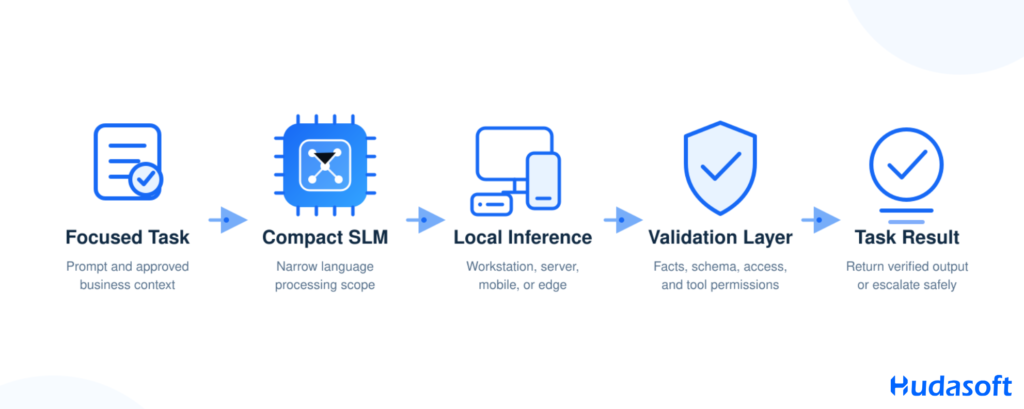
A small language model, or SLM, uses a comparatively compact architecture and limited compute footprint. Developers often train or adapt it for a narrower set of language tasks. The model may run on a local workstation, private server, mobile device, or edge system when its memory and runtime requirements fit that hardware.
NVIDIA Research uses an operational definition for its agentic AI position paper. The authors treat an SLM as a model that can fit on a common consumer electronic device and provide practical single-user inference latency. That definition focuses on deployability instead of a permanent parameter cutoff.
Microsoft’s Phi research also shows why data quality and training method matter. The Phi-4 technical report describes a 14-billion-parameter model built with a training recipe that emphasizes curated and synthetic data. The example demonstrates that parameter count cannot explain capability by itself.
An SLM still needs controls. A narrow model can invent facts, select an incorrect function, or generate valid JSON with the wrong business value. Local deployment changes the data path, yet it does not guarantee privacy without access controls, secure logs, encryption, and restricted tools.
What is a large language model?
A large language model, or LLM, learns patterns across extensive datasets and supports a broad range of language tasks. Teams commonly use LLMs for reasoning, coding, content generation, research assistance, multilingual communication, and complex question answering.
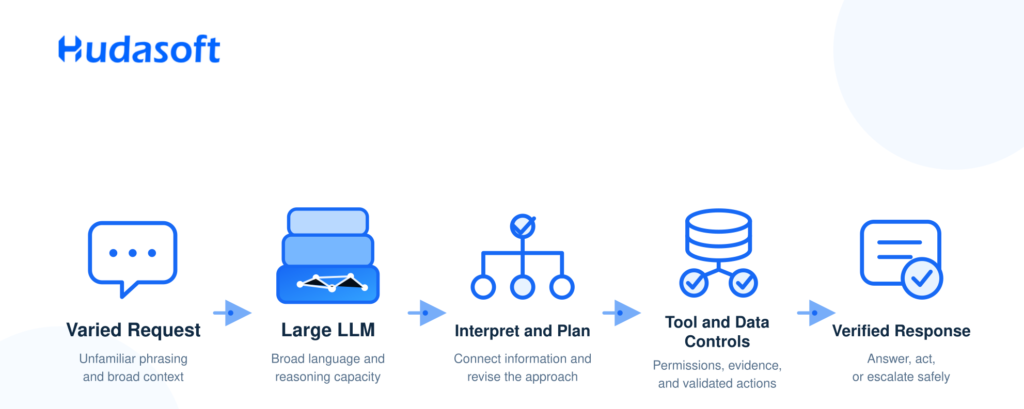
Teams use LLMs when agent requests vary significantly. A candidate must demonstrate that it can interpret unfamiliar phrasing, connect information across domains, revise a plan after a tool failure, and explain a result for different users. During discovery, teams can use an LLM to establish a baseline before they map the full input distribution.
That flexibility creates operating requirements. A larger model can consume more input and output tokens, increase latency across repeated calls, and produce convincing responses outside the available evidence. The application must still control tools, validate data, enforce permissions, and stop unsupported actions.
Why model size cannot make the decision
Two models with similar parameter counts can produce different results because their developers used different data, training objectives, architectures, tokenizers, context methods, and post-training techniques. Quantization can reduce memory needs. Distillation can transfer selected behavior into a smaller model. Fine-tuning can improve a narrow task and weaken performance elsewhere.
The execution environment also changes the outcome. A quantized model on one accelerator may respond faster than the same model under a different runtime. Long prompts can remove a smaller model’s latency advantage. Large batches can improve throughput and add queueing time. Tool definitions can consume a material share of the context before the user supplies any information.
Model selection therefore needs a complete test condition: model version, precision, runtime, hardware, prompt, context length, tools, output constraints, traffic pattern, and evaluation set.
Why AI Agents Change the Model Comparison
A chatbot can answer one prompt with one response. An AI agent may interpret a goal, gather context, create a plan, call several tools, inspect each result, correct errors, and determine whether it completed the task. One user request can trigger several model calls.
This execution pattern compounds small differences. An additional 300 milliseconds across six sequential calls adds 1.8 seconds before tool or network time. A small increase in output tokens repeats at every generation step. An incorrect tool choice can trigger another model call, another API request, and manual review.
The required capability also changes during the run. Intent classification may involve twelve labels. Planning may require judgment across several possible actions. Tool arguments may need an exact schema. The final response may need clear natural language and citations. One model can handle every stage, although that design may spend more computation than the constrained stages require.
Model-call amplification helps explain why small language models are the future of agentic AI for some bounded, high-volume responsibilities. Every saved token, millisecond, and retry can recur across the workflow, so teams must validate the effect across the complete agent run.
How SLMs and LLMs Compare Across Agent Capabilities
A capability-level comparison examines the work an agent performs. General benchmark scores cannot show whether a model can select the correct internal function, preserve a required schema, or recognize a business exception.
Reasoning and unfamiliar inputs
Teams can test an LLM first when an agent receives broad goals, incomplete instructions, or unfamiliar combinations of constraints. The evaluation should measure whether the model reaches correct conclusions and adjusts its approach when the initial plan fails.
An SLM can reason within a defined domain, especially when its training and evaluation data represent that domain well. Its risk grows when the request moves beyond the expected distribution. The application should identify unsupported input and transfer the task instead of asking the smaller model to improvise.
The team should test reasoning through observable results. Measures include correct conclusions, valid intermediate decisions, relevant evidence, successful recovery, and appropriate escalation. A long explanation does not prove sound reasoning.
Context, knowledge, and retrieval
Long and varied context increases the evaluation scope. An LLM can qualify when an agent must compare many documents, reconcile conflicting instructions, or maintain a long conversation. Context length alone does not guarantee that the model will use every relevant detail correctly.
An SLM can perform well when retrieval supplies a short, relevant evidence set. The retrieval layer narrows the information problem, and the model interprets the selected passages. Teams still need to test whether the model cites the correct source, follows document precedence, and declines to answer when retrieval finds insufficient evidence.
Retrieval and adaptation solve different problems. A team comparing RAG vs fine-tuning must decide whether the system needs current external knowledge, changed model behavior, or both. Either model class can use retrieved evidence.
Tool selection and structured output
Agent tools can retrieve records, create tickets, update orders, schedule appointments, or start approval workflows. Model quality affects two separate decisions: selecting the right tool and supplying correct arguments.
An SLM may suit a stable registry with a few distinct functions. Focused examples can teach the expected tool names and argument patterns. AWS published a 2026 example that combines supervised fine-tuning and direct preference optimization to improve SLM tool-calling accuracy. The work also compares several variants through a defined evaluation process.
Overlapping tools and incomplete requests increase the reasoning requirement. Tests should verify whether an LLM or SLM selects the correct function and requests missing information. Either model can select an unauthorized function or populate a valid field with an unsupported value. Application code should verify the tool name, user permission, required fields, data types, value ranges, and current system state before execution.
Latency and throughput
SLMs can reduce inference time because they require less computation per token. The result depends on hardware, model loading, prompt length, output length, batch size, queue depth, and network placement. A remote SLM endpoint can respond slower than a well-provisioned LLM API under some traffic conditions.
Agents expose end-to-end latency. A team should record p50 and p95 completion time for the complete workflow, then attribute time to model inference, retrieval, tool APIs, validation, and queues. This breakdown shows whether model replacement can improve the user’s experience.
Throughput matters when many users or background jobs share the same system. A smaller model may allow more concurrent requests per accelerator. The team must test peak traffic and long prompts because memory pressure can reduce that advantage.
Privacy and deployment control
SLMs expand the available deployment options. Teams may run a suitable model on-premises, inside a private cloud, or on an edge device. This setup can reduce the amount of prompt data sent to an external model provider.
The deployment location represents one privacy control. The full data path also includes logs, retrieval indexes, tool APIs, backups, monitoring platforms, and administrator access. A locally hosted model can still expose information through an unrestricted tool or an insecure trace.
An LLM API can meet many enterprise requirements when the provider’s contract, retention policy, regional processing, encryption, and access controls match the use case. Security teams should evaluate the exact service configuration instead of drawing conclusions from model size.
Customization and change management
An SLM often needs focused data, training work, and serving infrastructure to reach its target behavior. That investment makes sense when the task stays stable and processes enough volume to justify specialization. Frequent policy or schema changes can create recurring retraining and evaluation work.
An LLM can adapt through prompts, examples, retrieval, and updated tool descriptions. This flexibility supports early product stages and workflows that change often. Prompt complexity can grow over time, and each addition can affect unrelated behavior.
Both approaches require version control. Teams should record model version, prompt version, training dataset, retrieval configuration, tool schema, evaluator version, and release decision. NIST organizes AI risk work through Govern, Map, Measure, and Manage functions and encourages teams to define acceptable performance limits.
Governance and failure containment
An SLM’s narrow responsibility can make failures easier to categorize. A classifier can return the wrong label. An extractor can omit a field. A tool generator can violate a schema. Defined error classes support targeted monitoring.
Broader accepted inputs and output formats create more failure categories for a system to monitor. The system needs clear authority limits because fluent language can conceal uncertainty. High-impact actions require independent business-rule checks or human approval regardless of the model class.
A multi-model system adds governance work. The team must track routing decisions, endpoint versions, fallback paths, data access, and performance for each model. The architecture only creates value when its measurable gains exceed that operating burden.
When Should an AI Agent Use an SLM?
An SLM becomes a candidate when the agent serves a narrow business function and the team can describe success precisely. The task should contain enough repetition to support focused testing and enough volume to justify the engineering work.
Common conditions include:
- The system recognizes a stable set of user intents.
- The output follows a fixed schema or approved label set.
- The agent uses a small tool registry with distinct functions.
- The workflow needs low latency across frequent calls.
- The environment requires local or edge inference.
- The organization owns enough representative data for evaluation or adaptation.
- The system can detect unsupported cases and escalate them safely.
Examples include ticket classification, document field extraction, short policy summaries, retrieval-query rewriting, product-code normalization, and routing requests to an approved queue. Each model needs task-specific proof. The SLM label alone does not establish suitability.
An SLM may also power an entire agent when that agent owns one bounded responsibility. A warehouse device could answer questions from a local procedure set and create a limited set of maintenance requests. The model would still need grounded retrieval, authenticated users, validated actions, and an escalation path.
When Should an AI Agent Use an LLM?
An LLM becomes a candidate when the agent needs broad language capability or must respond to conditions that the team cannot enumerate in advance. The evaluation must verify interpretation, planning, and recovery across those conditions.
Common conditions include:
- Users provide open-ended goals instead of fixed request types.
- The task requires reasoning across several domains.
- The agent must compare long or conflicting documents.
- Tool selection depends on subtle context.
- The workflow changes frequently during product discovery.
- The agent must explain complex conclusions to different audiences.
- A broad range of languages, formats, or user behaviors enters the system.
Research assistants, coding agents, complex support agents, and analytical copilots often need these capabilities. The LLM should not receive unrestricted authority. Software controls should limit data access, permitted tools, transaction values, and completion conditions.
Teams can also use an LLM to establish a baseline, collect real input patterns, and identify tasks that show enough stability for a smaller specialist. The baseline must use the same tools, context, and acceptance rules as later comparisons.
When Should an AI Agent Use Both Models?
A hybrid design suits workflows that combine frequent routine work with occasional complex cases. The system routes a request according to task type, risk, context, or earlier failure signals.
One routing pattern uses four layers:
- A router assigns a recognized request to the appropriate path.
- An SLM handles a defined task such as classification or extraction.
- A validator checks structure, values, permissions, and completion evidence.
- An LLM or human reviewer receives ambiguous, invalid, or high-risk cases.
The router can use deterministic rules when the inputs contain reliable signals. A model-based router adds flexibility and another possible failure point. Teams should select the simpler method that meets the routing requirement.
AI agent frameworks vary in how they manage routing, shared state, tool registries, tracing, and human handoffs. The selected framework must support the hybrid design’s validation and escalation requirements.
Hybrid design does not require an SLM at every routine step. Code should handle deterministic calculations, database lookups, permission checks, and fixed transformations. The language model should perform work that genuinely requires language understanding or generation.
Model routing operates inside an agentic AI architecture that also coordinates context, memory, tools, permissions, execution state, and human oversight.
A Weighted Scorecard for Choosing the Model
A scorecard turns general preferences into an auditable decision. Teams should agree on the criteria and weights before they review candidate results. This order reduces the chance that familiarity with one model changes the acceptance rules.
Step 1: Set non-negotiable gates
A candidate fails immediately when it cannot meet a mandatory condition. Typical gates include:
- Required deployment region
- Maximum approved data retention
- Minimum tool-call accuracy
- Maximum harmful or unauthorized action rate
- Required language coverage
- Maximum p95 latency
- Required context length
- Supported output format
- Licensing compatibility
A high total score cannot compensate for a failed security or safety gate.
Step 2: Weight the decision criteria
Assign a percentage to each factor according to the use case. The weights must total 100 percent.
| Criterion | Illustrative weight | What the team measures |
| Task success | 30% | Correct completion on representative cases |
| Tool and output reliability | 20% | Correct tool, valid arguments, valid schema, and correct values |
| Failure handling | 15% | Safe refusal, clarification, and escalation behavior |
| Latency | 10% | p50 and p95 end-to-end completion time |
| Operating cost | 10% | Cost per successful task at expected traffic |
| Data and deployment fit | 10% | Residency, retention, infrastructure, and access requirements |
| Maintenance effort | 5% | Prompt, training, hosting, monitoring, and update workload |
This example prioritizes task quality and safe execution. A low-risk, high-volume classification system could assign more weight to throughput and cost. A regulated decision-support agent could assign more weight to failure handling and data control.
Step 3: Score candidates with measured results
Use a consistent scale, such as 1 through 5, for each criterion. Convert raw measurements into score bands before testing. For example, the latency score might give five points to a p95 result below the target and one point to a result that exceeds the maximum acceptable limit.
Calculate the weighted score with this formula:
Weighted model score = sum of criterion score multiplied by criterion weight
If an SLM receives 4.2 and an LLM receives 4.4, the difference may not justify another serving stack. The team should review confidence intervals, high-risk failures, and maintenance costs instead of treating the decimal as a final answer.
Step 4: Record the decision boundary
The final record should state:
- Which model handles the task
- Which input categories qualify for that route
- Which conditions trigger fallback
- Which metrics control continued use
- Who owns review and rollback
- Which changes require another evaluation
This record turns model selection into an operating policy instead of a one-time experiment.
How to Calculate SLM and LLM Agent Costs
Model price represents one part of an agent’s operating cost. A complete calculation should connect usage with successful business outcomes and include each retry, fallback call, supporting service, infrastructure expense, and review requirement.
Calculate direct API token cost
Use this formula for each model:
Monthly token cost = input tokens divided by 1,000,000 multiplied by the input rate, plus output tokens divided by 1,000,000 multiplied by the output rate
For an agent with several model calls:
Monthly input tokens = completed and failed task attempts multiplied by average calls per attempt multiplied by average input tokens per call
Apply the same structure to output tokens. Count retries and fallback calls as separate usage because the provider bills those tokens.
Worked price-tier routing example
The following example demonstrates the calculation. It does not classify a provider’s faster hosted model as an SLM. Providers use their own product categories, and teams must evaluate each model against the task.
Assume an agent processes 100,000 task attempts per month. Each attempt generates five model calls with an average of 900 input tokens and 150 output tokens. The complete workload therefore consumes:
- 450 million input tokens
- 75 million output tokens
Anthropic listed Claude Sonnet 5 at $2 per million input tokens and $10 per million output tokens on September 7, 2026. It listed Claude Haiku 4.5 at $1 per million input tokens and $5 per million output tokens.
If every call uses Sonnet 5:
- Input cost = 450 x $2 = $900
- Output cost = 75 x $10 = $750
- Total monthly token cost = $1,650
Assume a routing design sends three routine calls per task to Haiku 4.5 and two complex calls to Sonnet 5.
The Haiku route consumes 270 million input tokens and 45 million output tokens:
- Haiku input cost = 270 x $1 = $270
- Haiku output cost = 45 x $5 = $225
- Haiku subtotal = $495
The Sonnet route consumes 180 million input tokens and 30 million output tokens:
- Sonnet input cost = 180 x $2 = $360
- Sonnet output cost = 30 x $10 = $300
- Sonnet subtotal = $660
The routed design produces a direct monthly token cost of $1,155 under these assumptions. The difference equals $495, or 30 percent of the all-Sonnet token cost.
That result does not prove a 30 percent production saving. Routing adds engineering, evaluation, monitoring, and failure-handling costs. The faster model may also create more retries or escalations. Provider prices can change, so recalculate the example with current rates during planning.
Calculate self-hosted SLM cost
A self-hosted model replaces a per-token invoice with a combination of fixed and variable expenses. Include:
- Accelerator or server cost
- Redundant serving capacity
- Storage and data transfer
- Model registry and deployment pipeline
- Inference software
- Monitoring and logging
- Security operations
- Engineering support
- Fine-tuning and reevaluation
- Capacity reserved for traffic peaks
Use this formula:
Monthly self-hosted cost = compute plus storage plus networking plus platform tools plus engineering operations plus amortized adaptation cost
Calculate the break-even point against the avoided model calls:
Break-even successful tasks = monthly self-hosted cost divided by avoided hosted-model cost per successful task
This formula helps a team determine whether traffic volume can justify dedicated SLM infrastructure. Low or unstable traffic may favor a hosted endpoint even when the endpoint costs more per token.
Measure cost per successful task
Token cost can hide operational waste. Use a broader measure:
Cost per successful task = total model, retrieval, tool, infrastructure, monitoring, and human-review cost divided by verified successful tasks
Suppose one candidate lowers token cost and creates more invalid tool calls. The organization may spend the difference on retries and manual correction. Cost per successful task captures that downstream effect.
Architecture, data preparation, integrations, evaluation, security, deployment, and maintenance all contribute to AI agent development cost. Model inference represents one operating line rather than the complete project budget.
Worked Example for a Fleet Maintenance Agent
Consider an agent that helps a fleet operations team process maintenance requests. Drivers submit free-text descriptions, vehicle identifiers, warning codes, and images or documents. The agent retrieves maintenance rules, checks service history, proposes the next step, and creates an approved work order.
Request intake
The agent extracts the vehicle ID, location, reported symptoms, urgency signals, and available warning codes. An SLM can qualify when the business uses a stable schema and the evaluation set covers abbreviations, missing fields, and inconsistent identifiers.
Application code should validate the vehicle ID against the fleet system. The model should ask for missing information instead of inventing a record.
Issue classification
The workflow assigns the request to an approved category such as routine service, tire issue, battery issue, collision damage, drivability concern, or safety escalation. An SLM can handle this task when the categories remain distinct and the model escalates conflicting signals.
A safety term should trigger a policy rule even when the classifier expresses high confidence in a routine category. Deterministic safeguards should override model output for critical conditions.
Policy and history retrieval
The system retrieves service intervals, active warranty terms, previous work orders, and approved provider information. Retrieval and application services should gather current records. A language model can rewrite the search query or summarize the retrieved evidence.
An SLM may summarize a short, well-ranked evidence set. When several records conflict or a request combines mechanical, warranty, and scheduling questions, teams should compare both model classes on evidence selection and conflict resolution.
Next-action recommendation
This stage carries more variation and consequence. The model may need to compare policy, service history, operational urgency, and available appointments. Teams can test an LLM as the baseline, then compare any smaller candidate against the same decision-quality and escalation thresholds.
The model should propose an action within a permitted set. Business rules should control spending limits, provider eligibility, vehicle downtime, and required approvals. A fleet manager should review safety-sensitive or high-cost recommendations.
Work-order creation
The model prepares structured arguments for the work-order API. Application code validates the fields, user authority, vehicle status, provider, and approval reference. The API performs the transaction and returns the final work-order ID.
The model should not claim success until the fleet system confirms the record. This boundary prevents a fluent response from substituting for a completed action.
Model assignment for the complete workflow
| Workflow responsibility | Starting candidate | Required proof |
| Extract maintenance-request fields | SLM | Field accuracy and missing-data behavior |
| Assign an approved issue category | SLM | Category accuracy and safety escalation recall |
| Rewrite a retrieval query | SLM | Retrieval relevance against a fixed corpus |
| Interpret conflicting policy and history | LLM | Evidence use and correct conflict resolution |
| Recommend the next permitted action | LLM with business rules | Decision quality and safe escalation |
| Validate spending authority | Deterministic code | Exact rule execution |
| Create the work order | Authenticated API | Confirmed transaction and audit record |
| Explain the outcome to the operator | LLM or tested SLM | Accuracy, clarity, and source alignment |
The assignment represents a test plan instead of a final architecture. Evaluation results may show that one model can handle more stages or that a rule-based component can replace another model call.
How to Test Models for a Production Agent
A fair comparison needs the same task definition, tools, input categories, scoring rules, and operating conditions. The model candidates should receive equivalent context within their supported formats, and the final assessment should report performance by risk category.
Build the evaluation around business outcomes
Define the completed result first. A support agent may need to resolve the case or route it correctly. A maintenance agent may need to create an accurate work order with the required approval. Individual model scores support that result, yet they cannot replace it.
Track these measures:
- Verified end-to-end task completion
- Correct tool selection
- Valid and accurate tool arguments
- Grounded statements
- Appropriate clarification
- Appropriate escalation
- Unauthorized action attempts
- Average correction calls
- p50 and p95 completion latency
- Cost per successful task
- Human override rate
Separate routine, difficult, and high-risk cases
A combined average can hide dangerous weaknesses. Report results for normal requests, incomplete input, ambiguous cases, system errors, adversarial instructions, and high-impact actions.
The candidate should meet a separate acceptance threshold for each critical category. A strong routine score cannot offset unsafe behavior on a small group of consequential requests.
Test the surrounding system
Model evaluation should include retrieval, tool APIs, validators, permissions, and fallback logic. A model may select the correct tool and fail because the API changed. It may create valid arguments that violate a current business rule.
The production test should verify the system’s final state. A generated confirmation does not prove that a database update, booking, or work order succeeded.
Reevaluate material changes
Model providers update endpoints. Teams also change prompts, tool descriptions, policies, data sources, schemas, and traffic patterns. Each material change can alter performance.
Maintain a regression set and rerun it during releases. Monitor production error categories and add confirmed new patterns to future evaluation sets without mixing test data into training data.
Teams planning AI agent development should treat the model as one system component alongside routing, tool permissions, evaluation, monitoring, and rollback controls.
How Deployment Requirements Change the Decision
The same task may favor a different model under another deployment environment. Teams should evaluate model quality alongside infrastructure ownership, data location, traffic patterns, connectivity, hardware capacity, availability requirements, and internal support skills.
Managed API
A managed API reduces initial infrastructure work and provides access to capable models. It suits discovery, changing workflows, and variable traffic. The team must review provider availability, rate limits, data terms, regional support, model lifecycle, and pricing.
Private cloud or VPC
A private environment gives the organization more control over networking, logs, access, and data location. It introduces capacity planning, deployment, patching, and monitoring responsibilities. Both SLMs and some larger open models can run in this environment when the infrastructure supports them.
On-premises inference
On-premises deployment may support strict data-location requirements or stable internal workloads. The organization owns hardware utilization, redundancy, model updates, security, and support. Idle capacity can make a low-traffic model expensive even when each inference call appears inexpensive.
Edge and on-device inference
An SLM can support local interaction when the device provides enough memory and compute. Edge deployment can reduce network dependence and response time for selected tasks. Hardware diversity, battery use, model distribution, updates, and physical device security add constraints.
The agent may still need connectivity for cloud tools and business systems. Offline model inference does not make the complete workflow offline.
A model’s deployment environment must also support the organization’s AI integration strategy. That strategy defines how the agent exchanges data with CRM, ERP, fleet, helpdesk, document, or analytics systems through authenticated interfaces and controlled data paths.
Common Model-Selection Mistakes
Model-selection errors often begin with a shortcut that ignores part of the production system. Teams can avoid costly redesigns by testing the assumptions behind model size, benchmarks, hosting, retrieval, fallback, and unit pricing.
Using parameter count as the decision rule
Parameter count gives a rough indication of scale. It does not measure task success, tool accuracy, latency on the selected hardware, or safe failure behavior.
Trusting a public benchmark without reviewing its task
A benchmark may test math, coding, knowledge, or general reasoning. An agent may need exact classification, source-grounded policy interpretation, or valid tool arguments. The team should inspect the benchmark inputs and scoring method before applying the result.
Assigning every step to a language model
Databases should retrieve records. Application code should enforce permissions and calculate fixed rules. APIs should execute transactions. Validators should confirm required formats and values. Unnecessary model calls add cost and new failure paths.
Comparing token prices without measuring failures
Retries, fallback calls, longer prompts, extra output, and manual correction can erase a lower unit price. Cost per successful task connects unit price with completed business output.
Treating local hosting as complete privacy
The model represents one component of the data path. Retrieval stores, logs, tools, backups, administrator accounts, and monitoring services can still expose sensitive information.
Using RAG as a substitute for model selection
RAG supplies external evidence. The selected model still needs enough capability to interpret that evidence and complete the task. Teams should evaluate retrieval quality and generation quality separately.
Skipping fallback design
Every model encounters unsupported or ambiguous input. The system needs a safe route for clarification, another model, or human review.
Ignoring multi-model operating work
Additional endpoints create more deployment pipelines, tests, dashboards, access policies, and rollback procedures. A hybrid design should demonstrate enough quality, latency, or cost improvement to justify that work.
Choosing the Right Model for an AI Agent
Choose an SLM when the agent task has stable boundaries, measurable output, sufficient volume, and a safe escalation path. Choose an LLM when the task needs broad knowledge, flexible reasoning, complex planning, or strong performance across unfamiliar requests.
A hybrid architecture can combine both. It should route work through explicit policies, validate every consequential output, and record the complete execution path. Deterministic software should handle fixed rules and transactions whenever possible.
Model selection represents one decision within AI implementation. The organization must still prepare data, connect systems, assign ownership, train users, enforce governance, and monitor business outcomes after deployment.
The final SLM vs LLM decision needs evidence from the intended workflow. Compare task completion, tool reliability, latency, cost per successful task, deployment fit, and failure consequences. A public leaderboard cannot establish production suitability without task-specific evidence.
Hudasoft evaluates model choices within the business workflow, connected applications, permitted actions, and measurable production requirements. These conditions determine whether an SLM, LLM, or routed combination can support reliable agent execution.
Frequently Asked Questions
Does an SLM need fine-tuning before it can power an AI agent?
An SLM does not always need fine-tuning before it can power an AI agent. Start with the base instruction-tuned model, explicit tool descriptions, constrained output schemas, relevant examples, and retrieval when the task depends on external knowledge. Test that configuration on representative inputs before adding training work.
Fine-tuning becomes relevant when the evaluation reveals recurring, learnable errors such as incorrect tool selection, unstable field extraction, or failure to follow a specialized format. Use representative examples from the intended workflow and retain a separate evaluation set. Do not use fine-tuning to store frequently changing facts; retrieval and authoritative application data handle that requirement more reliably.
Can an existing LLM agent switch to an SLM without rebuilding its integrations?
An existing agent can switch models without rebuilding every integration when the application keeps model access behind a stable adapter and exposes consistent tool schemas. The CRM, ERP, database, or ticketing APIs can remain unchanged because authentication, permissions, and transaction rules belong in application code rather than the language model.
The change still requires regression testing. SLMs and LLMs can interpret tool descriptions, context, JSON constraints, missing fields, and API errors differently. Route limited traffic to the SLM first, compare tool selection and argument accuracy with the current baseline, and retain a rollback path. A model swap qualifies as an application release, not a configuration-only change.
How should an AI agent set the fallback threshold from an SLM to an LLM?
Set the fallback threshold with observable conditions instead of relying only on the SLM’s self-reported confidence. Triggers can include an unsupported intent, missing required evidence, schema-validation failure, repeated tool errors, a high-risk action category, excessive context, or a request outside the approved task boundary.
Calibrate each trigger on a labeled evaluation set. Measure missed escalations, unnecessary escalations, task completion, latency, and cost. A loose threshold sends too much routine work to the LLM, while a strict threshold leaves difficult cases with the SLM. Version the routing rules with the model and review production traces when input patterns change.
Does a larger context window make an LLM the right model for an agent?
A larger advertised context window does not establish that an LLM will complete the agent task correctly. The usable context must hold the system instructions, conversation history, tool definitions, retrieved evidence, and expected output. The evaluation must also verify that the model identifies and applies the relevant information at realistic prompt lengths.
Retrieval, filtering, summarization, and state management can reduce the amount of context a model needs, which may allow an SLM to meet the requirement. Workflows that require the model to reconcile many long or conflicting records may need a larger candidate. Test evidence recall, instruction priority, latency, and cost instead of selecting a model from the published context limit alone.
Is a mixture-of-experts model an SLM or an LLM?
A mixture-of-experts model does not fit either category through parameter count alone. It can store many total parameters while activating only a subset for each token. Total parameters affect storage and model loading, while active parameters influence computation during inference. Architecture and serving software also affect memory, latency, and throughput.
Classify the model according to the decision the label needs to support. For deployment planning, measure its actual hardware and memory requirements. For operating-cost analysis, measure throughput and inference cost under the expected workload. For agent selection, test task completion and failure behavior. These observed requirements provide more useful evidence than assigning the model a size label.

