Hero Background

AI in Automotive: Applications, Benefits, and Solutions

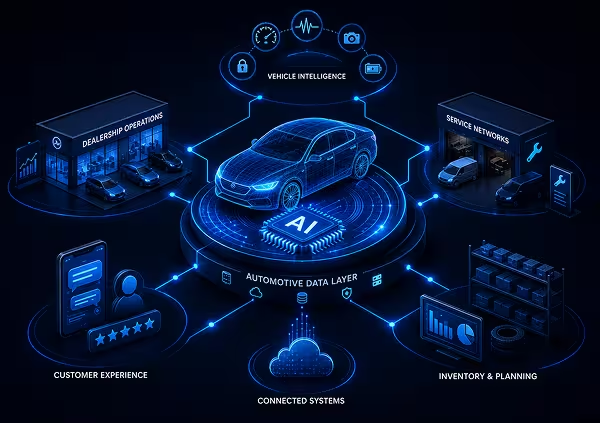
AI in automotive refers to using machine learning, computer vision, predictive analytics, and intelligent software to improve decisions across vehicles and automotive operations. It supports connected vehicles, dealerships, service workflows, customer experience, and the business systems that keep automotive data, processes, and teams aligned.

Company 1
Company 3
Company 2
Company 8
Company 9
Company 10
Company 4
Company 5
Company 6
Company 6
Company 6
Business Operational Challenges

What Is AI in Automotive?

AI in automotive describes software systems that analyze vehicle, visual, operational, and customer data to identify patterns, predict outcomes, recommend actions, or automate clearly defined tasks.
These systems may combine machine learning for pattern recognition, computer vision for image analysis, predictive analytics for forecasting, natural language processing and generative AI for communication, AI agents for multi-step workflows, and optimization models for resource planning.
Automotive AI is broader than autonomous driving. It also supports diagnostics, vehicle inspection, service planning, dealership operations, inventory decisions, customer assistance, and automation across connected automotive platforms.

AI in Automotive Industry Statistics and Adoption Signals

Current research shows how AI is entering automotive software, operational processes, digital customer journeys, and in-vehicle systems. Each figure represents a distinct adoption or investment signal.

1,200+

Volkswagen reports more than 1,200 active AI applications across its group, with hundreds more in development or nearing implementation.

2025 | Volkswagen Group, global operations
Source: Volkswagen Group
85%

Capgemini reports that 85% of surveyed automotive organizations consider AI an increasingly integral part of automotive software, features, and functions.

2025 | 600 executives from 200 automotive organizations across North America, Europe, and Asia-Pacific
Source: Capgemini Research Institute
21% → 58%

Automotive executives expect the share of R&D budgets allocated to software and digital development to rise from 21% to 58% by 2035.

2024 | 1,230 automotive executives across nine countries
Source: IBM Institute for Business Value
74%

IBM reports that 74% of surveyed executives expect vehicles to become software-defined and AI-powered by 2035.

2024 | 1,230 automotive executives across nine countries
Source: IBM Institute for Business Value
76%

Capgemini found that 76% of vehicle and mobility-service customers expect the same hassle-free, end-to-end experience available in other industries.

2024 | 10,000 consumers across 11 countries
Source: Capgemini Research Institute
39%

McKinsey reports that 39% of surveyed automotive stakeholders identified offline availability as a key requirement for in-vehicle AI applications.

2024 | Approximately 50 Western OEM, Tier 1 supplier, and semiconductor representatives
Source: McKinsey & Company

How AI Is Used Across Automotive Operations

The use of AI in the automotive industry varies by workflow because each decision requires different data, response times, risk controls, and human review. Manufacturers apply AI in automotive manufacturing to improve factory decisions, and fleet operators use AI in fleet management to strengthen vehicle monitoring and operational planning.

Driver Assistance and Monitoring

Driver Assistance and Monitoring

AI analyzes camera, radar, and driver-monitoring data for perception and attention alerts. Safety-critical assistance requires real-time processing, specialized validation, human accountability, and regulatory controls.

Connected Vehicle Experiences

Connected Vehicle Experiences

Connected systems process vehicle, location, and driver-preference data for voice assistance, personalized cabin settings, navigation recommendations, vehicle guidance, and relevant operating alerts when needed.

Predictive Diagnostics and Maintenance

Predictive Diagnostics and Maintenance

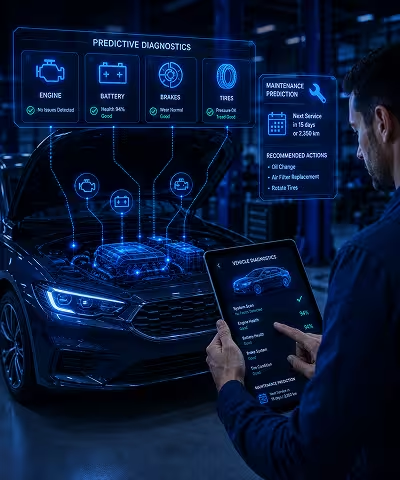
AI evaluates vehicle health, component behavior, diagnostic codes, and repair history to estimate failure risk. Service teams use the results to prioritize diagnostics, maintenance, and scheduling.

Vehicle Inspection and Damage Assessment

Vehicle Inspection and Damage Assessment

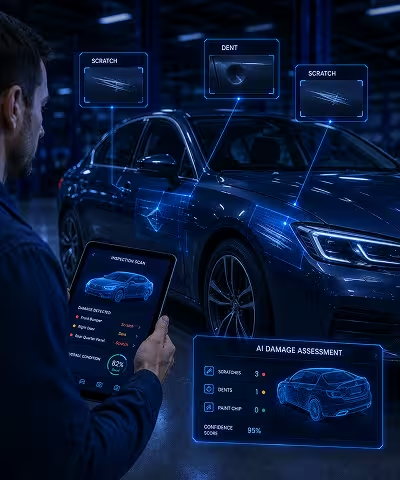
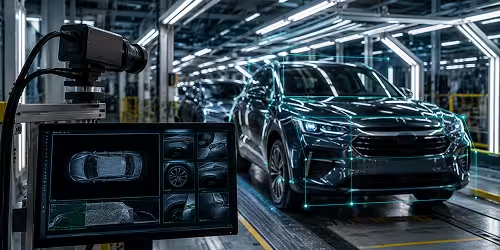
Automotive inspection workflows use computer vision to analyze vehicle images for condition assessment, damage detection, repair-estimate support, and digital records. Uncertain, safety-sensitive, or high-value cases require human review.

Dealership Sales and Customer Management

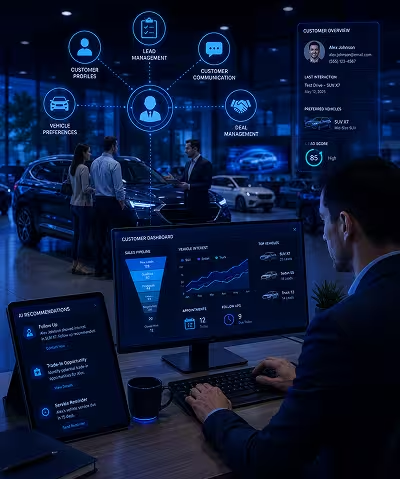
Dealership Sales and Customer Management

AI analyzes lead data, customer intent, communication history, and vehicle preferences. Sales teams use the results to assign inquiries, recommend vehicles, forecast demand, and prioritize follow-ups.

Inventory, Pricing, and Dealership Performance

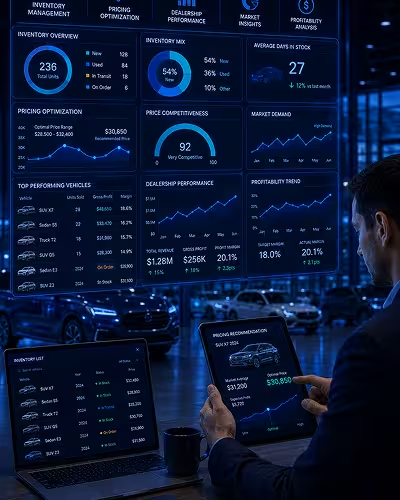
Inventory, Pricing, and Dealership Performance

Dealership teams use AI to monitor inventory aging, forecast demand, recommend pricing, allocate vehicles across locations, track stock availability, and predict sales pace and operational performance.

Service and After-Sales Operations

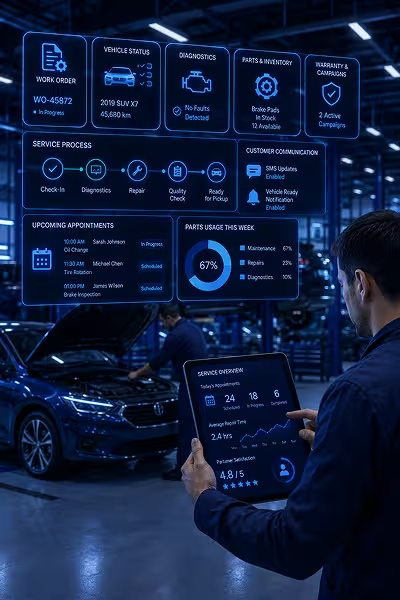
Service and After-Sales Operations

AI coordinates service appointments, retrieves technician knowledge, generates maintenance reminders, communicates repair status, identifies retention signals, supports parts workflows, and routes feedback requiring escalation.

Automotive Customer Support and AI Agents

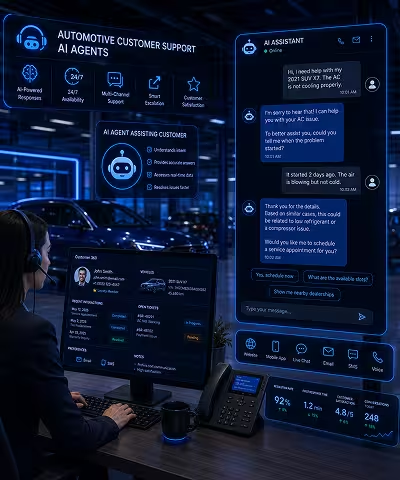
Automotive Customer Support and AI Agents

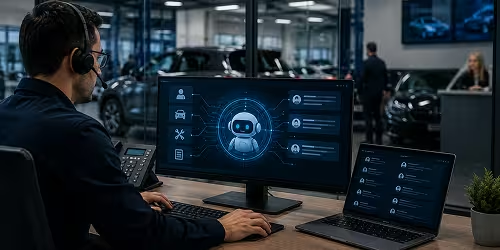
Automotive AI agents classify inquiries, retrieve approved vehicle information, book appointments, coordinate follow-ups, update permitted CRM fields, log completed activities, and escalate complex cases to employees.

Technologies That Power Automotive AI Systems

Automotive AI systems use different technologies according to the data, decision, and required output. Each technology also introduces specific requirements for validation, monitoring, permissions, or human review.

Technology or Deployment ApproachPrimary FunctionAutomotive ApplicationTypical OutputMain Control Requirement
Predictive AIEstimates future conditions using historical and current dataComponent failure prediction and maintenance planningRisk score, probability, or forecastAccuracy testing, drift monitoring, and defined action thresholds
Computer visionAnalyzes images and video to identify visual conditionsVehicle inspection and exterior damage detectionClassification, detected location, or condition recordImage quality controls, confidence thresholds, and human review
Generative AIProduces or transforms content using instructions and approved informationGenerative AI in automotive supports service summaries, technical guidance, and customer responsesText, image, structured response, or codeSource grounding, output validation, and restricted data access
AI agentsCoordinates approved tasks across connected applications and data sourcesService booking, customer follow-up, and permitted CRM updatesCompleted action, updated record, or escalationSystem permissions, action limits, logging, and human escalation
Optimization modelsSelects suitable options within defined rules and constraintsVehicle allocation across dealership locationsRanked option, schedule, or allocation recommendationAccurate constraints, current data, and enforceable business rules
Natural language processingIdentifies meaning, intent, and entities in written or spoken languageCustomer inquiry classification and service-request routingIntent label, extracted details, summary, or responseContext validation, confidence thresholds, and language coverage
Edge AIRuns AI processing inside or near the vehicle or connected deviceDriver monitoring and time-sensitive in-vehicle alertsLow-latency classification, detection, or inferenceHardware capacity, model efficiency, reliability, and update controls

Benefits of AI in the Automotive Industry

Section visual

AI creates measurable value when its outputs improve a defined automotive decision or workflow. The main benefits appear in maintenance planning, operational response, inventory control, customer service, employee productivity, and consistent execution across connected locations.

Earlier Issue Detection

Analysis of sensor, diagnostic, inspection, and service data identifies risk signals earlier, giving technicians more time to investigate faults and plan corrective work.

Reduced Unplanned Downtime

Failure-risk estimates help service teams schedule maintenance before disruption, improving vehicle availability and reducing delays caused by unexpected component problems.

Faster Operational Decisions

Prioritized alerts, summaries, and recommendations reduce time spent searching disconnected systems, allowing dealership and service teams to act on relevant information sooner.

More Accurate Resource Planning

Demand, sales, service, and vehicle-health signals improve forecasts for inventory, staffing, maintenance, and appointment capacity, helping teams match resources with expected operational needs.

Consistent Customer Assistance

AI-assisted classification, retrieval, and follow-up provide customers with consistent information, shorten routine response paths, and preserve human escalation for complex or sensitive cases.

Higher Employee Productivity

Automating data entry, triage, record updates, and knowledge retrieval reduces repetitive workload and applies approved processes consistently across teams, systems, and dealership locations.

,

Requirements for Reliable Automotive Artificial Intelligence Systems

Reliable automotive AI depends on usable data, connected systems, defined authority, representative testing, human oversight, and continuous monitoring throughout the operational workflow, from input to action.

Relevant and Governed Data

Relevant and Governed Data

Vehicle, service, inventory, inspection, and customer data require documented ownership, consistent definitions, suitable quality, and permitted access for each application.

Connected Automotive Systems

Connected Automotive Systems

DMS, CRM, ERP, OEM feeds, service platforms, and customer portals require APIs or adapters that preserve permissions, context, and consistency.

Defined AI Authority

Defined AI Authority

AI governance defines whether a system retrieves, classifies, predicts, recommends, generates, or executes actions, with approval controls matched to consequences.

Human Review and Escalation

Human Review and Escalation

Uncertain, safety-sensitive, high-value, or exceptional cases require named reviewers, escalation thresholds, accessible evidence, and authority to stop automated operational actions.

Representative Workflow Testing

Representative Workflow Testing

Evaluation must reflect real vehicles, images, records, languages, edge cases, and workflow conditions, including costly false positives and false negatives.

Continuous Performance Monitoring

Continuous Performance Monitoring

Production monitoring tracks accuracy, latency, availability, drift, workflow completion, user adoption, incidents, and movement against the defined business performance baseline.

Choosing Between Edge, Cloud, and Hybrid Deployment

Automotive AI workloads run inside vehicles, in centralized cloud environments, or across both. Deployment selection depends on response time, connectivity, data sensitivity, computing demand, update requirements, and the systems receiving each output.

Edge AI

Edge AI

Processes data inside or near the vehicle when applications require low latency, offline availability, limited data transfer, or local handling of sensitive information.

  • Driver and hazard alerts
  • On-device diagnostics
  • Local image processing

Primary consideration: Vehicle hardware limits model size, computing capacity, storage, and update options.

Hybrid AI

Hybrid AI

Combines local processing with cloud-based training, analytics, updates, and monitoring when applications need immediate responses and centralized operational context.

  • Local inference with cloud analytics
  • Cloud-managed model updates
  • Central monitoring with local response

Primary consideration: Version control, synchronization, connectivity failures, and fallback behavior must remain consistent across local and cloud components.

Cloud AI

Cloud AI

Uses centralized computing for model training, large-scale analytics, enterprise workflows, and reporting where the application does not require an immediate on-device response.

  • Demand and inventory forecasting
  • CRM and service workflows
  • Cross-location reporting

Primary consideration: Connectivity, response time, data-transfer permissions, availability, and cloud operating requirements affect production reliability.

Operational Challenges and Risks in Automotive AI

Automotive AI risk varies by application, data, system access, and the consequence of an incorrect output. Each deployment requires controls matched to its decision authority, operating environment, and human-review requirements.

!

Data Quality and Drift

Changes in vehicle conditions, customer behavior, hardware, and operating processes affect performance. Teams need data checks, drift thresholds, and update rules.

!

Safety and Reliability

Safety-relevant outputs require defined acceptance criteria, failure handling, fallback behavior, traceable testing, and accountable human oversight before approved production use.

!

Privacy and Cybersecurity

Vehicle and customer data require purpose-based access, encryption, data minimization, retention controls, activity logging, and protected connections between integrated systems.

!

Bias and Explainability

Training data, evaluation sets, and decision rules require review across relevant users and conditions, with traceable evidence for consequential outputs.

!

Integration Complexity

Legacy systems, inconsistent identifiers, incomplete records, and unreliable APIs interrupt data exchange and prevent AI outputs from reaching the correct workflow.

!

Adoption and Workflow Fit

AI outputs create operational value only when teams understand their purpose, own the next action, and follow defined review and escalation procedures.

How to Select an Automotive AI Use Case

Select an automotive AI use case by comparing its measurable value, data readiness, technical feasibility, integration effort, operational risk, and adoption requirements. A production candidate also needs a defined owner, baseline, decision point, and action after each output.

01

Measurable Business Value

Define the cost, delay, risk, revenue, or service outcome the workflow must improve. Record its current baseline and acceptance threshold before evaluating technology options.

02

Data Readiness

Confirm that representative vehicle, service, inspection, inventory, or customer data is accessible and permitted for the intended purpose. Assess completeness, consistency, coverage, and update frequency.

03

Technical Feasibility

Test whether the selected AI capability meets required accuracy, latency, and reliability under real operating conditions. Include edge cases and costly error types in the evaluation.

04

Integration and Actionability

Identify the systems that provide inputs and receive outputs, including DMS, CRM, OEM feeds, and service platforms. Confirm that an authorized user or system can act on each result.

05

Risk and Oversight

Document the consequence of an incorrect, delayed, or unavailable output. Set approval limits, human-review rules, fallback behavior, and escalation paths according to the highest credible impact.

06

Workflow Ownership and Adoption

Assign an owner responsible for the workflow, decision, and measured outcome. Verify that users have the understanding, training, authority, and process required to apply the output.

Suitable First Pilot
Named owner
Reliable data
Testable output
Manageable risk
Measurable baseline

AI Solutions for Automotive Operations

Hudasoft develops connected automotive platforms around defined operational workflows and shared business data. AI is added where it improves a measurable decision or reduces manual effort within an established process.

Dealership Systems Delivered by Hudasoft

These projects show how Hudasoft translated dealership requirements into working production platforms. Each case connects operational data with defined workflows, management visibility, and measurable results across live dealership environments.

IBIZI Dealership Management and Integration

Results Achieved

40%
Improvement in Process Efficiency
70%
Faster Deal Entry Time
100%
Eliminated Duplicate DealNos
100%
Adoption in First 60 Days

IBIZI Dealership Management and Integration

Industry
Automotive
Location
United States

Hudasoft developed DealerERP as a predictive dealership performance platform for US automotive groups. It tracks new and used vehicle sales, calculates pace against targets, and forecasts performance across single and multi-location operations. Executive dashboards consolidate sales activity and KPIs for management reporting. The case study reports a 65% reduction in reporting time and 65% improvement in multi-location data consolidation.

DealerERP Predictive Dealership Intelligence

Results Achieved

40%
Improvement in Process Efficiency
70%
Faster Deal Entry Time
100%
Eliminated Duplicate DealNos
100%
Adoption in First 60 Days

DealerERP Predictive Dealership Intelligence

Industry
Automotive and Dealership Technology
Location
United States

Hudasoft developed DealerERP as a predictive dealership performance platform for US automotive groups. It tracks new and used vehicle sales, calculates pace against targets, and forecasts performance across single and multi-location operations. Executive dashboards consolidate sales activity and KPIs for management reporting. The case study reports a 65% reduction in reporting time and 65% improvement in multi-location data consolidation.

AI Products for Automotive and Mobility Operations

These products provide configurable starting points for defined automotive and mobility workflows. Each implementation is adapted to the organization's operating environment and required level of human control.

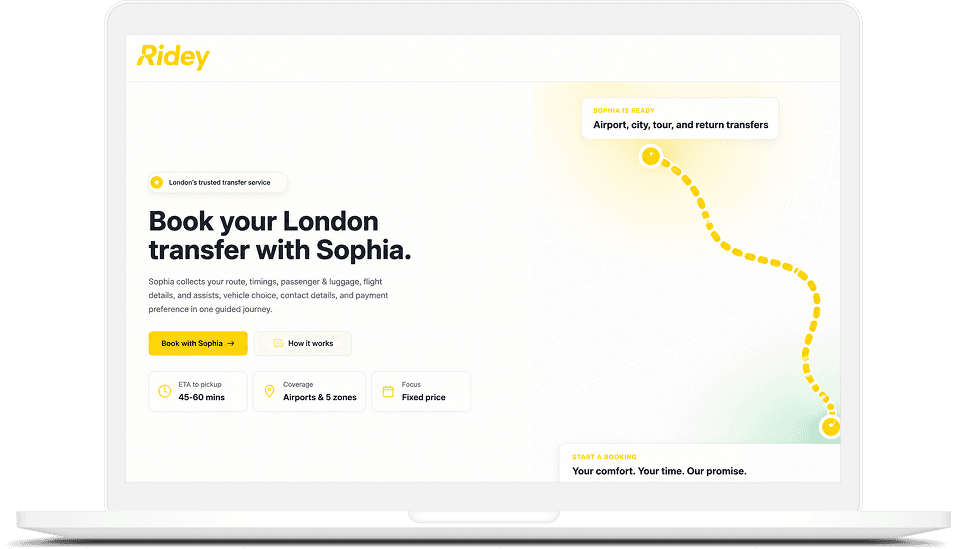
Ridey

Ridey manages taxi and transfer bookings through a conversational interface, connecting passenger requirements with pricing, vehicle availability, trip coordination, and customer communication.

  • Smart Booking Intake: Captures pickup and drop-off points, travel time, passenger details, luggage needs, and vehicle preferences within one guided conversation.
  • Fare Calculation: Generates estimates using configured pricing models, route information, vehicle categories, promotional rules, and business-specific fare policies.
  • Vehicle and Driver Coordination: Matches each booking with available drivers and suitable vehicles according to location, capacity, timing, and service requirements.
  • Customer Updates: Sends confirmations, driver information, journey updates, and reminders at the appropriate stage of the booking workflow.
Feature Image

Automotive AI Development Services

Hudasoft's automotive AI development services turn a defined operational use case into a production system that works within the organization's existing technology environment. Each engagement connects the required intelligence with the workflow, controls, and accountable owners needed for daily use.

Service Tab

Hudasoft's AI consulting services examine dealership sales, service, inventory, inspection, and connected-vehicle workflows before recommending a use case. The engagement verifies available records, system access, failure impact, workflow ownership, and the KPI used to approve implementation.

Service Tab

Our AI development services build forecasting models, vehicle-inspection applications, dealership decision tools, model APIs, evaluation systems, and monitoring components around approved automotive data. Enterprise AI development services extend these systems across OEM environments, dealer groups, brands, regions, and shared governance structures.

Service Tab

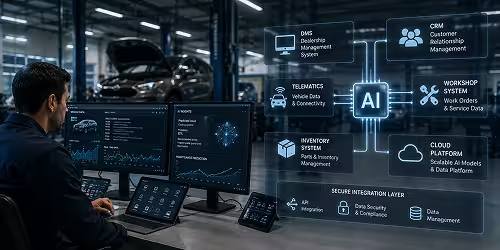
Our AI integration services connect automotive models and applications with DMS, CRM, ERP, F&I, OEM feeds, telematics sources, inventory platforms, and service systems. The integration preserves VIN, customer, repair-order, vehicle-status, permission, and activity context during each exchange.

Service Tab

Predictive analytics services use sales history, vehicle condition, repair records, inventory age, service demand, and location-level performance to forecast operational outcomes. Each score or forecast connects to a named dealership decision, acceptance threshold, and responsible owner.

Service Tab

Computer vision services develop inspection workflows that analyze exterior images for damage, condition, component, or classification results. Delivery includes image-capture standards, labeled evaluation sets, confidence thresholds, reviewer interfaces, and escalation rules for uncertain or high-value vehicles.

Service Tab

AI agent development services build service-coordination, customer-inquiry, internal-knowledge, and CRM-workflow agents for dealerships. These agents retrieve approved vehicle information, create permitted records, coordinate appointments, and escalate exceptions under defined permissions, action limits, and activity logs.

Service Tab

Enterprise AI chatbot development creates customer and employee interfaces for vehicle availability, service intake, appointment scheduling, repair-status questions, and dealership knowledge access. Each chatbot uses approved sources, identity controls, conversation testing, human handoff, and interaction logging.

Service Tab

AI governance services establish controls for dealership and vehicle data, model access, automated actions, inspection evidence, human approvals, incident handling, and production monitoring. Requirements reflect the consequence of each prediction, recommendation, generated response, or system update.

How Hudasoft Moves a Workflow Into Production

Each project starts with one dealership or vehicle workflow and ends with a controlled production release. Automotive engineers design the system around its source data and existing software before employees rely on its output.

01
Discovery

Define the Workflow

Dealership specialists map the current workflow and set a measurable result with its owner.

02
Assessment

Assess Technical Readiness

Data engineers confirm that DMS records and vehicle feeds reach the system through permitted APIs.

03
Design

Design the System

Solution architects define model boundaries, deployment infrastructure, human approvals, and failure handling.

04
Development

Build and Integrate

Engineers build the AI component and connect it with dealership interfaces and system records.

05
Validation

Validate the Complete Workflow

Automotive test scenarios expose weak outputs and integration failures before the system reaches dealership employees.

06
Production

Release and Monitor

Release engineers deploy gradually and monitor whether performance remains stable across daily dealership operations.

Automotive AI operating system

Why Automotive Teams Work With Hudasoft

Hudasoft’s delivery team understands how a vehicle record moves through sales, service, inventory, and customer workflows across dealership locations. That operational context guides model design and integration behavior. It determines who may use each output, how employees handle exceptions, and which production result confirms that the system remains useful.

Vehicle-to-Customer Data Context
DMS-Aware Integration Architecture
Workflow-Based System Validation
Accountable Production Ownership
Plan Your Automotive AI Project

Excellence Through Visionary Leadership

Azfar Siddiqui
Azfar Siddiqui

Founder / CEO

LinkedIn
Saboor Ahmed
Saboor Ahmed

CTO (Chief Technology Officer)

LinkedInMediumDev

Frequently Asked Questions

FAQs

No, AI will not replace automotive technicians. It can analyze diagnostic records, retrieve repair information, and prioritize possible faults. Technicians still inspect vehicles, verify findings, perform physical repairs, and make safety-critical decisions that require practical experience and professional judgment.

Yes, car dealerships use AI to qualify leads, recommend vehicles, forecast demand, monitor inventory, coordinate service appointments, and answer routine customer questions. Dealership teams review important decisions and control actions that affect customers, pricing, finance, or vehicle service.

The automotive industry uses AI across vehicle diagnostics, damage inspection, driver assistance, predictive maintenance, dealership operations, inventory planning, and customer support. Each application uses different data and requires controls that match its response time, operational impact, and safety risk.

No, automotive AI supports many applications beyond self-driving vehicles. Automotive companies use it to detect component problems, inspect vehicle damage, forecast inventory demand, personalize in-vehicle experiences, assist customers, and coordinate approved tasks across connected business systems.

AI predicts vehicle maintenance needs by comparing current sensor readings, diagnostic codes, mileage, operating conditions, and service history with known fault patterns. The system can flag developing risks, helping service teams inspect the vehicle and schedule appropriate maintenance.

An automotive company should start with one recurring workflow that has accessible data, a responsible owner, and a measurable performance baseline. The team should test the system under representative conditions, define human approval rules, connect required platforms, and monitor production results.

Helpful Resources

Let us accelerate your

Custom App Development

Whether you're building from scratch, scaling what works, or exploring what's possible, we're here to help turn your ideas into impact.